
What Is Bitcoin Dominance?
Bitcoin dominance is bitcoin's share of total crypto market value. How it is calculated, what rising and falling dominance signal, why stablecoins distort it.
Bitcoin dominance is bitcoin’s share of total crypto market value: bitcoin market cap ÷ total crypto market cap × 100. In September 2026 it was roughly 57% to 59%, depending on the source. Traders watch it to see whether money is concentrating in bitcoin or spreading into altcoins, but stablecoins can distort it.
How it is calculated
If bitcoin’s market value is $2 trillion and the whole crypto market is $3.4 trillion, dominance is about 59%. Different data providers include different coins, so their figures can differ by a few points. See what crypto market cap is.
What changes in dominance can mean
- Rising dominance in a rising market: bitcoin is leading; altcoins lag.
- Falling dominance in a rising market: money is rotating into altcoins, often called altcoin season. See what altcoin season is.
- Rising dominance in a falling market: altcoins are falling harder than bitcoin.
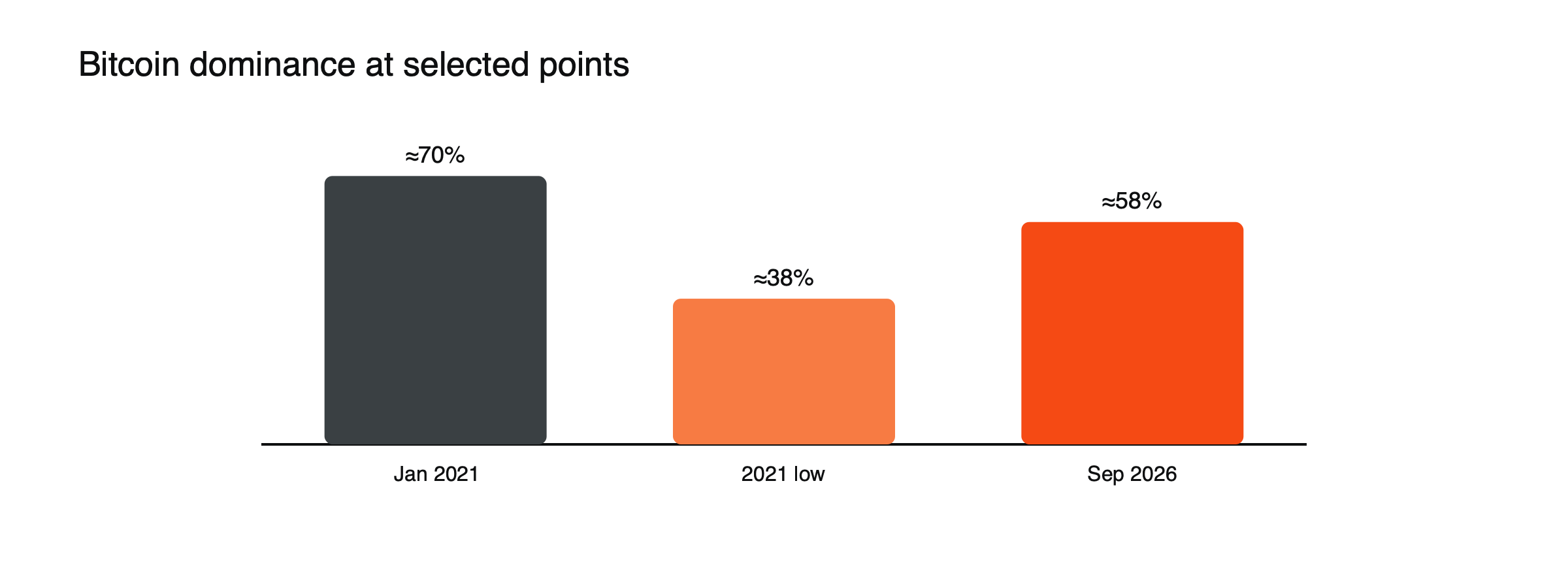
Figure: Bitcoin dominance at selected points. Sources: Spark; Binance Square, September 2026.
In 2021, dominance fell from roughly 70% in January to around 38% as altcoins rallied. In 2026, readings moved between about 55% and the low 60s.
Reading dominance alongside price
| Bitcoin price | Dominance | Common reading |
|---|---|---|
| Rising | Rising | Bitcoin leads a rally; altcoins lag |
| Rising | Falling | Money rotating into altcoins |
| Falling | Rising | Altcoins falling harder than bitcoin |
| Falling | Falling | Broad selling, or stablecoin supply growing |
The last row shows why dominance needs care: falling dominance in a falling market can simply mean that stablecoins, which hold their value, are taking a larger share of a shrinking total.
Why stablecoins distort it
Stablecoins such as USDT and USDC count toward total crypto market value. When their supply grows, bitcoin’s share falls even if nobody buys altcoins. Some analysts look at dominance excluding stablecoins for a cleaner signal.
The effect in numbers
Suppose bitcoin is worth $2 trillion, the whole crypto market $3.4 trillion and stablecoins $300 billion of that. (Illustrative figures.) Dominance including stablecoins is about 58.8%. Excluding them, bitcoin’s share of the remaining $3.1 trillion is about 64.5%. A difference of several points can change how a chart is read, which is why many analysts track both versions.
Other ratios worth watching
Dominance is one of several ways to see where money is moving. The ETH/BTC ratio, ether’s price in bitcoin, shows whether the second-largest asset is gaining or losing ground; it often moves early when money rotates out of bitcoin. Altcoin dominance, the share of everything except bitcoin and stablecoins, isolates the riskier part of the market. Watching these together gives a fuller picture than a single percentage.
What dominance has looked like over time
Dominance has swung widely. During the 2021 rally it fell from roughly 70% in January to around 38% as money poured into altcoins, before recovering as those rallies faded. In 2026, readings moved between about 55% and the low 60s. Periods of high dominance have tended to coincide with caution and bitcoin-led markets; sharp falls in dominance have tended to coincide with speculative peaks in altcoins. See what a crypto market cycle is.
How new tokens distort the total
The total crypto market cap used in the calculation includes every coin a data provider lists, valued at its last traded price. New tokens often launch with a small amount in circulation and a high price, giving them large paper valuations that may not reflect what could actually be sold. When many such tokens appear, the total grows and bitcoin’s share shrinks, without any money moving out of bitcoin. During periods of heavy token launches, dominance can therefore understate how concentrated real liquidity remains in bitcoin.
What dominance means for altcoin holders
Dominance is effectively a scoreboard of bitcoin against everything else. When it rises, the average altcoin is losing value measured in bitcoin, even in a rising market. Someone holding a basket of altcoins through a long period of rising dominance may make money in dollars and still underperform a simple bitcoin holding. Comparing an altcoin’s chart priced in bitcoin, not just in dollars, shows whether it is actually outperforming. Many exchanges list pairs against bitcoin for exactly this reason, and charting sites let you switch the quote currency in one click. A coin that looks strong in dollars but keeps falling against bitcoin is underperforming the market leader, which is useful to know before adding to it.
Using dominance to review your own holdings
Dominance offers a simple benchmark for a crypto portfolio. If bitcoin makes up 58% of the market and 20% of your holdings, you are making a much larger bet on altcoins than the market as a whole. That may be intentional, but knowing the gap helps when deciding whether to rebalance after a strong run in either direction.
Limits
- Not a timing tool: dominance shows where value sits, not where price goes next.
- Data differences: providers count different assets.
- Large single moves: a sharp move in one big asset can shift the reading without a broad rotation.
For the bigger picture, read what tokenomics is and what an altcoin is.
This article is educational content and does not constitute financial, investment, legal or tax advice. Digital assets are volatile and you may lose the amount you invest.
Frequently asked questions
Is high bitcoin dominance good or bad?
Neither in itself. High dominance means bitcoin holds most of the market’s value, which often reflects caution or bitcoin-specific demand. It says nothing direct about whether prices will rise or fall.
Why do websites show different dominance figures?
They include different sets of coins in the total, treat stablecoins differently and update at different times. Comparing the trend on one source is more useful than comparing the exact level across sources.
Does dominance include stablecoins by default?
On most major data sites, yes: the total market cap includes stablecoins, so their growth lowers bitcoin’s share. Some sites offer a version that excludes them, and analysts who use dominance to judge rotation between bitcoin and altcoins often prefer it, because stablecoin growth reflects demand for dollars on-chain rather than a shift in risk appetite.
Sources
- How Bitcoin Dominance is Calculated (formula; stablecoin growth reduces BTC share; September 2026 near 57%) — Analytics Insight, September 2026
- Altcoin Market Dominance — September 2026 update (BTC dominance about 57%–59%; above 60% early in 2026; about 55% in Q2) — Binance Square
- Altseason (dominance from ~70% to ~38% in 2021) — Spark