
Seed Phrase Mistakes That Lead to Lost Funds
Run this seed phrase check: digital copies, typing it into sites, who has seen it, single copies, untested backups, passphrases, split words and inheritance.
The seed phrase mistakes that lose people money fall into two groups: exposing the phrase, which lets someone steal funds, and losing access to it, which locks you out for good. Storing it digitally, typing it into a website, keeping a single fragile copy, never testing it and forgetting a passphrase cause most losses.
Audit your own setup
Rather than a list of other people’s errors, the questions below are a check you can run on your own backup in a few minutes. Each “no” points to a specific risk and how to fix it.
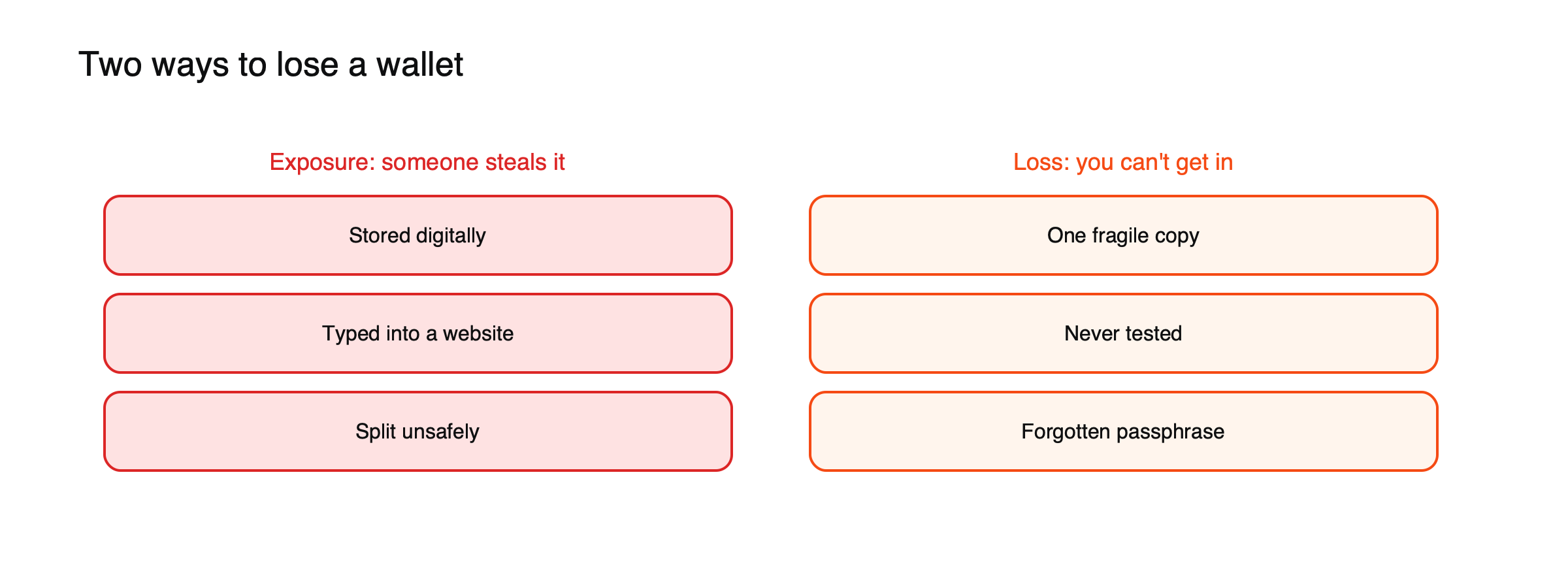
Figure: Mistakes fall into two groups: exposure and loss.
Questions about exposure
Is your phrase anywhere digital?
Photos, screenshots, notes apps, email drafts, chat messages to yourself and cloud documents all count. Phones back up photos automatically, notes sync across devices, and malware scans files for anything that looks like a list of seed words. A phrase that has ever been stored digitally should be treated as exposed: create a new wallet and move your funds. Going forward, keep it only on paper or metal. See how to back up a seed phrase safely.
Have you ever typed it into a website, form or chat?
Fake wallet sites, “validation” pages and so-called support agents all ask for the phrase, often with urgent warnings that your wallet will be locked. No legitimate service needs it. If you have entered it anywhere other than a wallet you were restoring yourself, assume it is compromised and move your funds to a new wallet straight away.
Could someone see it where it is stored?
A phrase taped under a desk, kept in a wallet case or stored in a shared drawer is easy to find. So is one kept in a document labeled as a crypto backup. The aim is for the backup to be both protected and unremarkable to anyone who stumbles on it.
Does anyone else know the words?
A partner, friend or relative who helped you set up the wallet, or saw the screen, may still remember or have photographed the words. Trust can change. If you are unsure who has seen the phrase, a fresh wallet is the safe answer.
Did the phrase come from a wallet you trust?
Fake wallet apps in app stores and on search ads look like well-known brands but generate phrases the attackers already know, or send the words to them as you type. Funds deposited into such a wallet can be taken whenever the attacker chooses. Download wallets only from the developer’s official site or a link it publishes, and check the publisher name in the app store.
Did your device arrive with a phrase already written down?
A genuine hardware wallet always generates a new phrase on the device during setup. A device that arrives with a printed recovery card, a “pre-configured” wallet or instructions to use a phrase from the box has been tampered with, and whoever prepared it can empty the wallet. Buy hardware wallets new, from the manufacturer or an authorized seller, and reset any device that does not ask you to create a fresh phrase.
Questions about loss
Do you have more than one copy, in different places?
A single sheet of paper can burn, flood, fade or be thrown out by someone who did not know what it was. At least two durable copies, kept in separate secure locations, protect against one bad day destroying both.
Have you restored the wallet from your written copy?
A misspelled word, a swapped pair or a missing number may not be noticed until the moment you need the backup. Restoring once, with a small balance, and checking that the same addresses appear catches these mistakes while the original device still works. Write the date of the test on the backup.
If you use a passphrase, is it backed up separately?
A passphrase, the optional “25th word,” opens a different wallet. The written words without it lead to an empty wallet. People who set one up in a hurry and never wrote it down lose those funds permanently. Back it up as carefully as the words, but store it apart from them.
Is your backup readable in ten years?
Pencil fades, ink smudges, paper yellows and handwriting written in a rush can be hard to read later. Clear block capitals in permanent ink, or stamped metal, last far longer.
Questions about clever ideas that backfire
Have you split the phrase into halves?
Cutting a phrase in two and storing the halves in different places sounds safer. In practice it weakens protection, because each half reveals a large part of the secret, and losing either half can lock you out. If you want spending to require more than one piece, use a multisig wallet designed for it. See what a multisig wallet is.
Have you changed the words to disguise them?
Some people rearrange, encode or swap words so a finder cannot use them. The risk is that you, or whoever inherits your crypto, forget the rule. A disguise that only you understand can become a lock nobody can open.
Questions about the future
Would someone you trust know what to do?
If you could not access your funds, would anyone know that a backup exists, where it is and how to use it safely? Without a plan, crypto can be lost to an estate even when the backup survives. See how to plan for crypto inheritance.
Scoring the audit
Any “no” in the exposure questions is urgent, because funds can be taken at any time. A “no” in the loss questions is serious but can be fixed calmly. Clever disguises and missing inheritance plans are risks that grow quietly over years. Fixing the urgent ones first, then working down the list, turns a fragile setup into a sound one in an afternoon. Fixing these takes time, but each one closes a gap that attackers or accidents could otherwise exploit. Working through the list again after any major life change, such as a move, a new relationship or a new device, keeps the setup sound over the years.
For the basics, read what a seed phrase is and what a crypto wallet is.
This article is educational content and does not constitute financial, investment, legal or tax advice. Digital assets are volatile and you may lose the amount you invest.