
What Is a 51% Attack?
A 51% attack lets whoever controls most of a network's mining or stake rewrite recent blocks and double-spend. See how it works, a real case and who is at risk.
A 51% attack is when a single party controls more than half of a blockchain’s block-producing power, mining hash rate on proof of work or stake on proof of stake, and uses it to rewrite recent history. The usual goal is a double spend: paying an exchange, withdrawing something else, then erasing the original payment from the chain.
How a 51% attack works
On a proof-of-work chain, nodes follow the version of the chain with the most accumulated work. An attacker with a majority of hash rate can exploit that rule in a few steps:
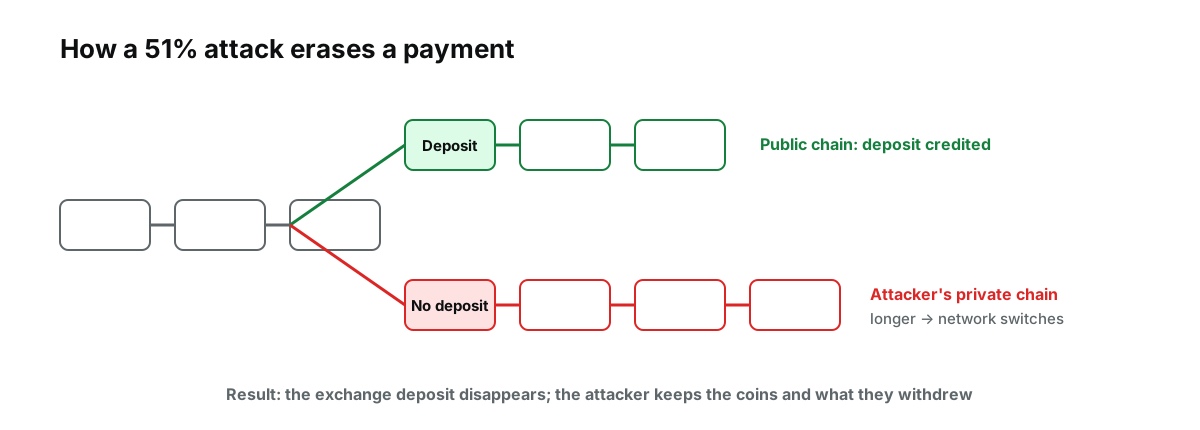
Figure: The double-spend reorg. Nodes follow the chain with the most work, so the longer private chain wins.
- Send coins to an exchange on the public chain and wait for the deposit to be credited.
- Secretly mine a private chain in which those same coins go to an address the attacker controls instead.
- Trade or withdraw the credited funds on the exchange.
- Release the private chain. Because it is longer, nodes switch to it. The deposit to the exchange disappears, and the attacker keeps both the coins and whatever they withdrew.
The switch is called a reorganization, or “reorg.” The deeper the reorg, the more confirmed transactions it can undo.
What an attacker can and cannot do
Can: reverse their own recent transactions, block or delay other people’s transactions, and stop others’ blocks from being accepted while the attack lasts.
Cannot: spend coins they never had the keys to, change the rules of the protocol, or create coins beyond the normal block reward. Nodes still reject invalid blocks, whoever produced them. Our guide to blockchain nodes explains why.
Why confirmations make attacks harder
An attacker who controls less than half of the hash rate can still try to rewrite history by getting lucky, but the odds fall quickly with every block added on top of a payment. Bitcoin’s white paper works through the numbers: an attacker with 10% of the network’s hash rate has less than a 0.1% chance of catching up once a payment is buried under five blocks. With a majority, luck is no longer needed, which is why the 50% line matters so much and why waiting for confirmations protects against everything short of it.
A real case: Ethereum Classic in 2020
Ethereum Classic, a smaller proof-of-work network, was hit by repeated 51% attacks in the summer of 2020. In the attack between July 31 and August 1, analysts at Bitquery found that the attacker rented hash power worth about 17.5 BTC, roughly $192,000 at the time, and double-spent about 807,260 ETC, worth around $5.6 million. A few days later, on August 6, another reorganization of more than 4,000 blocks followed, and major exchanges and mining pools paused ETC deposits and withdrawals.
The economics are the lesson. Renting majority hash power for a few days cost a small fraction of what the attacker took. On networks where the hash rate is small relative to what can be rented, that math works in the attacker’s favor.
What an attack would cost on a large network
The price of an attack is roughly the cost of controlling more than half of the network’s block production for as long as the attack lasts. On a small proof-of-work chain that can mean renting hash power for a few hours. On Bitcoin, the hash rate is so large that there is nowhere near enough rentable capacity; an attacker would need to build or buy a mining operation larger than the rest of the network combined and pay for its electricity.
There is also a self-defeating element. A visible attack would likely crash the price of the coin, which is the very asset an attacker with that much mining hardware has the most exposure to. The larger and more valuable the network, the more an attacker stands to lose by succeeding.
| July 31–August 1, 2020 | August 6, 2020 | |
|---|---|---|
| Reorganization depth | About 3,693 blocks | 4,236 blocks |
| Double-spent | About 807,260 ETC (around $5.6 million) | About 238,306 ETC (around $1.68 million) |
| Attacker’s cost | About 17.5 BTC of rented hash power (roughly $192,000) | Not reported |
Figures are from blockchain analytics firm Bitquery, as reported at the time.
Who is most at risk
Small proof-of-work chains. The cost of an attack depends on how much hash power secures the network. If a small chain shares a mining algorithm with a much bigger one, an attacker can rent or redirect hardware to overwhelm it. Bitcoin’s scale makes this far harder; our explainer on Bitcoin hash rate shows how that scale is measured.
Exchanges and services that credit deposits quickly. The attack only pays if the victim releases funds before the reorg. That is why platforms set confirmation requirements by network and raise them for smaller chains. Our guide to why network confirmations matter covers this.
Proof-of-stake networks, differently. On proof of stake, a majority attack requires controlling a large share of staked coins. Ethereum’s documentation notes that an attacker with 34% of stake could, in theory, cause two conflicting checkpoints to be finalized, which would force the community to coordinate off-chain to choose a chain. The attacker’s stake could then be destroyed through slashing. Our guide to proof of stake explains slashing and finality.
How users and platforms protect themselves
- Wait for more confirmations on smaller networks before treating a payment as final.
- Watch for unusual reorganizations; monitoring services and mining pools often spot them first.
- Be wary of very new or very small chains for large transfers.
- Understand that “decentralized” depends on distribution. If a few pools or stakers control a majority between them, the theoretical risk exists even without an attack.
How platforms decide how many confirmations to require
Exchanges and payment processors do not use one number for every coin. They weigh how much hashing power or stake secures each network, how cheaply majority control could be rented or bought, and how large the deposits they accept tend to be. A large, well-secured network may need only a handful of confirmations for a typical deposit, while a small proof-of-work chain that shares its mining algorithm with a bigger one may need hundreds, enough that renting majority power for that long would cost more than any plausible double spend.
These requirements are not fixed. After the Ethereum Classic attacks in 2020, several platforms sharply raised the confirmations they demanded for ETC deposits, which made deposits much slower but the attack far less profitable. If a platform’s deposit time for a coin suddenly lengthens, that is often a sign it has reassessed the network’s security.
Signs a chain may be under attack
- Unusually deep reorganizations, where several recent blocks are replaced at once.
- A sudden jump in hash rate from unknown miners on a small network.
- Exchanges pausing deposits or sharply raising confirmation requirements for a coin.
- Warnings from mining pools or monitoring services, which often detect reorgs first.
Has Bitcoin ever suffered a 51% attack? No successful majority attack on Bitcoin has been recorded. Concentration among a few large mining pools is still watched closely, because a pool’s members could in principle be directed to act together.
For how the two security models compare more broadly, see proof of work vs proof of stake, and for the bigger picture of what these networks support, what Web3 is.
This article is educational content and does not constitute financial, investment, legal or tax advice. Digital assets are volatile and you may lose the amount you invest.
Sources
- 51% Attack Bleeds More Than $5M From Ethereum Classic — Cointelegraph, August 2020
- Ethereum Classic Suffers Another 51% Attack in Five Days — The Block, August 2020
- Ethereum Classic Network Hit by Second Attack in a Week (17.5 BTC rental cost) — ForkLog, August 2020
- Proof-of-Stake Attack and Defense — ethereum.org Developer Docs
- Bitcoin: A Peer-to-Peer Electronic Cash System (Section 11, Calculations) — Satoshi Nakamoto, October 2008
- Ethereum Classic Attack, 8 August: Catch Me If You Can (4,236-block reorg; $1.68M double-spent) — Bitquery, August 2020