
Blockchain Myths That Still Get Repeated
Blockchain is not automatically anonymous, immutable, decentralized or secure. Here are the claims that cause the most confusion and what is actually true.
The most persistent blockchain myths come from turning a conditional property into an absolute claim. A blockchain can be hard to alter without being literally immutable. A public network can be decentralized without every application on it being decentralized. Transactions can be pseudonymous without being private. Those distinctions matter when you judge what a blockchain actually does.
Myth 1: “Blockchain data can never be changed”
A better description is tamper evident and tamper resistant.
Public blockchains make historical alteration difficult because changing past data can require rewriting subsequent history and convincing the network to accept the replacement. NIST uses the language “tamper evident” and “tamper resistant” rather than treating immutability as magic.
The claim becomes misleading when people assume every blockchain has the same security model. A small network with weak participation, concentrated control or poor consensus design can be easier to reorganize than a mature network with deep economic security.
Use instead: ask how finality works, who can reorganize the chain, what consensus mechanism is used and how much control is concentrated among a small number of participants.
Myth 2: “Blockchain means there is no trust”
Blockchains can reduce the need to trust one central record keeper. They do not remove trust from the system.
You may still rely on wallet software, smart-contract code, bridge operators, validators, oracles, token issuers and the people who control upgrade keys. If a token represents an offchain asset, you also depend on the legal and operational structure connecting the token to that asset.
A blockchain changes where trust sits. It does not make trust disappear.
Use instead: map the trust assumptions. Who can change the code? Who controls the assets? Who supplies external data? What happens if one component fails?
Myth 3: “Public blockchains are anonymous”
Most public blockchains are better described as pseudonymous.
An address may not show a legal name, but the address and its transaction history can be public. Ethereum, for example, is transparent by design: onchain actions are visible to anyone inspecting the ledger. Activity patterns, exchange deposits, public wallet disclosures and other data can connect an address to a person or organization.
Privacy tools can reduce disclosure, and zero-knowledge systems can prove claims without revealing underlying data. That is different from saying the base ledger is anonymous.
Use instead: separate identity privacy, transaction privacy and network privacy. They are different problems.
Myth 4: “A decentralized blockchain makes every app decentralized”
An application can run on a decentralized network while keeping important control points centralized.
A development team may control an upgrade key. A front end may depend on one web host. An oracle may supply a critical price. A stablecoin contract may allow an issuer to freeze addresses. A bridge may depend on a small validator set.
The base chain and the application layer can have very different governance structures.
Use instead: evaluate decentralization component by component: consensus, contract control, data feeds, front end, custody and governance.
Myth 5: “Smart contracts are legal contracts”
A smart contract is code that runs on a blockchain. Ethereum’s documentation describes it as a program with functions and state stored at an address.
That program can encode rules that resemble a contractual arrangement, such as releasing collateral after a condition is met. Whether those rules create or satisfy a legal contract depends on the jurisdiction, the parties and the surrounding legal agreement. The word “contract” in the technical term does not settle the legal question.
Use instead: treat smart contracts as executable software first. Legal enforceability is a separate layer.
Myth 6: “If the code is public, the code is safe”
Transparency lets people inspect code. It does not guarantee that enough qualified people have inspected it, that they found every bug or that the economic design cannot be exploited.
Ethereum’s security documentation warns that deployed smart contracts can control large amounts of value while being difficult to patch after deployment. Public code can help auditing, but attackers can read it too.
A verified source-code match is also not the same as a formal proof that the program behaves correctly. It only establishes that the published source compiles to the code running at the address.
Use instead: look for audits, formal verification where appropriate, bug-bounty history, upgrade controls and the size of value exposed to the contract.
Myth 7: “Blockchain removes the need for databases”
A conventional database is usually faster, cheaper and easier to modify when one organization is already trusted to maintain the record.
A blockchain becomes interesting when several parties need a shared state but do not want one participant to have unilateral control over the ledger. Even then, a blockchain may only be one component of the system. Applications still use databases for search, analytics, customer records and data that should not be public.
NIST explicitly frames blockchain as a technology that should be applied where its properties fit the problem, not as a universal replacement for existing systems.
Use instead: start with the coordination problem. If there is no meaningful multi-party trust problem, a blockchain may add cost without adding much value.
Myth 8: “Every blockchain is basically Bitcoin”
Bitcoin established one important design: a permissionless network that uses proof of work to order transactions and protect a scarce digital asset.
Other blockchains make different choices. They can use proof of stake, different finality rules, different execution environments, permissioned participation or smart-contract platforms designed for general computation.
Calling all of them “Bitcoin with another name” hides the differences that matter for security, governance and performance.
Use instead: compare networks by consensus, validator access, execution model, finality, data availability and governance.
The practical test is simpler than the slogans
When a blockchain claim sounds absolute, replace it with a question.
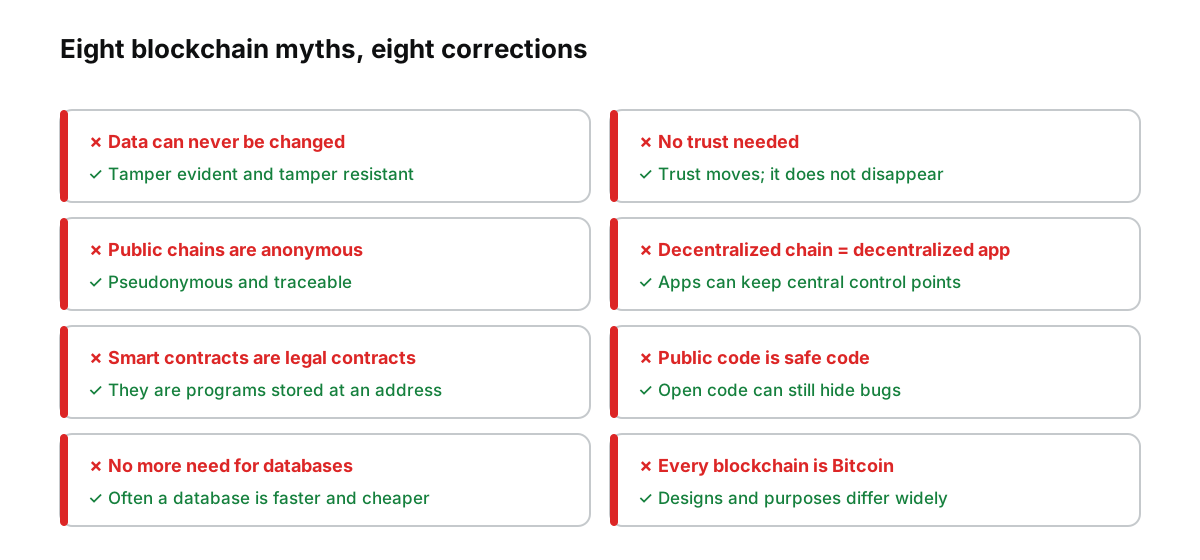
Figure: The eight myths in this article, with the short version of what is true.
“Immutable” becomes: what would it take to reverse history?
“Trustless” becomes: which parties or pieces of software still have to be trusted?
“Anonymous” becomes: which data are public and what can be linked to identity?
“Decentralized” becomes: which part of the system is actually decentralized?
Those questions are less exciting than slogans. They are also far more useful when money or data is involved.