
How DeFi Lending and Borrowing Works
DeFi lending lets you deposit crypto to earn interest or borrow against collateral via smart contracts. How rates are set, why loans need extra collateral.
DeFi lending lets people deposit crypto into a smart contract to earn interest from borrowers, and lets borrowers take loans by locking up more collateral than they borrow. Protocols such as Aave and Compound set rates automatically. If collateral falls too far, anyone can repay part of the loan and take collateral at a discount.
How deposits work
Depositors, often called suppliers, send tokens such as USDC or ETH to a lending pool. In return they receive a token representing their deposit, which grows as borrowers pay interest. They can usually withdraw at any time, as long as the pool has enough unborrowed tokens.
How borrowing works
- Deposit collateral, for example ETH.
- Borrow a different token, such as a stablecoin, up to a limit set by the protocol for that collateral.
- Pay interest that accrues continuously.
- Repay the loan to get the collateral back.
Loans are overcollateralized: you must lock up more value than you borrow. There is no credit check and no fixed term.
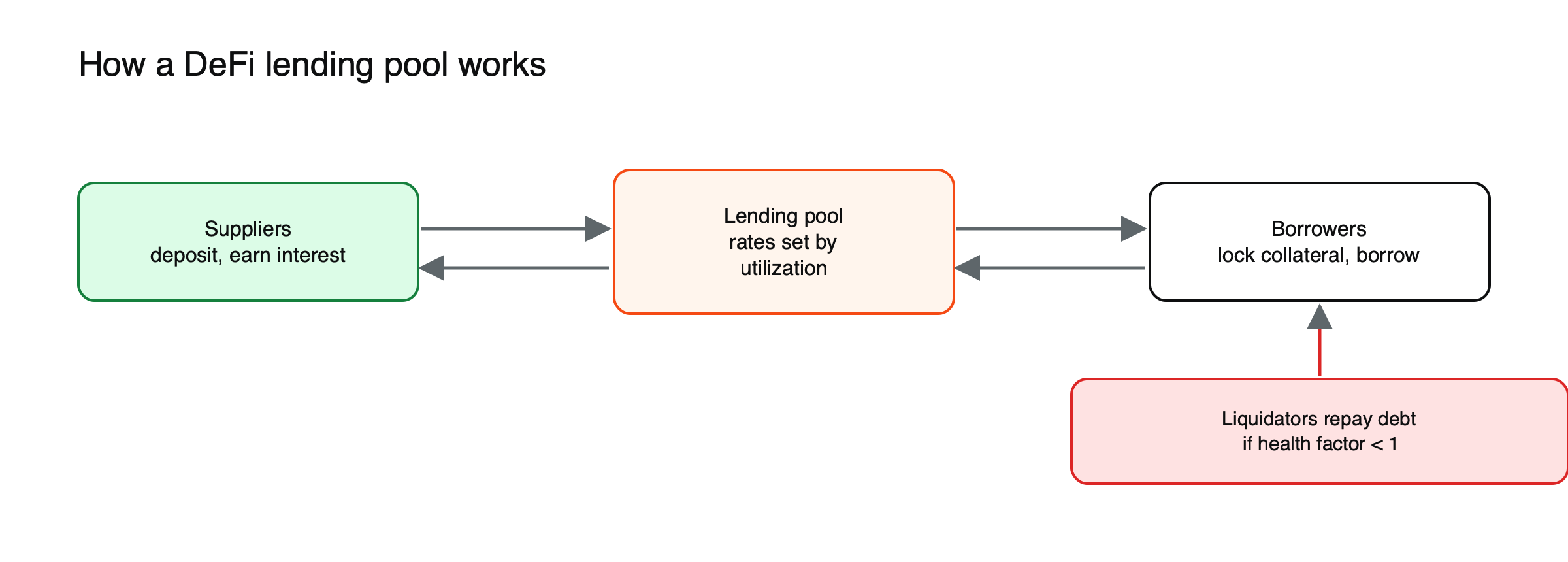
Figure: Money flows in a DeFi lending pool.
How interest rates are set
Rates depend on utilization, the share of a pool that has been borrowed. When utilization is low, rates are low to encourage borrowing; as it rises, rates climb to attract deposits and discourage further borrowing. Rates change continuously, so the rate shown when you deposit or borrow is not fixed.
The rate curve, worked through
Most lending pools use a curve that raises rates gently at first and steeply above a target utilization. Suppose a pool’s model sets a borrow rate of 4% at 50% utilization and keeps 10% of interest as a reserve. Suppliers then earn about 4% × 50% × 90% = 1.8%, since only half the pool is lent out. If utilization climbs to 90%, past the target, the model might set the borrow rate at 20%; suppliers would then earn about 20% × 90% × 90% = 16.2%. (Illustrative parameters.) The steep part of the curve is designed to pull in new deposits and push borrowers to repay before the pool runs dry.
Liquidation: the safety mechanism
Each position has a health factor comparing collateral, adjusted by a liquidation threshold, with debt. Below 1, the position can be liquidated: a liquidator repays part of the debt, often up to 50%, and receives collateral plus a bonus. Our guide to health factor and liquidation price works through the numbers.
Why withdrawals can get stuck
A supplier can only withdraw what has not been lent out. If a pool is 98% borrowed, only 2% of its funds are available, and a large withdrawal may have to wait until borrowers repay or new deposits arrive. The rising rates usually solve this within hours or days, but during market stress, when many suppliers want out at once, it can take longer. Checking a pool’s utilization before depositing shows how easily you could leave.
Flash loans
DeFi lending also allows something traditional finance cannot: flash loans, which require no collateral at all because the money must be borrowed and repaid within the same transaction. If the loan is not repaid by the end of the transaction, the whole transaction is reversed as if it never happened. Flash loans are used for arbitrage, refinancing and collateral swaps, and they have also been used in attacks that exploit flaws in other protocols by borrowing huge sums for a few seconds.
Pooled and isolated markets
Large lending protocols often pool many assets together, so any accepted collateral can back a loan in any asset. That is efficient but means a problem with one asset can affect the whole pool. Newer designs isolate markets, pairing one collateral asset with one loan asset, so losses are contained. Isolated markets allow riskier assets to be listed without endangering everyone else, at the cost of splitting liquidity.
Many protocols also offer separate modes for assets that move together, such as staked ether and ether, allowing higher borrowing limits because the collateral and the debt are unlikely ever to diverge sharply. These modes make looping strategies more efficient, but they rely on the two assets staying close in value; if a staked token loses its link to the underlying asset, positions built this way can be liquidated very quickly.
Who sets the rules
Interest rate curves, collateral limits, liquidation thresholds and the list of accepted assets are parameters, not fixed laws. In most large protocols, token holders vote on changes, often advised by specialist risk firms that model how each asset might behave under stress. Adding a new collateral asset or raising a borrowing limit can increase a protocol’s revenue but also its exposure, so these votes matter to every depositor.
Why people borrow
- Access to cash without selling, for example borrowing stablecoins against ETH.
- Leverage: borrowing to buy more of an asset increases both gains and losses, and is a common path to liquidation.
- Short-term needs, such as covering a payment while waiting for funds.
Risks to know
- Liquidation when collateral prices fall quickly.
- Smart contract and oracle risk: bugs or wrong prices can cause losses or unfair liquidations. In 2026, after one exploit elsewhere in DeFi, Aave users withdrew about $15 billion in four days.
- Withdrawal limits when most of a pool is borrowed.
- Variable rates that can rise sharply.
For how this compares with company-run lenders, read DeFi lending vs centralized crypto lenders. For the bigger picture, see what DeFi is.
This article is educational content and does not constitute financial, investment, legal or tax advice. Digital assets are volatile and you may lose the amount you invest.
A supplier’s checklist
- What is the pool’s current utilization, and how high has it gone before?
- Which collateral assets back the loans, and how volatile are they?
- Which oracle sets prices, and what safeguards exist?
- Has the protocol had bad debt or exploits, and how were losses handled?
- Is there a reserve or insurance fund to absorb shortfalls?
Frequently asked questions
Can I lose money by only depositing, not borrowing?
Yes, though it is less likely. If liquidations fail to cover a borrower’s debt, the pool can be left with bad debt, and a smart-contract exploit can drain deposits. Suppliers also face the risk of not being able to withdraw quickly when utilization is high.
Are DeFi lending rates fixed?
Mostly not. Rates change continuously with utilization, so the rate shown when you deposit or borrow can be very different a week later.
Sources
- Liquidations (health factor below 1; close factor; liquidation bonus) — Aave documentation
- Liquidation Penalty, Close Factor and Health Factor (overcollateralized lending; liquidations) — DEXTools
- DeFi TVL drops 39% in 2026 (Aave users withdrew about $15 billion in four days after an exploit) — Cointelegraph, June 2026