
What Are AI Crypto Tokens?
AI crypto tokens fund decentralized computing, machine-learning networks, AI agents and data markets. Learn the main types, how they make money and the risks.
AI crypto tokens are tied to projects that combine blockchains with artificial intelligence: networks that rent out computing power, reward machine-learning work, launch AI agents or trade data. The category was worth roughly $22 billion in mid-2026. Some tokens pay for measurable work; many trade mainly on AI headlines.
The main types
Decentralized compute. Networks such as Render pool graphics processors from many providers and rent them out for rendering and AI workloads. The token pays for that capacity.
Machine-learning networks. Bittensor runs subnets in which participants compete to provide useful AI outputs and earn TAO for it. It is one of the few projects where the token pays directly for AI work done on the network.
AI agents. Platforms such as Virtuals Protocol and the Artificial Superintelligence Alliance let developers launch software agents that hold wallets, trade and interact on-chain.
Data. Some projects collect or sell data for training models and reward the people who contribute it.
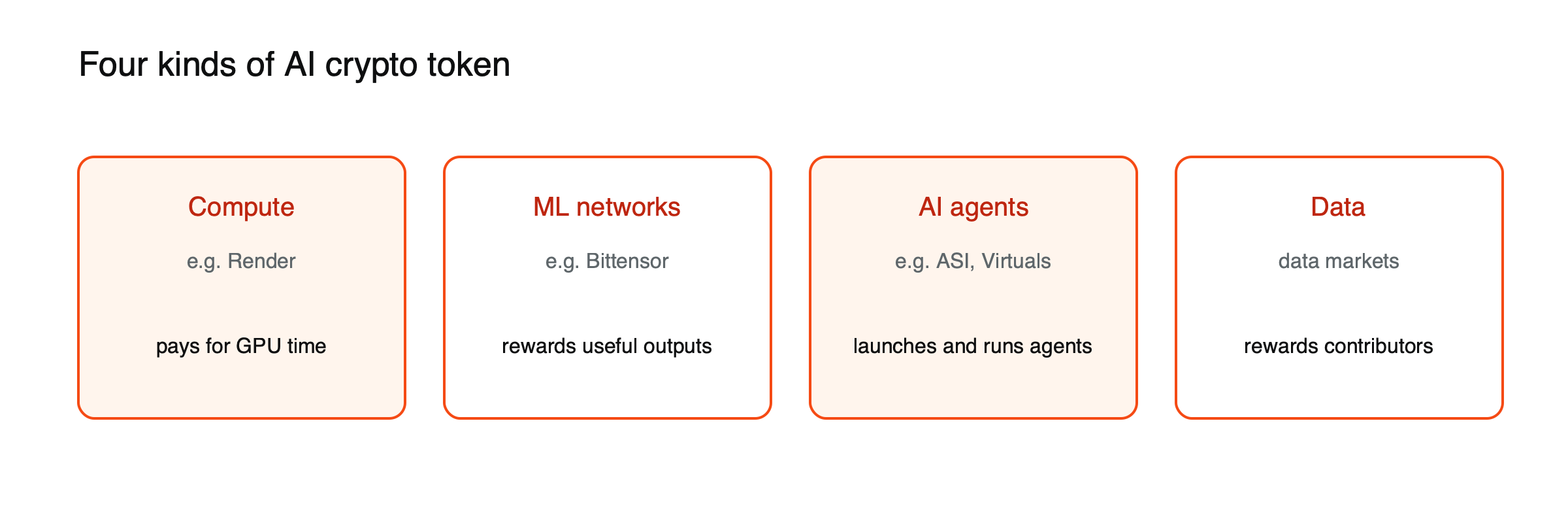
Figure: The four main types of AI crypto tokens and what the token is used for.
Decentralized compute, in an example
Suppose a small studio needs graphics processing power for a week to render an animation or fine-tune a model. (Illustrative scenario.) On a decentralized compute network, it submits the job and pays in the network’s token or a stablecoin converted into it. Providers with spare graphics cards pick up the work, and the network checks results and pays them. The appeal is access to idle hardware, sometimes at lower prices than large cloud providers. The challenges are reliability, data privacy and proving that the work was done correctly, which is why many serious AI workloads still run on conventional cloud platforms.
How Bittensor’s subnets work
Bittensor organizes its network into subnets, each focused on a type of AI task, such as text generation, data scraping or prediction. Participants called miners provide outputs, and validators score them; new TAO tokens are distributed according to those scores. The design aims to reward useful AI work directly with tokens. Critics question how well scores reflect real-world usefulness and whether rewards attract work aimed at the scoring rules rather than at customers.
AI agents with wallets
AI agents are software programs that can hold crypto wallets, make payments and interact with applications on their own. Platforms let developers launch agents, often with their own tokens, which can be bought and traded like any other. In late 2024, agent tokens drew a burst of speculative interest, with many launched quickly and most losing value afterward. The idea of software that pays and gets paid on-chain is real; the tokens attached to individual agents are often closer to meme coins than to businesses.
A merger that reshaped the sector
In 2024, Fetch.ai, SingularityNET and Ocean Protocol agreed to merge their tokens into a single token for the Artificial Superintelligence (ASI) Alliance, converting AGIX and OCEAN into FET at fixed rates. Ocean later left the alliance. By mid-July 2026, FET traded around $0.16, well below its early-2024 highs, a reminder that consolidation did not protect holders from the sector’s swings.
Why these tokens move so much
AI tokens often react to news from the wider AI industry rather than to their own usage. Tokens of Render, Fetch.ai, SingularityNET and Bittensor fell 3% to 5% on one occasion when an Apple product event disappointed traders, even though bitcoin barely moved. Compute networks with paying customers have tended to hold up better in drawdowns than agent-launch tokens, which depend more on attention.
Questions to ask about an AI token:
- What does the token pay for, and does anyone pay for that service today?
- Could the product work without the token, for example by charging in stablecoins?
- How much real AI work happens on-chain, as opposed to on ordinary servers?
- Who holds the supply, and when do team and investor tokens unlock?
AI tokens compared with AI stocks
Investors seeking exposure to artificial intelligence can buy shares in companies that make chips, run cloud platforms or build models, which have revenue, financial reports and shareholder rights. AI tokens offer exposure to smaller, often experimental networks, with no claim on profits and much less disclosure. They can rise faster in enthusiastic markets and fall much further when sentiment turns. Treating them as a high-risk satellite to broader exposure, rather than as a substitute for it, reflects that difference.
How big the sector is
By mid-2026, AI-related crypto tokens were valued at roughly $22 billion in total, a small fraction of the overall crypto market and tiny compared with the value of listed AI companies. Much of that value sits in a handful of tokens, while hundreds of smaller ones trade thinly. The sector’s size has swung widely with the AI news cycle, rising quickly when AI dominates headlines and shrinking just as fast when attention moves elsewhere.
Supply and unlocks
Many AI tokens are young, with large allocations to teams, early investors and ecosystem funds still to be released. That creates the same unlock pressure seen across newer tokens, often at moments when the project is trying to grow its user base. Checking the vesting schedule and the share of supply already circulating matters as much here as anywhere. See what token unlocks are.
Questions specific to compute networks
- How much paid demand does the network have, and from whom?
- How does its pricing compare with large cloud providers for the same work?
- How does it verify that providers actually did the work correctly?
- What happens to customers’ data while it is processed?
- How easily could its customers switch to another provider?
For agent and data tokens, the equivalent questions are who pays for the service, whether the token is needed to pay, and how much of the activity comes from incentives rather than customers. Asking them before buying separates projects with real use from those simply riding the AI theme.
Risks to know
- Narrative risk: prices can rise and fall with headlines about AI companies.
- Thin real usage: many projects use “AI” in their name without meaningful AI activity.
- Competition: centralized cloud providers offer the same services at scale.
- Supply unlocks and concentration, as with most newer tokens.
For how to judge any new token, read common mistakes when buying altcoins and utility tokens vs governance tokens. For the wider category, see what an altcoin is.
This article is educational content and does not constitute financial, investment, legal or tax advice. Digital assets are volatile and you may lose the amount you invest.
Frequently asked questions
Do AI tokens give exposure to companies like the major AI labs?
No. They are tokens of separate crypto projects. News about major AI companies can move them, but holding an AI token gives no stake in those companies.
How can I tell whether a project really uses AI?
Look for evidence of paying customers, measurable workloads on the network and published technical details. A name, logo or roadmap mentioning AI is not evidence of real AI activity.