
What Are Token Unlocks and Vesting Schedules?
Token unlocks release locked team, investor and community tokens on a schedule. How vesting and cliffs work, what research shows about prices and what to check.
Token unlocks are scheduled releases of tokens that were locked at launch for teams, investors, advisers or community programs. A vesting schedule sets when and how fast they become tradable. Unlocks add supply to the market, and research on more than 16,000 unlock events found about 90% were followed by negative price pressure, often starting weeks before the unlock date.
How vesting works
- Cliff: nothing unlocks for a set period, often 12 months, then a block of tokens unlocks at once.
- Linear vesting: after the cliff, tokens release steadily, for example monthly, over two to four years.
- Cliff plus linear: the common default for team and investor allocations.
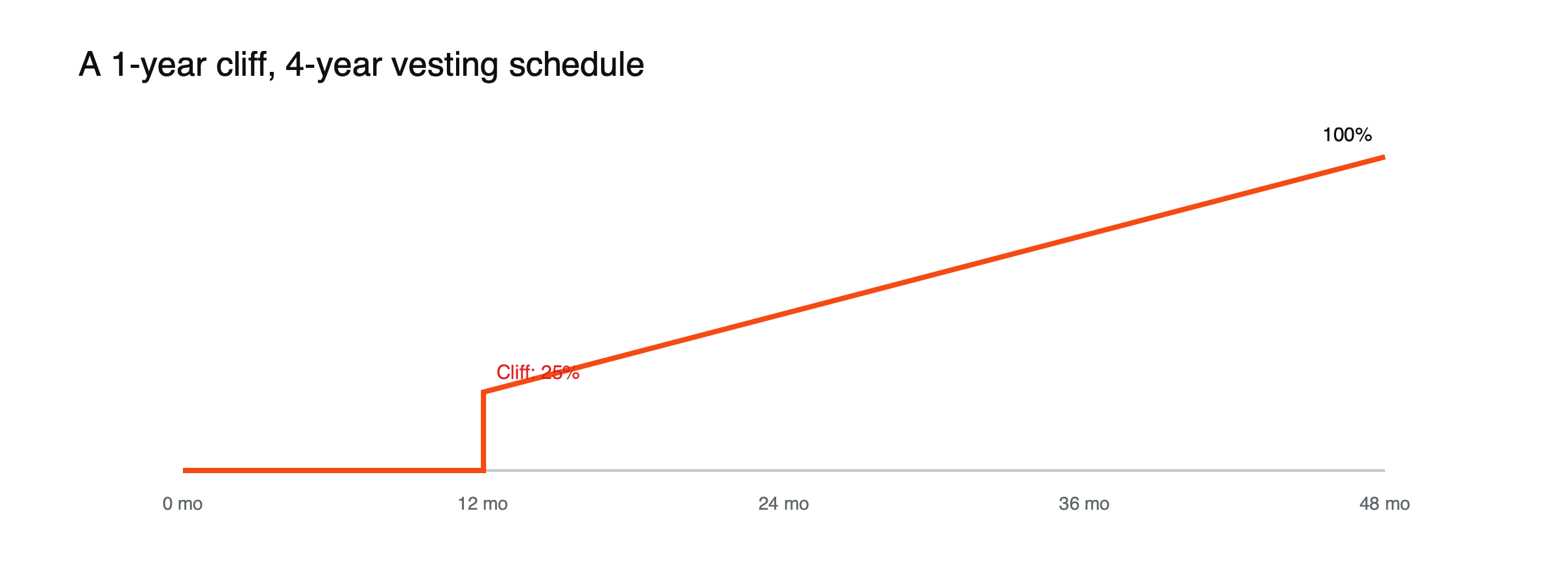
Figure: Cumulative unlocked share under a 1-year cliff and 4-year vesting (illustrative).
A schedule like “1-year cliff, 4-year vesting” means no tokens for a year, then a portion at the cliff and the rest spread over the following years.
Reading an unlock calendar
Unlock calendars list upcoming releases by date and amount. Four details decide how much a single entry matters:
- Size relative to circulating supply, not total supply. An unlock of 2% of total supply can be 10% of what actually trades if most tokens are still locked.
- Size relative to daily trading volume, which shows how easily the market could absorb a sale.
- Who receives the tokens: team, investors, ecosystem fund or community.
- Cliff or linear release: a single large cliff is a visible event; a steady drip is easier to absorb but adds constant pressure.
What the research shows
Keyrock, a crypto market maker, studied more than 16,000 unlock events:
- About 90% were associated with negative price pressure.
- The decline often began about 30 days before the unlock, as traders positioned early.
- Team unlocks were linked to the worst drawdowns, around 25% on average.
- Investor unlocks were more controlled, since funds often sell through hedges or off-exchange deals.
- Ecosystem unlocks, used for development and grants, averaged slightly positive.
Size matters too: unlocks below about 1% of circulating supply rarely had a meaningful effect.
Worked example: sizing an unlock
Suppose 30 million tokens unlock next month for early investors. The token has 500 million in circulation and trades about 20 million tokens a day. (Illustrative figures.)
- Unlock as a share of circulating supply: 30 ÷ 500 = 6%
- Unlock in days of normal trading volume: 30 ÷ 20 = 1.5 days
By the research above, an unlock of this size is well above the roughly 1% level below which effects tend to be small. If the recipients sold everything quickly, it would equal a day and a half of the whole market’s normal activity. Whether they will is another question, which is where knowing who receives the tokens helps.
Why unlocks move prices
Recipients may sell to cover costs, take profits or diversify. Even when they do not, buyers anticipate the extra supply, which weighs on price beforehand.
How recipients actually sell
Large holders rarely dump an entire unlock on the open market. Investment funds often hedge in advance, for example by shorting perpetual futures before the unlock, which is one reason prices tend to soften in the weeks beforehand. Others sell through over-the-counter deals with trading firms or spread sales over weeks. Some stake or hold their tokens instead. The selling still happens, but often in ways that spread its impact over a longer period than the unlock date itself.
Can an unlock be good news?
Sometimes. Unlocks that fund development, grants or community programs averaged slightly positive in the research, because the tokens are more likely to be spent building the ecosystem than sold immediately. An unlock that passes without heavy selling can also remove an overhang that had been weighing on the price.
Unlocks as dilution over time
Looking at unlocks one by one can hide their combined effect. If 25% of a token’s total supply is scheduled to unlock over the next two years, circulating supply grows by roughly 12% a year from that source alone, before any rewards or emissions. (Illustrative.) Demand has to grow at a similar pace just to keep the price where it is. Adding up the next twelve months of scheduled releases, as a share of today’s circulating supply, gives a simple dilution figure that is easy to compare across tokens.
Unlocks also interact with market conditions. In a strong market with rising volume, even a large release can be absorbed with little effect, because new buyers outnumber recipients who sell. In a weak market with thin trading, a modest unlock can push the price down, since there are few buyers on the other side. The same schedule can therefore matter much more in a downturn than in a rally, which is worth remembering when an unlock falls during a period of falling prices.
Planning around unlocks as a holder
For someone already holding a token, the unlock calendar is a planning tool. Large insider unlocks are known well in advance, so deciding beforehand whether to hold through them, reduce exposure or simply avoid adding new money in the weeks around them is better than reacting on the day. Watching on-chain movements from known team and investor wallets near unlock dates also shows whether newly unlocked tokens are heading to exchanges. Tokens moving to an exchange deposit address are a stronger hint of selling than tokens moving to a new private wallet, though neither is proof of what the holder will do next.
What to check before buying
- Circulating vs total supply: a low circulating share means more unlocks ahead.
- The next large unlock: its size as a share of circulating supply and who receives it.
- The full schedule: published by most projects and tracked by unlock calendars.
- Whether schedules can change: governance votes can alter them.
Limits
Unlocks are only one factor; strong demand can absorb them, and weak demand can sink a token without any unlock. See what tokenomics is, inflationary vs deflationary tokens and common mistakes when buying altcoins.
This article is educational content and does not constitute financial, investment, legal or tax advice. Digital assets are volatile and you may lose the amount you invest.
Frequently asked questions
Where can I see upcoming unlocks?
Most projects publish their vesting schedules in their documentation, and dedicated unlock calendars collect them across many tokens. Comparing the two is worthwhile, because calendars can lag behind schedule changes.
Should I sell before every unlock?
Not automatically. Large, insider-heavy unlocks have a poor record, but small unlocks and ecosystem releases often pass with little effect. Unlocks are one input alongside demand, liquidity and the project’s progress.
Sources
- From Locked to Liquidity: What 16,000+ Token Unlocks Teach Us (90% negative; 30 days before; team unlocks −25%) — Keyrock
- Token Unlock Report (ecosystem unlocks +1.18%; investor unlocks more controlled) — Streamflow
- Crypto Token Unlock Calendar (cliff plus linear as default; 12-month cliff) — Spark
- Do token unlocks cause price drops? (unlocks below ~1% of circulating supply show little impact) — Autheo