
What Is Altcoin Season and What Usually Triggers It?
Altcoin season is when most large altcoins outperform bitcoin for weeks or months. See how it is measured, what tends to start it and why it is hard to time.
Altcoin season is a stretch of the crypto market in which most large altcoins rise faster than bitcoin. The most cited test comes from the Blockchain Center index: at least 75% of the top 50 coins, excluding stablecoins and wrapped tokens, beat bitcoin over 90 days. Such periods are hard to time.
How it is measured
The Altcoin Season Index tracks how many of the top 50 coins outperformed bitcoin over the past 90 days. A reading of 75 or more signals altcoin season; 25 or less signals bitcoin season; anything in between is neutral.
Bitcoin dominance is bitcoin’s share of the total crypto market value. When it falls while the market is rising, money is flowing into altcoins faster than into bitcoin.
Reading the index, worked through
Suppose that over the past 90 days, 38 of the top 50 coins, after the index’s exclusions, rose more than bitcoin. That is 76%, just above the 75% threshold, so the index would signal altcoin season. If only 10 had beaten bitcoin, the reading would be 20, deep in bitcoin season. (Illustrative figures.) Because the window is 90 days, the index lags: by the time it confirms an altcoin season, much of the outperformance has already happened.
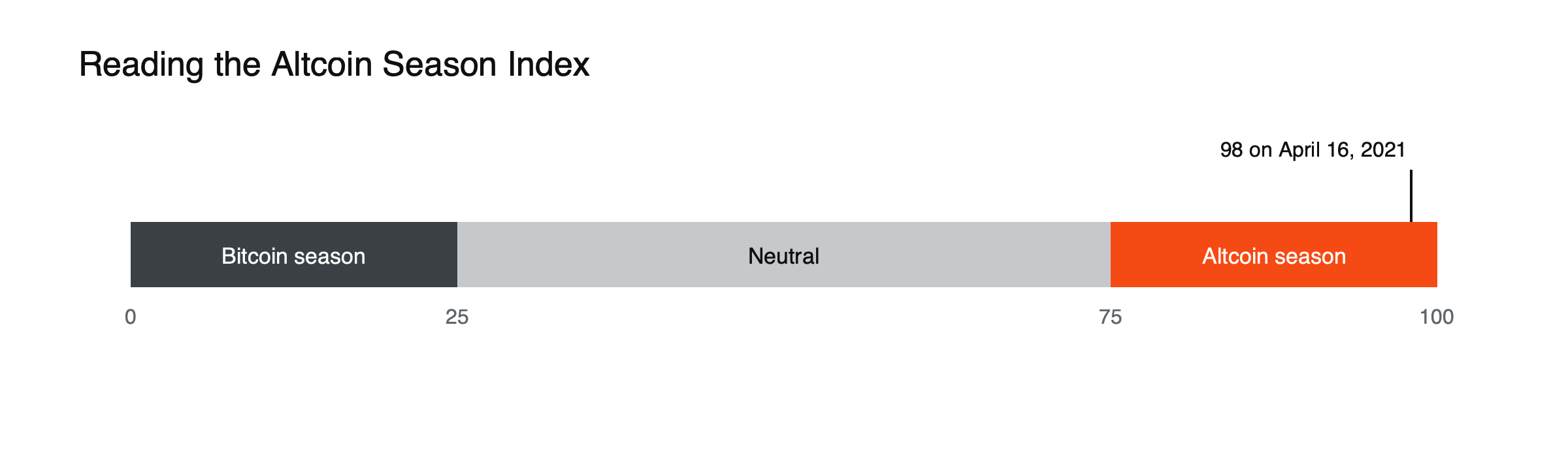
Figure: How to read the Altcoin Season Index. Source: Blockchain Center definition; peak reading via Spark.
What usually comes before it
There is no fixed rule, but past altcoin seasons have shared some conditions:
- A strong bitcoin rally first. Gains in bitcoin lift confidence and give holders profits to move into riskier assets.
- Bitcoin pausing. When bitcoin’s price stops rising quickly, traders look elsewhere for gains.
- Easy money and rising risk appetite. Low interest rates and strong markets push investors further out on the risk curve.
- A new story. DeFi, NFTs and memecoins each gave traders a reason to buy smaller tokens in a particular period.
The 2021 example
The clearest recent altcoin season came in 2021. Bitcoin dominance fell from roughly 70% in January to around 38%, and the Altcoin Season Index peaked at 98 on April 16, 2021, as DeFi tokens, NFT-related coins and memecoins rallied far faster than bitcoin.
Why the 2024–2026 cycle looked different
The cycle that followed the launch of US spot bitcoin ETFs in January 2024 did not produce a broad altcoin season on the scale of 2021. Much of the new institutional money flowed into bitcoin through those funds, keeping its share of the market high; bitcoin dominance was still between about 55% and the low 60s in 2026. At the same time, millions of new tokens split speculative money into ever smaller pieces, so gains were concentrated in particular themes, such as memecoins on Solana or AI tokens, rather than spread across the top 50. Many traders waiting for a classic altcoin season saw only short bursts in narrow corners of the market.
Sector seasons instead of a single altseason
More recent markets have shown rotations between sectors more than one broad altcoin season. A wave of buying lifts memecoins for a few weeks, then AI-related tokens, then tokenized real-world assets or a particular blockchain’s ecosystem. Each wave looks like an altcoin season from inside the sector while the index barely moves. Following which sectors lead, and how quickly leadership changes, can say more about risk appetite than the headline index.
Where altcoin season sits in the market cycle
In the classic pattern of a crypto market cycle, altcoin season belongs to the later part of a rally. Money first flows into bitcoin, then into the largest altcoins, and only after confidence is high does it spread to smaller and more speculative tokens. That makes a full altcoin season less a sign that a rally is starting than a sign that it may be maturing. Signs of excess often appear alongside it: a flood of new token launches, rising leverage and stories about ordinary people making quick fortunes. None of these marks a top on its own, but together they suggest that overall risk is rising faster than the rewards. See what a crypto market cycle is.
Why it is hard to rely on
- Short and irregular. Altcoin seasons come and go with little warning, and the gaps between them can be long.
- Late entry is costly. Altcoins usually rise most near the end of a rally, so buying when an altcoin season is obvious often means buying close to the top.
- More tokens, thinner gains. With millions of tokens launched in recent years, new money is spread across far more assets than in earlier cycles.
- Falls are steeper. When the rotation reverses, altcoins usually fall harder than bitcoin.
Leverage makes the reversal worse. Altcoin rallies attract borrowed money through perpetual futures, often at high leverage. When prices turn, liquidations force selling across many tokens at once, which is part of why altcoin seasons tend to end abruptly. See how liquidation cascades work.
Having a plan before the rally
If you want altcoin exposure, decisions made in advance are easier to follow than ones made in the middle of a rally. Decide the maximum share of your crypto holdings that altcoins can be. Set rules for taking profits, for example selling part of a position after it doubles, and for rebalancing back to your target mix. Choose in advance which signals would make you reduce exposure, such as a sharp rise in dominance or funding rates. A plan does not guarantee good timing, but it reduces the chance of buying at the top and selling at the bottom.
How to use the idea sensibly. Treat altcoin season as a description of what the market is doing, not a forecast. The index and bitcoin dominance can show whether risk appetite is broad or narrow; they cannot tell you when a phase will end. Position sizes that survive a sharp reversal matter more than catching the start.
For the wider cycle, read what a crypto market cycle is. For why altcoins move with bitcoin, see why most cryptocurrencies move together, and for the category, what an altcoin is.
This article is educational content and does not constitute financial, investment, legal or tax advice. Digital assets are volatile and you may lose the amount you invest.
Frequently asked questions
Is there a reliable signal that altcoin season is starting?
No single signal has worked consistently. Falling bitcoin dominance in a rising market, broad gains among large altcoins and rising risk appetite have accompanied past altcoin seasons, but each can also appear in rallies that fade quickly.
Does altcoin season include stablecoins?
No. The common index excludes stablecoins and asset-backed tokens, since they are not expected to outperform bitcoin. Their growth can, however, lower bitcoin dominance without any real rotation into altcoins.
Sources
- Altseason (Blockchain Center index definition; 2021 dominance ~70% to ~38%; index peak 98 on April 16, 2021) — Spark
- Here’s why alt season may be on the horizon (Blockchain Center definition; exclusions) — CryptoSlate, April 2023
- Over Half of All Crypto Tokens Are Now Dead: CoinGecko Report (20.2 million projects by 2025) — CryptoPotato via KuCoin, January 2026