
Centralized vs Decentralized Stablecoins
Centralized stablecoins rest on an issuer's reserves; decentralized ones on smart contracts and collateral. Compare backing, control, risks and track record.
The key difference in centralized vs decentralized stablecoins is who stands behind the dollar. A centralized stablecoin, such as USDT or USDC, is issued by a company that holds reserves and redeems tokens for dollars. A decentralized one, such as DAI, is created by smart contracts against crypto collateral. Each design moves risk elsewhere.
How centralized stablecoins work
A company receives dollars, issues the same number of tokens and invests the dollars in reserves, mostly short-term US government debt and bank deposits. Verified customers can redeem tokens for dollars. The company can also freeze tokens at specific addresses, for example under a court order. Trust rests on the issuer’s reserves, honesty and regulators. Our article on how much an issuer earns on its reserves shows the business behind this model.
How decentralized stablecoins work
Users lock collateral, such as ether, in a smart contract and mint stablecoins against it, usually worth less than the collateral. If the collateral’s value falls too far, the contract sells it to keep the stablecoin backed. No company has to approve each mint. Trust rests on the code, the collateral and the price feeds that tell the contracts what the collateral is worth.
Minting one, in numbers
Suppose you lock 10 ETH worth $20,000 in a lending protocol and mint 10,000 of its dollar stablecoin, a collateral ratio of 200%. If the protocol requires at least 150%, your position is liquidated if ether falls to $1,500, a 25% drop, and part of your collateral is sold, usually with a penalty. (Illustrative figures.) To get your ether back, you repay the 10,000 stablecoins plus any accumulated fee. The stablecoin’s backing is your excess collateral, which is why these systems lock up more value than they issue.
Side by side
| Centralized (e.g. USDT, USDC) | Decentralized (e.g. DAI) | |
|---|---|---|
| Who issues it | A company | Smart contracts governed by token holders |
| Backing | Cash, T-bills, bank deposits | Crypto collateral, sometimes other stablecoins |
| Redemption | Issuer redeems for dollars | Repay the loan or trade it on the market |
| Can tokens be frozen? | Yes, by the issuer | Usually not at the token level |
| Main risks | Issuer failure, bank exposure, regulation | Collateral crashes, code bugs, oracle errors |
| Scale | By far the largest stablecoins | Much smaller |
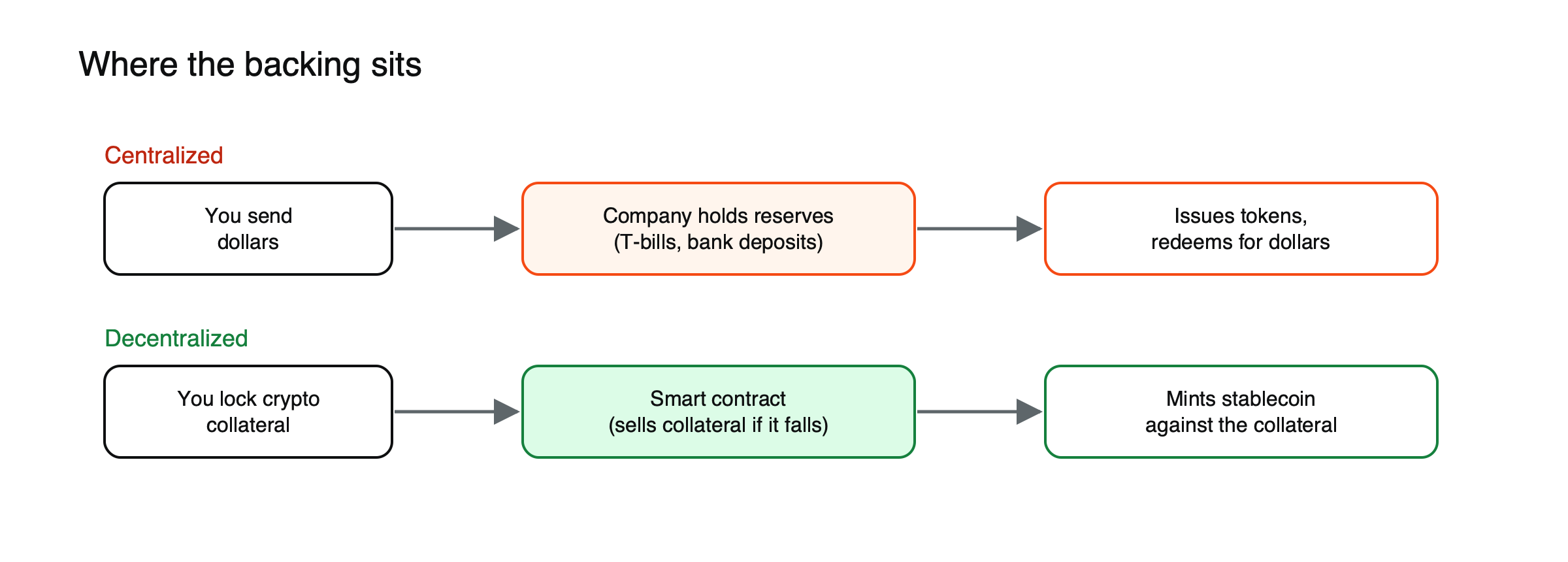
Figure: Where the backing sits in each model.
Decentralized does not always mean independent
«Decentralized means independent of banks» sounded right until March 2023. When USDC fell to about $0.87 because $3.3 billion of its reserves were caught in the failure of Silicon Valley Bank, DAI fell to about $0.88 too. About half of DAI’s backing at the time was USDC. A stablecoin can be decentralized in how it is issued and still centralized in what backs it. The full story is in what happened when USDC lost its peg.
When central control is a feature
The flip also works the other way. Centralized stablecoins can freeze stolen funds and comply with sanctions, which some users see as protection, not a weakness.
Hybrids are now the norm
The two models have moved toward each other. Major decentralized stablecoins now hold large amounts of real-world assets, such as tokenized Treasury bills and other stablecoins, alongside crypto collateral, which makes them more stable and more dependent on traditional custodians. Centralized issuers, meanwhile, publish on-chain supply data and frequent reserve reports, and some offer their tokens across many blockchains with programmable features. Rather than two opposite camps, the market is a spectrum, and a stablecoin’s position on it can change through governance votes or business decisions.
Transparency also differs. A centralized issuer reports its reserves through periodic accountant reports, so outsiders see a snapshot each month at best. A decentralized stablecoin’s collateral sits in public smart contracts that anyone can inspect at any moment, though understanding the positions, collateral types and risk settings takes more effort than reading a summary table. For most users, the practical difference shows up only in a crisis, which is exactly when it is too late to switch without paying a cost.
Censorship resistance in practice
The main practical advantage of a decentralized stablecoin is that no single company can freeze an individual holder’s tokens. That matters to users worried about mistaken freezes or overreaching authorities. The limits are real, though: if a decentralized stablecoin holds frozen-capable centralized stablecoins as collateral, part of its backing can still be affected, and the websites and front ends people use to access it can be restricted even when the contracts cannot.
A third model that failed
Algorithmic stablecoins tried to hold their peg with no reserves at all, relying on a paired token and arbitrage. TerraUSD, the largest, collapsed in May 2022. Our account of the TerraUSD collapse explains why that design broke.
How each type holds up under different kinds of stress
| Stress event | Centralized stablecoin | Decentralized stablecoin |
|---|---|---|
| A bank holding reserves fails | Directly exposed, as USDC was in 2023 | Exposed if it holds centralized stablecoins or bank-held assets |
| Crypto prices crash | Largely unaffected | Liquidations; collateral shortfall if prices fall too fast |
| Regulators act against the issuer | Freezes, delistings or forced wind-down | Front ends may be restricted; contracts keep running |
| A smart-contract bug | Limited, token contracts are simple | Potentially severe, given complex lending logic |
| An individual address is sanctioned | Tokens there can be frozen | Usually cannot be frozen at the token level |
No design wins on every row. The choice is about which risks you are more comfortable carrying, and many experienced users hold some of each so that no single event affects all of their dollar balances.
How to choose
Ask what backs the coin, who can redeem it and how fast, who can freeze or change it, and what happened to it in past stress events. The answers matter more than the label.
For the basics, read what a stablecoin is and how stablecoins maintain their value.
This article is educational content and does not constitute financial, investment, legal or tax advice. Digital assets are volatile and you may lose the amount you invest.
Frequently asked questions
Which type is more widely accepted?
Centralized stablecoins, by a wide margin. They dominate trading pairs on exchanges, payment integrations and cross-border transfers, largely because businesses can redeem them for dollars and because regulators recognize them.
Can a decentralized stablecoin become centralized over time?
In practice, partly. If governance votes to hold more real-world assets or centralized stablecoins as collateral, the stablecoin’s risks shift toward those of traditional custodians and issuers, even though its contracts remain decentralized. Checking the current collateral mix matters more than the original design.