
How China’s Policy Moves Ripple Into Commodities and the Australian Dollar
China buys about 70% of seaborne iron ore and over half of the world's copper, so its stimulus moves metals and the Australian dollar. How the links work.
China’s stimulus and commodities are tightly linked because China buys about 70% of the world’s seaborne iron ore and accounts for just over half of global copper demand. When Beijing cuts rates or promises spending, metal prices often jump, and so does the Australian dollar, since iron ore is Australia’s largest export. When stimulus disappoints, the moves reverse.
The chain
- Policy: China cuts interest rates, eases property rules or announces fiscal support.
- Metals: expected construction and factory demand lifts iron ore and copper.
- Exporters: Australia, Brazil and Chile benefit from higher prices.
- Currencies: the Australian dollar tends to rise with iron ore and Chinese growth hopes.
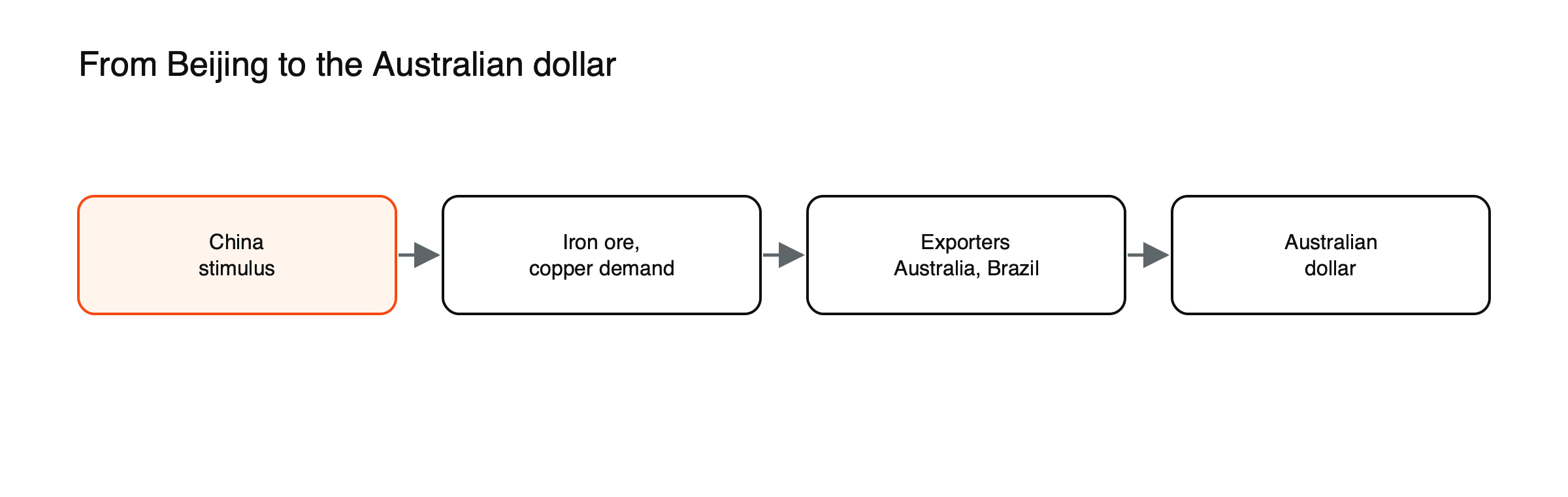
Figure: How China’s policy reaches commodities and the AUD.
September 2024 example
After the People’s Bank of China cut rates and signaled further support in late September 2024, iron ore jumped back above $100 a tonne after falling more than a third that year. Copper’s response was more muted, reflecting doubts about demand outside China.
A stimulus day, illustrated
Suppose Beijing announces a larger-than-expected package of interest rate cuts and support for property developers. (Illustrative scenario.) Iron ore futures might jump 8% to 10% within days, copper 3% to 4%, and the Australian dollar 1% to 2% against the US dollar. Shares of large mining companies in Australia and London rise, and Chinese share indices rally. If later details show that the support is smaller or slower than hoped, much of the move can reverse within weeks, as has happened repeatedly.
Why the Australian dollar is sensitive
China is Australia’s largest trading partner, and iron ore exports were worth about $118 billion a year in 2021. Higher iron ore prices improve Australia’s trade balance and support demand for the currency. The Reserve Bank of Australia’s rate decisions also matter, so the two forces can pull in different directions.
The property slump
China’s property sector was for years the single biggest source of demand for steel, and therefore for iron ore. From 2021, heavily indebted developers ran into trouble, new construction fell and home prices weakened. The slump capped iron ore demand and made Chinese stimulus less effective, because much of it aimed to stabilize the property market rather than spark a new building boom. Iron ore prices became more sensitive to property data than to headline growth figures.
Copper’s different story
Copper depends less on Chinese property than iron ore does, and more on power grids, electric vehicles, renewable energy and data centers worldwide. With mine supply struggling to keep up, copper reached a record of about $14,624.50 a tonne on the London Metal Exchange in 2026, even as Chinese property stayed weak. That divergence shows that China remains important for metals, but global electrification has become another major driver. See what moves copper prices.
Limits
Stimulus aimed at stabilizing growth rather than boosting it has often disappointed markets, and China’s property slump has capped steel demand. See what the copper-gold ratio says about growth expectations , how a strong dollar hits commodities, emerging markets and crypto and how recession signals have performed.
Other channels
China’s policy affects more than metals. Its oil imports influence crude prices, its soybean and grain purchases matter for agricultural markets, and changes in its currency management can move emerging market currencies. China also dominates processing of many critical minerals, so its export policies can affect prices for materials used in batteries and electronics.
What to watch
- People’s Bank of China rate decisions and liquidity measures
- Announcements from major policy meetings on growth and property
- Monthly data on property sales, construction and industrial output
- Iron ore port inventories and steel production
- Chinese credit growth
Trading the China link
Traders often use the Australian dollar, iron ore and copper CFDs and shares of large miners to express views on Chinese policy. Because stimulus headlines can trigger sharp moves that fade when details disappoint, many wait for confirmation in data before holding positions for long. See what moves AUD/USD.
Steel and iron ore, illustrated
Making a tonne of steel in a blast furnace takes roughly one and a half tonnes of iron ore. (Approximate industry ratio.) Suppose Chinese steel output falls 5% as property construction slows. Because China buys about 70% of the world’s seaborne iron ore, that cut alone removes a large share of global seaborne demand, enough to push prices down sharply unless supply also falls. That arithmetic explains why iron ore prices are so sensitive to Chinese construction data.
The 2015 yuan move
In August 2015, China surprised markets by devaluing the yuan and changing how its exchange rate was set. Commodity prices and emerging market currencies fell as investors worried about Chinese growth, and global shares sold off in the following weeks. The episode showed that Chinese currency policy, not just stimulus, can move commodities and global risk appetite.
Other commodity currencies
Australia is not alone. The Brazilian real moves with iron ore and soybeans, the Chilean peso with copper and the New Zealand dollar with dairy and broader Chinese demand. Traders often look at several of these currencies together to judge how markets read Chinese growth.
The growth target
China sets an annual growth target, and markets watch closely whether policy support is enough to meet it. When growth falls short, investors expect more stimulus, which can lift commodities in anticipation.
Common misreadings
- Treating every stimulus headline as a lasting boost.
- Assuming copper and iron ore always move together.
China and oil
China is the world’s largest crude oil importer, so its demand outlook affects oil prices. Stimulus aimed at manufacturing and transport can lift oil expectations, while the growth of electric vehicles in China has started to slow its fuel demand. Oil traders watch Chinese import data, refinery activity and stockpiling, which can swing sharply when prices are low.
Critical minerals
China processes most of the world’s rare earths and a large share of other minerals used in batteries and electronics. Export restrictions or licensing changes can move prices of these materials and shares of companies that depend on them. Unlike stimulus, these measures can lift prices outside China by limiting supply.
Headlines and follow-through
Markets often react strongly to the first announcement of Chinese support and then wait for details. If the follow-up measures are smaller or slower than hoped, prices can give back gains. Traders therefore distinguish between announcements of intent and concrete spending or lending figures.
China and global shares
Chinese stimulus affects more than commodities. Luxury goods makers, carmakers, machinery producers and chemical companies with large Chinese sales often rally on stimulus news, as do shares in commodity-exporting countries. When Chinese growth disappoints, those companies tend to fall together, giving traders another way to express views on China.
How long stimulus rallies last
Rallies triggered by Chinese stimulus have often been short unless followed by real improvements in credit, property sales and industrial output. Traders who chase the first jump can be caught if those improvements fail to appear. Waiting for one or two months of confirming data has historically reduced the risk of buying a fading rally.
A note on data
Chinese economic data are released on a fixed schedule, but markets often react as much to policy statements as to the numbers themselves.
The yuan and commodities
A weaker yuan makes imported commodities more expensive for Chinese buyers, which can reduce demand, while a stronger yuan has the opposite effect. Chinese authorities manage the currency within limits, and signs that they are allowing it to weaken have sometimes weighed on commodity prices and emerging market currencies, as in 2015. Watching the yuan alongside stimulus news gives a fuller picture of how Chinese demand may evolve.
Seasonal patterns
Chinese construction slows during the winter and around the Lunar New Year holiday, then picks up in spring. Iron ore and steel prices often reflect these seasonal swings, so traders compare data with the same period in previous years rather than with the previous month. Spring often brings a pickup in steel output, which can lift iron ore prices even without any new stimulus, a seasonal pattern worth separating from genuine policy-driven moves.
Frequently asked questions
Why does iron ore react more than copper to Chinese stimulus?
Because China dominates seaborne iron ore demand, mainly for steel used in construction, while copper demand is more global and tied to electrification.
Does Chinese stimulus always lift commodities?
No. Support aimed at stabilizing rather than boosting growth has often disappointed markets after initial rallies.
This article is educational content and does not constitute financial, investment, legal or tax advice. Digital assets are volatile and you may lose the amount you invest.
Sources
- Exuberant iron ore, subdued copper show different sides of China stimulus (China buys about 70% of seaborne iron ore; just over half of copper demand) — Reuters column via Mining.com, 2024
- China stimulus a ‘very good development for Australia’ (iron ore back above $100 after falling more than a third) — AAP, September 2024
- Australian Dollar FAQs (iron ore largest export, $118 billion a year in 2021; China largest trading partner; RBA rates) — FXStreet
- [Copper hits record amid weak output (LME record $14,624.50 a tonne; grids, electrification and data centers) — Saxo, September 2026](https://www.home.saxo/de-ch/content/articles/commodities/copper-hits-record-amid-weak-output-and-metal-pil