
How to Open an OTCN Account
Register, verify your identity and address, answer the knowledge questions, fund the account and log in: how to open an OTCN account and what to prepare.
To open an OTCN account, register with your email and personal details, verify your identity and address with the documents requested, answer questions about your trading knowledge and experience, then fund the account and log in to the trading platform. Identity checks are required by anti-money laundering rules, and leveraged products may only be offered after an appropriateness assessment.
[PRODUCT FACTS SHEET — Open decision 3: every OTCN-specific step, screen name, fee, limit and time in this article is a placeholder marked PFS and must be confirmed before publishing.]
Before you start
Have a valid passport or national ID card and a recent proof of address, such as a utility bill or bank statement. [PFS: accepted documents, maximum document age, eligible countries.]
Why brokers ask for so much information
Regulated brokers must know who their clients are, a requirement known as know your customer, or KYC. Anti-money-laundering rules require firms to verify identity and address, screen clients against sanctions and politically exposed person lists and, in some cases, ask where funds come from. These checks protect the financial system and clients themselves, because they make it harder for criminals to open accounts in other people’s names. The specific documents and checks depend on the regulator and the client’s country. [PFS: OTCN’s regulator and KYC requirements by country.]
From registration to first login
Register
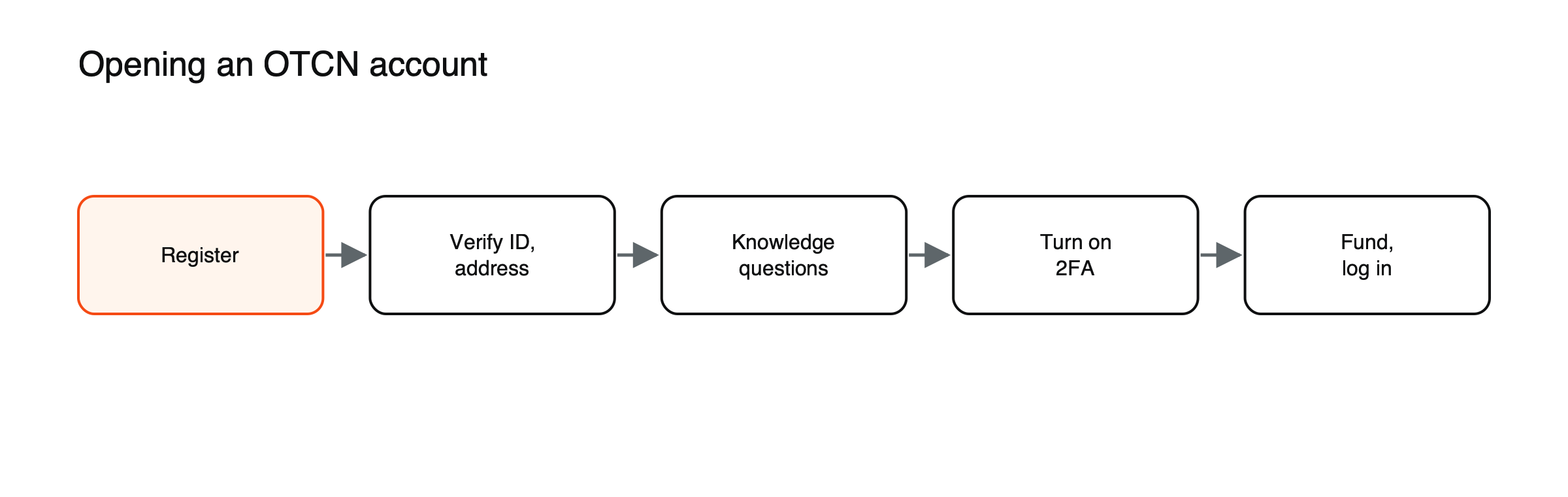
Figure: Opening an account (steps to be confirmed against the Product Facts Sheet).
Create your login on otcn.com. [PFS: registration fields and account types.]
Verify your identity and address
Upload your documents; checks may be automatic or manual. [PFS: typical review time.]
Answer the appropriateness questions
These assess whether leveraged products such as CFDs are suitable for your knowledge and experience. See what a CFD is.
Set up security
Turn on two-factor authentication. See how to set up two-factor authentication on OTCN.
Fund and log in
See how to deposit funds into your OTCN account. [PFS: platform name and download links.]
The appropriateness test, explained
Before offering leveraged products such as CFDs, regulated firms in many jurisdictions must assess whether a client has enough knowledge and experience to understand the risks. The questions usually cover past trading, education or work in finance and understanding of leverage, margin and losses. If the answers suggest the product may not be appropriate, the firm must warn the client, and some firms may decline to offer the product. Answering honestly matters: the test exists to protect you, not to be passed. See what a CFD is.
Typical reasons for delays
Most delays come from documents that cannot be read, have expired or do not match the application, from addresses that differ between documents, or from additional checks when a name matches a sanctions or watch list. Uploading clear, complete, current documents usually speeds things up. [PFS: typical review times and how clients are notified.]
Retail or professional?
New clients are normally classified as retail clients, which gives them the highest level of protection, including leverage limits and negative balance protection where these apply. Some clients who meet strict criteria on trading activity, portfolio size and professional experience can apply to be treated as professional, which removes some protections. Most individual traders remain retail clients. [PFS: client categories OTCN offers.] See leverage limits in the EU, UK and Australia compared.
Common mistakes
Blurry or cropped document photos, an address that does not match your application, and depositing from an account in someone else’s name. See how to place your first trade on OTCN.
Your data and its protection
Identity documents and personal details are sensitive. Regulated firms must store them securely, use them only for permitted purposes and keep them for periods set by law. Before uploading documents, check that you are on the genuine website, look for a secure connection and never send documents through unofficial channels such as social media messages. [PFS: OTCN privacy policy and data retention summary.]
An account-opening checklist
- A valid passport or national ID card, not expired
- A recent proof of address in your own name
- A funding method in your own name
- An authenticator app ready for two-factor authentication
- Time to read the client agreement, risk disclosures and costs
Reading the documents
Before funding, read the client agreement, the risk disclosures, the costs and charges information and the order execution policy. These explain how the provider operates, what you pay, how orders are handled and what happens in situations such as margin calls or disputes. Many complaints arise from terms clients did not read. [PFS: names and locations of OTCN’s client documents.]
Sanctions and screening
As part of onboarding, firms check names against sanctions lists and lists of politically exposed persons, people with prominent public roles and their close associates. A match does not mean an application will be refused, but it can trigger extra checks and requests for information. False matches, where a client shares a name with someone listed, are usually resolved with additional documents.
Funding in your own name
Deposits must normally come from accounts or cards in the client’s own name. Third-party payments are usually rejected, because they can be used to hide the source of funds. Withdrawals typically return to the original funding method where possible. See how to deposit funds into your OTCN account.
Common misreadings
- Believing verification is a formality that can be skipped.
- Assuming the appropriateness test is something to pass rather than answer honestly.
After approval
Once the account is approved, the next steps are usually setting up security, funding the account and downloading or logging in to the trading platform. Take time to explore the platform before placing real trades: find the contract specifications, practice placing and cancelling orders on a demo if available and set up price alerts. [PFS: OTCN onboarding emails and first-login steps.] See how to place your first trade on OTCN.
Keeping details up to date
Regulated firms must keep client information current, so they may ask clients to update documents periodically or when details change, such as a new address or name. Keeping details current avoids delays to withdrawals, which may be held until checks are complete. [PFS: how OTCN clients update personal details.]
Closing an account
Clients can usually close an account by withdrawing remaining funds and requesting closure through support. Firms must still keep certain records for periods set by law after the account is closed. [PFS: OTCN account closure process.]
Demo accounts
Many providers offer demo accounts with virtual money, allowing new clients to explore the platform before funding. A demo is useful for learning order types, reading specifications and practicing position sizing, though it cannot reproduce the emotions of real trading. [PFS: OTCN demo availability and duration.]
Joint and business accounts
Some providers offer joint accounts or accounts for companies, which require additional documents, such as company registration papers and details of directors and owners. [PFS: account types OTCN offers.]
Beware of impersonation
Scammers sometimes pose as brokers or their staff, offering to help open accounts, asking for documents or passwords, or promising guaranteed returns. Genuine firms do not ask for passwords or two-factor codes, and they communicate through official channels. Check website addresses carefully and contact the firm directly if a message seems suspicious. See what a SIM-swap attack is.
How long it takes
Account opening can take minutes when automated checks succeed, or several days when documents need manual review. Times vary with the volume of applications, the client’s country and the quality of documents submitted. Starting the process before you plan to trade avoids pressure to rush. [PFS: OTCN typical approval times.]
Accessibility and support
If you have difficulty uploading documents or completing the questionnaire, support teams can usually help through official channels. Firms are expected to treat clients fairly, including those who need additional support. [PFS: OTCN support channels and languages.] See how to contact OTCN support.
Why the process protects you
The checks can feel slow, but each one has a purpose: verification protects against identity theft, appropriateness questions highlight risks before money is at stake and source-of-funds checks deter criminals from using platforms that ordinary clients rely on. Clients who understand the reasons behind each step usually find the process smoother, because they can prepare the right documents and answer questions accurately the first time, avoiding costly delays and repeated requests later.
Frequently asked questions
Can I open an account for someone else?
No. Accounts must be opened and funded by the account holder, in their own name.
Why was I asked about my income or source of funds?
Anti-money-laundering rules require firms to understand where clients’ money comes from, especially for larger deposits.
[RISK WARNING — Open decision 2: approved CFD and leverage risk warning to be inserted here before publishing.]
This article is educational content and does not constitute financial, investment, legal or tax advice. Digital assets are volatile and you may lose the amount you invest.