
How to Place Your First Trade on OTCN
Choose a market, check its specification and costs, size from risk, set a stop-loss, place the order and monitor it: a careful first-trade checklist for OTCN.
To place your first trade on OTCN, practice on a demo if available, pick a market and read its specification, size the position from what you are willing to lose, set a stop-loss, place the order and monitor margin and costs while it is open. Leveraged products can lose money quickly, so start small.
[PRODUCT FACTS SHEET — Open decision 3: every OTCN-specific step, screen name, fee, limit and time in this article is a placeholder marked PFS and must be confirmed before publishing.]
Before you start
Fund the account, turn on two-factor authentication and, if offered, try the demo. [PFS: demo availability and platform name.]
Reading a contract specification
Every market has a specification that shows how it trades: the contract size, the minimum and maximum trade size, the value of one point or pip, the margin requirement, trading hours, overnight financing rates and any commission. Reading it before trading prevents surprises, such as a position being ten times larger than expected because the contract size was misunderstood. [PFS: where specifications appear on the OTCN platform.]
From idea to order
Choose a market
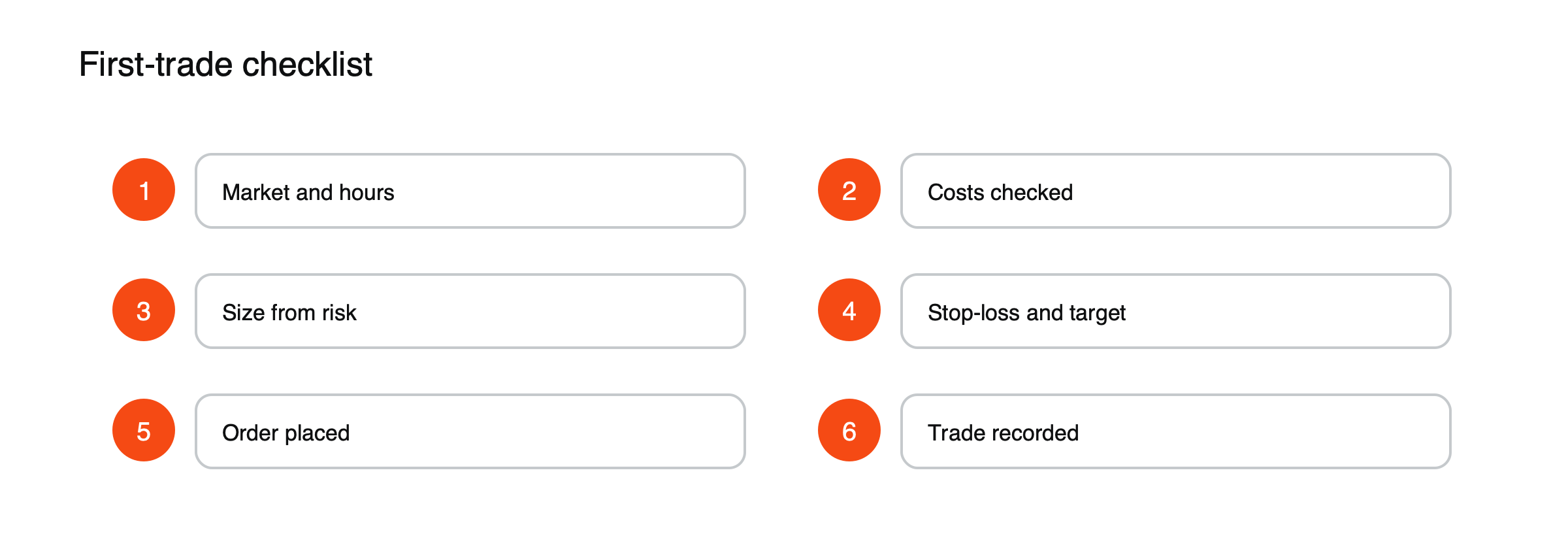
Figure: A first-trade checklist.
Check its trading hours and specification. See how to check trading hours on OTCN.
Check costs
Spread, commission and overnight financing. See OTCN fees explained.
Size from risk
See how to size a CFD position using risk per trade.
Set a stop-loss and target
See how stop-loss orders work.
Place the order
Market or pending order. [PFS: order ticket fields on the OTCN platform.]
A first trade, illustrated
Suppose a trader with a $2,000 account decides to risk no more than 1%, $20, on a first trade in a major currency pair, with a stop 25 pips from entry. (Illustrative scenario.) At about $1 per pip for a 0.1 lot position, a 25-pip stop would risk $25, too much, so the trader chooses about 0.08 lots, risking roughly $20. The margin required depends on the leverage available; at 30:1, a position worth about $8,000 needs about $267. The trader sets the stop and a target before placing the order, then records the reasoning in a journal. [PFS: lot sizes and minimum trade size on OTCN.]
Market or pending order?
A market order fills immediately at the best available price, which may differ slightly from the price seen on screen, especially in fast markets. A pending order, such as a limit or stop entry order, waits until the market reaches a chosen price. Beginners often find limit orders useful for controlling the entry price, accepting that the order may not fill. See CFD order types.
Before you click
Know your margin requirement and what happens at a margin call. See how OTCN calculates margin and overnight financing.
After the trade
Record it in a journal and review the result. See how to keep a trading journal.
Common mistakes
Oversizing, trading without a stop and holding through events you did not plan for. See what a CFD is.
Watching the open position
Once a trade is open, its profit or loss changes with each price move, and the account’s free margin and margin level change with it. Keep an eye on the margin level, especially if several positions are open, and know at what level positions may be closed automatically. [PFS: OTCN margin call and close-out levels.] Avoid widening a stop to avoid a loss, which turns a planned risk into an unplanned one.
Costs while the trade is open
Holding a CFD position overnight usually incurs a financing charge or, occasionally, a credit, depending on the market and direction. Over days or weeks, these charges can add up. Check them before planning to hold a position for longer than a day. See OTCN fees explained.
Practice first
A demo account lets new traders learn the platform, test order types and practice sizing without risking money. Demo results can be misleading, because real money changes behavior, but they are useful for learning mechanics. Moving to small real positions afterward helps bridge the gap.
Choosing a first market
Many beginners start with a liquid, widely followed market, such as a major currency pair or major share index, because spreads are usually tight and information is plentiful. Volatile markets such as crypto or small-cap shares can move far in minutes, which makes them harder to learn on. Choosing a market whose drivers you understand, and trading it during its most active hours, makes the first trades easier to manage. See how to check trading hours on OTCN.
Placing a stop, illustrated
Suppose a trader buys an index CFD at 5,000 because the price bounced from a support area near 4,960. (Illustrative scenario.) Placing the stop just below support, at about 4,950, means the trade is closed if the reason for entering is proved wrong, with 50 points of risk. Placing it at 4,990 would be tighter but likely hit by normal noise; placing it at 4,850 would risk far more than planned. The stop should reflect where the idea fails, and the position size should then be set so that a stop-out costs no more than the planned amount.
Trading around news
Major economic releases and central bank decisions can cause spreads to widen and prices to jump. Beginners often avoid opening new positions just before such events. See how to read an economic calendar.
Common misreadings
- Believing a demo result predicts live results.
- Treating a stop-loss as a guarantee of the exit price.
The trading journal
Recording each trade, with the reason for entering, the planned stop and target, the position size and the result, turns trading into a learning process. Over time, a journal shows which setups work, which mistakes repeat and whether rules are being followed. Many traders also note their emotions, which often explain decisions that the reasons alone do not. See how to keep a trading journal.
The first trade and emotions
The first real-money trade often feels different from a demo. Small price moves can seem large, and the temptation to close a winning trade too early or hold a losing one too long is strong. Keeping the first positions small, deciding the exit plan in advance and sticking to it helps separate the trade from the emotions. It also helps to treat the first few trades as practice rather than as a test of ability.
A pre-trade checklist
- Do I know the market’s specification and trading hours?
- Is my position sized so a stop-out costs no more than planned?
- Where is my stop, and why there?
- Is major news due soon?
- Have I checked overnight costs if I plan to hold?
Partial closes and trailing stops
Some traders close part of a position at a first target and let the rest run, moving the stop to the entry price to protect against a loss. Others use trailing stops, which follow the price at a set distance as it moves favorably. Both techniques can lock in gains, but they also need practice, because stops placed too close can close trades on normal fluctuations. [PFS: whether OTCN offers trailing stops and partial closes.]
Knowing when to stop
A daily or weekly loss limit helps prevent a bad day from becoming a bad month. If the limit is reached, stopping and reviewing the trades is usually wiser than trying to win the money back immediately.
Learning from losing trades
Every trader has losing trades, and the first few are rarely profitable. What matters is whether a loss stayed within plan. A small, planned loss after following the rules is a good trade, even if it lost money; a large, unplanned loss from ignoring a stop is a bad trade, even if the market later recovers. Reviewing losses in the journal with this distinction in mind builds better habits than focusing only on profit and loss.
Building up gradually
After a series of small, rule-following trades, traders can consider modestly increasing position sizes, still within the same risk per trade. Increasing size after a few wins, or to recover losses, is a common way beginners get into trouble. Gradual growth, backed by a record of disciplined trades in the journal, is far more sustainable than sudden jumps in position size.
Frequently asked questions
How much should I risk on my first trade?
Many experienced traders risk 1% or less of their account per trade, and smaller amounts while learning.
Should my first trade use maximum leverage?
No. Using far less leverage than the maximum gives more room for mistakes and reduces the risk of rapid losses.
[RISK WARNING — Open decision 2: approved CFD and leverage risk warning to be inserted here before publishing.]
This article is educational content and does not constitute financial, investment, legal or tax advice. Digital assets are volatile and you may lose the amount you invest.