
What Is a Crypto Airdrop?
A crypto airdrop sends free tokens to eligible wallets, often for past use of a protocol. How airdrops work, how to claim them safely and how to spot fakes.
A crypto airdrop is a distribution of tokens to wallets that meet certain conditions, usually for free. Projects use airdrops to reward early users, spread ownership of a new token or attract attention. Eligibility is set by a snapshot of the blockchain at a chosen moment. Real airdrops never ask for your seed phrase or a payment to claim.
How an airdrop works
- The project sets the rules. It decides who qualifies, for example wallets that used its app before a certain date or held a certain token.
- A snapshot is taken. At a specific block, the project records which addresses meet the rules and how many tokens each one gets.
- Tokens are sent or made claimable. Some airdrops land in wallets automatically. Others require each eligible address to claim through the project’s smart contract, which costs a network fee.
- The token starts trading. Once it is listed, recipients can hold it, use it in governance votes or sell it.
Because the snapshot looks backward, the most valuable airdrops have often gone to people who used a product for its own sake, long before anyone knew a token was coming.
The airdrop that set the template
On September 17, 2020, the decentralized exchange Uniswap released its UNI governance token with no advance notice. Every address that had used the Uniswap v1 or v2 contracts before a snapshot on September 1, 2020, could claim at least 400 UNI, and more than 250,000 addresses qualified.
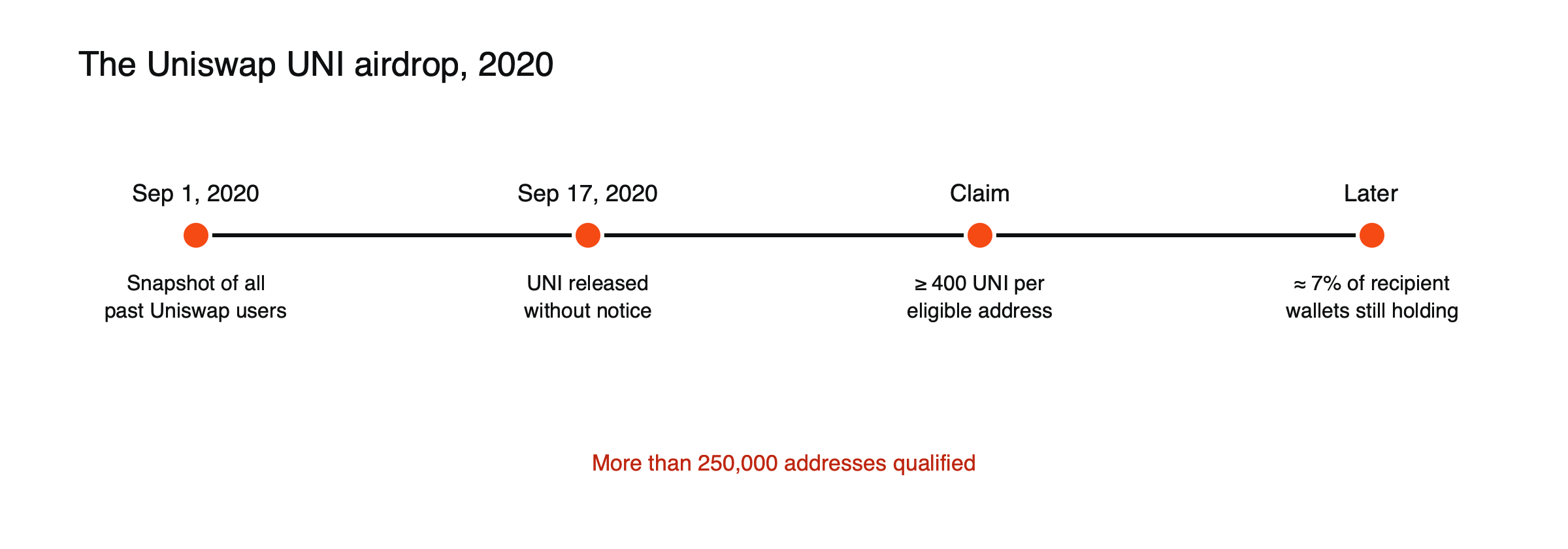
Figure: The UNI airdrop in four steps. Holding figure from Dune’s later analysis of recipient wallets.
Most recipients did not stay. A later analysis by Dune found that only about 7% of airdrop wallets were still holding UNI, and that the number of recipients trading weekly fell from over 62,000 in mid-September 2020 to around 10,000 a year later. The airdrop spread ownership widely, but it did not turn most recipients into long-term users, a pattern repeated in many airdrops since.
The main kinds of airdrop
- Retroactive: rewards people who used a protocol before its token existed, as Uniswap did.
- Holder-based: goes to wallets that held a particular token at the snapshot.
- Points and task programs: reward activity after an announcement, such as bridging funds, trading or providing liquidity, often tracked as “points” that convert to tokens later.
- Promotional: small amounts handed out to build awareness, sometimes to any wallet that signs up.
Farming, and why projects fight it
Once airdrops became valuable, a whole activity grew up around qualifying for them. “Airdrop farmers” spread funds across many wallets and repeat simple actions to look like many separate users. Projects respond by filtering out addresses that appear linked, a process often called sybil filtering, and by weighting rewards toward sustained or meaningful activity.
For an ordinary user, farming has real costs. Network fees, time spent and the risk of interacting with new, untested contracts all add up, and there is no guarantee that a token will be issued, that you will qualify or that the token will be worth much when it arrives.
What tends to happen to the price
Airdropped tokens often face heavy selling in their first days of trading. Many recipients have no attachment to the project and treat the tokens as free money to be cashed out, so supply hits the market at exactly the moment a new token is trying to find a price. Later token unlocks for the team and investors can add further supply. A token’s price on its first day of trading is therefore a poor guide to what it will be worth a few months later, in either direction. See how token unlocks affect price.
Claiming an airdrop safely
- Confirm it is real. Find the announcement on the project’s official website or verified social account, not through a link in a message or a token that appeared in your wallet.
- Check the contract address against the official source before interacting with it.
- Use a separate wallet for claims and new apps, holding only what you need to pay fees, rather than your main savings wallet.
- Read what you are signing. A claim should not need unlimited approval to move your other tokens.
- Review approvals afterwards and revoke any you do not need. See what a wallet drainer is.
Fake airdrops are a common scam
Scammers copy the language of real airdrops because people expect free tokens. Common patterns include unknown tokens appearing in your wallet with a website in the token’s name, claim pages that ask you to sign a transaction you do not understand, requests for your seed phrase or a fee to “unlock” tokens, and lookalike websites and social accounts that copy a real project’s branding. No legitimate airdrop needs your seed phrase. See crypto scam warning signs and how to spot fake crypto exchange websites.
Frequently asked questions
Are airdrops free money?
The tokens cost nothing to receive, but they are not free of cost or risk. Claiming may require network fees, qualifying may have taken time and fees spent using a protocol, and the token’s price often falls sharply once recipients start selling. Some “airdrops” are scams designed to get you to approve a malicious contract.
How do I know if I’m eligible for an airdrop?
Only the project’s official announcement can tell you. Legitimate projects publish eligibility rules and a claim page on their own website or verified accounts. Third-party “eligibility checkers” that ask you to connect a wallet or sign a message are a common route for theft.
Why did a token I never asked for appear in my wallet?
Unsolicited tokens are often bait. They may carry a website name or message inviting you to claim more or swap them, which leads to a malicious approval. Leaving an unknown token untouched is the safest response; it cannot move your other funds unless you interact with it. Hiding it in your wallet’s display settings is enough; there is no need to send it anywhere or try to destroy it, which can itself trigger a malicious contract.
Airdrops and tax
In many countries, tokens received in an airdrop count as income at their market value when you receive or claim them, and selling them later can create a separate gain or loss. Rules vary widely, so keeping a record of the date and value at receipt makes any later tax filing easier. See how to keep crypto transaction records.
For how tokens work in general, read what a crypto token is. For another way holders earn new tokens from a network, see what staking is in crypto, and if you are new, start with what cryptocurrency is.
This article is educational content and does not constitute financial, investment, legal or tax advice. Digital assets are volatile and you may lose the amount you invest.