
How Does a Crypto ATM Work?
A crypto ATM swaps cash for crypto sent to your wallet. Learn how the machines work, why they cost more than exchanges and why scammers send victims to them.
A crypto ATM is a kiosk that lets you buy cryptocurrency with cash or a card and sends it to a wallet address you provide; some machines also buy crypto for cash. It is fast and needs no bank account, but fees are usually far higher than on an exchange, and scammers favor these machines.
What the machine actually does
Despite the name, a crypto ATM is not connected to your bank the way a cash machine is. It is closer to a vending machine for crypto. The operator keeps a supply of coins, or buys them from an exchange when you pay, and sends the amount you purchase to the wallet address you show it. The machine does not store your coins and cannot get them back once they are sent.
Most machines are one-way: they only sell crypto. Two-way machines also buy it, paying out cash once your transfer to them is confirmed.
Buying, step by step
- Choose the coin and amount. Most machines offer bitcoin and a handful of other coins.
- Verify your identity. Depending on the amount and local rules, the machine may ask for a phone number, an ID scan or a selfie. Limits rise as verification increases.
- Show a wallet address. Scan the QR code from your own wallet app. This is the single most important step: the coins go to whoever controls that address.
- Pay with cash or card. The machine shows the exchange rate and fees before you confirm.
- Wait for confirmation. The coins arrive once the blockchain transaction confirms, usually within minutes to an hour for bitcoin.
What it really costs: a worked example
Operators pay for hardware, location rent, cash collection and compliance, and recover those costs through a markup on the exchange rate plus fixed fees. (Example values; check the machine’s own figures.)
- You insert $500.
- The machine charges a $3 fixed fee, leaving $497.
- Its bitcoin price is 12% above the market price.
- You receive bitcoin worth about $443.75 at market prices.
In this example, about $56, or 11% of the cash, goes to costs. The same purchase on a regulated exchange would typically cost a small fraction of that. Comparing the machine’s quoted price with the live market price on your phone before confirming shows the real cost.
Crypto ATMs and scams
Scammers frequently instruct victims to withdraw cash and feed it into a crypto ATM, sending the coins to an address the scammer controls. Once the transaction confirms, it cannot be reversed.
The FBI’s figures show how fast this has grown. Its Internet Crime Complaint Center recorded about $247 million in losses from crypto ATM scams in 2024. In 2025 it received more than 13,400 complaints involving crypto kiosks, with losses over $388 million, a 58% increase on the previous year. More than 30,000 crypto kiosks were operating in the United States as of 2024. New Zealand has banned crypto ATMs, and Australia has introduced legislation with spending limits.
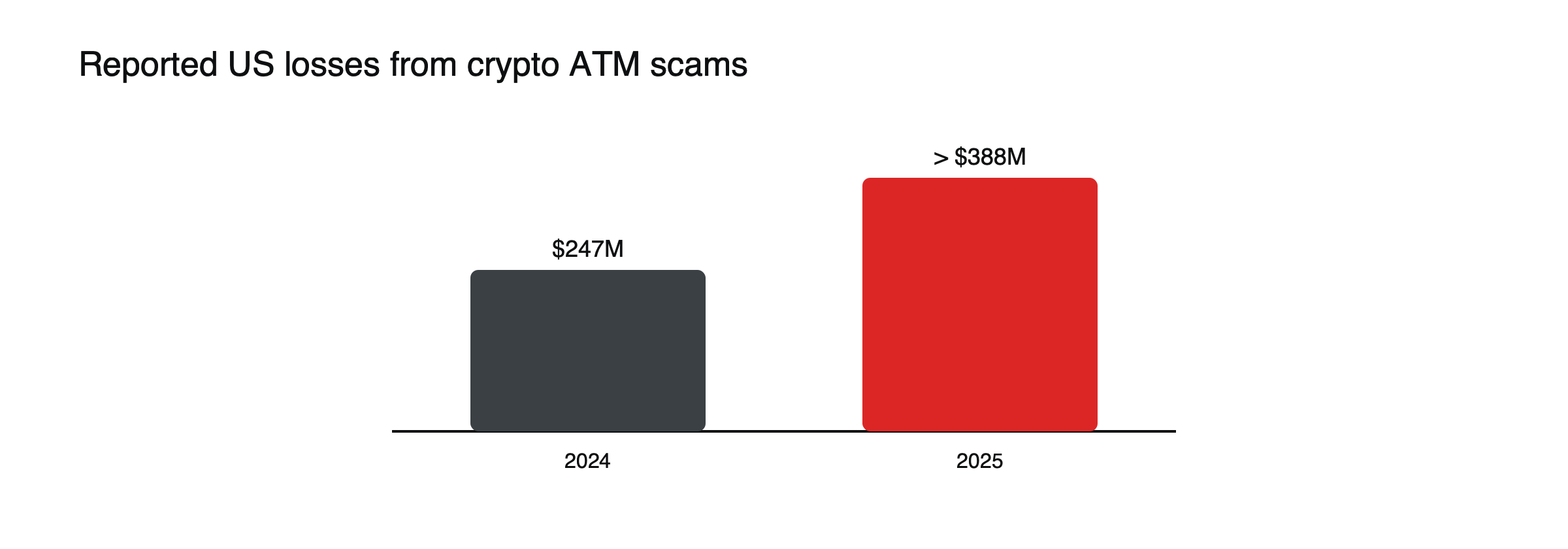
Figure: Reported crypto kiosk scam losses in the US. 2024: FBI IC3 via The Block; 2025: FBI IC3 supplement via The Record. Actual losses are likely higher because many victims do not report.
How the scam usually unfolds
The scripts differ, but the shape is consistent. A caller claims to be from a government agency, a bank’s fraud team, a utility or tech support, or a romance contact builds trust over weeks. The victim is told their money is in danger or that a payment is urgent. They are directed to withdraw cash, often while the caller stays on the phone, and given a QR code to scan at a kiosk. The code belongs to the scammer. Because the money moves as crypto, there is no bank to call afterward.
The rule that prevents most losses: no real government agency, bank, utility or technology company will ever ask you to pay with a crypto ATM. If someone is guiding you to a kiosk, it is a scam.
If you have already paid
Act quickly, even though recovery is difficult. Keep the receipt, which shows the transaction details, and contact the kiosk operator, whose support number is usually on the machine, to report the fraud. Report the crime to local police and, in the United States, to the FBI’s Internet Crime Complaint Center at ic3.gov. Be wary of anyone who then offers to recover the money for a fee; “recovery” offers are a common second scam.
Who regulates crypto kiosks
Rules depend on the country. In the United States, kiosk operators are generally treated as money transmitters, which brings registration with federal authorities, state licensing in many states and identity checks above set amounts. Several US states have added daily transaction limits and fee caps for kiosks in response to scam losses. Elsewhere, New Zealand has banned crypto ATMs outright and Australia has introduced legislation with spending limits. Where a machine operates legally, the operator’s name, license details and support contact should be displayed on the machine or its receipt.
Checking a machine before you use it
- Look for the operator’s name and support number on the machine, and check them against the operator’s own website.
- Read the fee disclosure screen before inserting cash; reputable machines show the rate and fees in full.
- Check the receipt options. You should get a printed or emailed receipt with a transaction ID.
- Be cautious of machines in isolated locations or with damaged or covered screens and card readers.
Selling crypto at a two-way machine
At a machine that buys crypto, you choose the amount of cash you want, the machine shows an address and an amount to send, and you send the coins from your own wallet. Once the transaction has enough confirmations, which can take from minutes to an hour for bitcoin, the machine pays out cash, sometimes against a redemption code printed on a receipt. The same markup logic applies in reverse: the machine’s buying price is usually well below the market.
When a crypto ATM makes sense
For someone without a bank account, or who needs to turn cash into crypto quickly, a kiosk can be the most practical option despite the cost. For anyone who can use an exchange, the exchange will almost always be cheaper and offer more coins. In both cases, using your own wallet and checking the address you scan matters more than which machine you choose.
Before you use one
- Compare the total cost with the live market price on the confirmation screen.
- Use a wallet you control and recognize; never scan a QR code someone sent you.
- Keep the receipt; it records the amount, rate and transaction details.
- Expect limits and ID requirements to rise with the amount.
For safer ways to buy, read how to buy bitcoin safely. For the warning signs scammers leave, see crypto scam warning signs, and for your own setup, what a crypto wallet is. New to crypto? Start with what cryptocurrency is.
This article is educational content and does not constitute financial, investment, legal or tax advice. Digital assets are volatile and you may lose the amount you invest.
Sources
- FBI says Americans over 60 lost nearly $3 billion to crypto scams in 2024 (about $247 million in crypto ATM scam losses) — The Block, April 2025
- Texas, Florida top list of crypto ATM scam losses (2025: 13,400+ complaints, $388 million losses; New Zealand ban; Australia legislation) — The Record
- FBI: Over $333 Million Reported Stolen by Scammers Through Crypto Kiosks (30,000+ US kiosks as of 2024) — AARP