
How to Calculate the Annualized Basis on Crypto Futures
The basis is the gap between a futures price and spot. The annualized basis formula, three worked examples, contango and backwardation and how traders use it.
The basis is the difference between a dated futures price and the spot price. To compare contracts with different expiries, traders annualize it: annualized basis = (futures price ÷ spot price − 1) × (365 ÷ days to expiry). A bitcoin future at $66,500 against spot at $65,000 with 60 days left has an annualized basis of about 14%.
Why futures trade away from spot
Dated futures, such as those on CME or Deribit, settle on a set date, when their price must meet spot. Before then they usually trade above spot (contango), because buyers pay for leveraged exposure without tying up cash. Sometimes they trade below spot (backwardation), usually in fearful markets.
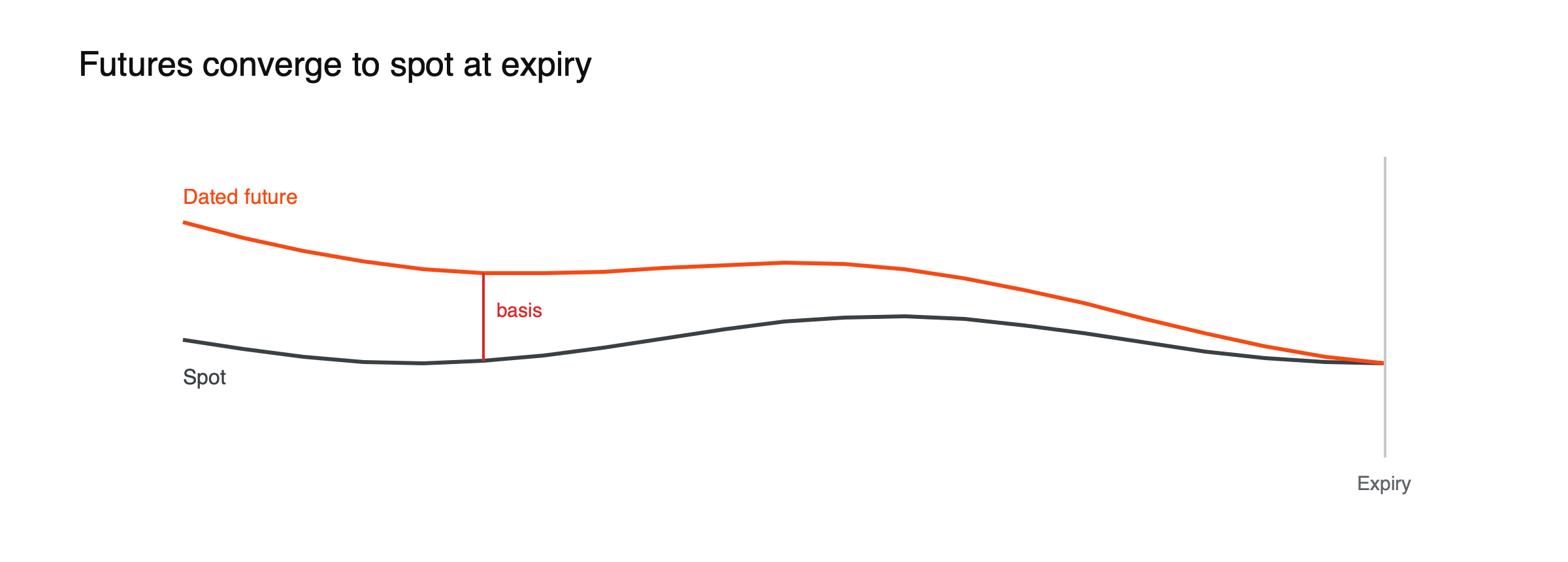
Figure: A dated future converges to spot at expiry; the gap along the way is the basis.
Worked example 1
Spot $65,000, futures $66,500, 60 days to expiry.
(66,500 ÷ 65,000 − 1) × (365 ÷ 60) = 2.31% × 6.083 ≈ 14.0% a year.
Worked example 2
A future trades 3% above spot with 90 days to expiry.
3% × (365 ÷ 90) ≈ 12.2% a year.
Worked example 3: backwardation
Spot $100,000, futures $99,000, 30 days to expiry.
(99,000 ÷ 100,000 − 1) × (365 ÷ 30) = −1% × 12.17 ≈ −12.2% a year.
In late 2025, CME bitcoin futures briefly showed an annualized basis of about −2.35%, their deepest backwardation since FTX’s collapse.
How traders use the basis
Cash and carry: buy spot and sell the future when the basis is high. At expiry the two prices meet, locking in the gap minus costs, whatever happens to the price. Institutions scaled this trade after US spot bitcoin ETFs launched in 2024.
Sentiment reading: a rising basis signals demand for leveraged long exposure; a negative basis signals fear.
Perpetual futures have no expiry, so their equivalent is the funding rate. See how funding rates are calculated.
Cash and carry, worked through
Take worked example 1: spot at $65,000 and a 60-day future at $66,500. A trader buys 1 BTC on the spot market and sells one futures contract for 1 BTC. At expiry, the two prices meet, so the trader locks in the $1,500 gap however bitcoin moves. If trading fees are about 0.1% on each leg, roughly $130, the profit is about $1,370, or around 12.8% a year on the $65,000 tied up. (Illustrative fees.) Financing costs, margin requirements on the short future and the gap between the settlement price and the spot price at which the coins are sold reduce that further.
Basis compared with funding
Dated futures express the market’s premium through the basis; perpetual futures express it through funding. They can be compared once both are annualized. Funding at the baseline 0.01% every 8 hours works out to about 10.95% a year. If a dated future offers an annualized basis well above that, traders may prefer it for carry trades, since the return is locked in at entry rather than changing every 8 hours.
The term structure
Futures with different expiry dates form a curve. In normal conditions, longer-dated contracts trade at higher prices than shorter ones, though usually at similar or slightly lower annualized rates. A steep curve signals strong demand for leveraged long exposure; a flat or inverted one signals caution. Watching how the curve shifts gives a richer picture than any single contract.
Exchange differences
CME bitcoin futures, used mainly by institutions, often trade at a different basis from contracts on crypto-native exchanges, reflecting different participants, margin rules and the cost of capital for each group. Comparing them can show where demand for leverage is coming from.
The basis through market cycles
The basis has tended to widen in strong bull markets, when traders compete for leveraged long exposure and are willing to pay a large premium for futures, and to shrink or turn negative in fearful periods. After US spot bitcoin ETFs launched in 2024, institutions scaled up cash-and-carry trades, buying spot exposure and selling futures to capture the basis, which added a large, steady seller of futures. In late 2025, CME bitcoin futures briefly traded at an annualized basis of about −2.35%, their deepest backwardation since FTX’s collapse, a sign of how sharply sentiment had cooled.
Where to find the basis
Many data providers publish annualized basis for major futures contracts, by exchange and by expiry. You can also calculate it yourself from any exchange’s futures and spot prices with the formula above, as long as you use prices taken at the same moment and count the days to expiry correctly. Small differences in timing can change the result noticeably for contracts close to expiry.
Reading the basis with other signals
The basis says most when read with funding rates, open interest and spot flows. A high basis together with high funding and rising open interest describes a market crowded with leveraged longs. A collapsing basis with falling open interest suggests deleveraging. A negative basis while spot buying continues may point to hedging rather than outright pessimism. See what open interest is.
For individual traders, the basis is most useful as a reading of sentiment rather than as a trade to copy. Running a cash-and-carry position properly needs capital on two venues, careful margin management and attention to costs that large institutions handle at scale and at much lower cost.
What eats into the basis
- Trading and financing costs on both legs.
- Margin calls on the short futures leg if the price rises sharply.
- Differences between the futures settlement price and the spot price you trade.
For the bigger picture, read what perpetual futures are and what spot trading is.
This article is educational content and does not constitute financial, investment, legal or tax advice. Digital assets are volatile and you may lose the amount you invest.
Frequently asked questions
Is cash and carry risk-free?
No. It removes exposure to the price direction, but leaves exchange risk, margin calls on the short future, execution costs and the risk that one leg cannot be closed as planned.
Why does the basis shrink as expiry approaches?
Because the future must settle at the spot price on its expiry date. As fewer days remain, there is less time for the premium to exist, and the gap narrows toward zero.