
Common Crypto Trading Mistakes
What crypto trading mistakes cost in numbers: overtrading fees, leverage, chasing pumps, no exit plan, revenge trading, fake volume and no records.
The crypto trading mistakes that cost most are trading too often, using too much leverage, chasing pumps, trading without an exit plan, trusting inflated volume, revenge trading and keeping no records. Each has a price that can be estimated in advance, which is the best argument for avoiding it.
Every mistake has a price
Trading mistakes are easier to resist when you can see what they cost. The figures below are illustrative, but the arithmetic behind them applies to any account. Seen this way, most trading errors are not bad luck; they are predictable expenses.
What overtrading costs
Every round trip, a buy and a later sell, pays a fee on each side plus the spread. At 0.1% per side, a round trip costs about 0.2% of the amount traded. Twenty round trips a month with the same money cost about 4% of it in fees alone, before spreads or slippage. Over a year, that is a hurdle few strategies can clear. Research by Barber and Odean on retail stock traders found that the most active traders underperformed by about 6.5 percentage points a year, largely because of trading costs. In crypto, where fees and spreads on smaller tokens are often higher, the drag can be larger. See how to calculate profit after fees.
What too much leverage costs
At 10x leverage, a move of about 9.5% against a long position is enough to liquidate it, and crypto often moves that much in a day. The cost is not just the lost margin: liquidation usually happens at a poor price and carries a fee, and the position is gone before any recovery. At 50x, a move of about 1.5% is enough. Leverage turns ordinary volatility into a total loss on the position. See how to calculate a liquidation price.
What chasing a pump costs
Buying after a token has already risen 40% in a few days usually means buying from earlier buyers who are taking profits. A pullback of 25% from that point is common. Recovering from a 25% loss needs a gain of about 33%, just to break even. The cost of chasing is that you start the trade in the zone where the move is most likely to pause or reverse, and every pullback has to be climbed back before you make anything.
What trading without an exit plan costs
Without a planned exit, small losses tend to become large ones, because each fall feels like a better reason to wait. A 40% loss needs a gain of about 67% to recover. The asymmetry grows quickly: the deeper the loss, the steeper the climb back. A stop decided before entering, at the point where the trade idea is clearly wrong, caps that cost at a level you chose while calm.
What revenge trading costs
After a loss, the urge to win it back quickly often leads to bigger positions. Suppose you normally risk 2% of your account per trade, then double the risk after each loss: 2%, then 4%, then 8%. Three losses in a row cost about 14% of the account instead of about 6% at a steady 2%. (Illustrative figures.) Losing streaks happen to every strategy, so the cost of revenge trading is that it turns a normal streak into serious damage. A daily or weekly loss limit, after which you stop, prevents it.
What trusting fake volume costs
Some exchanges and tokens show inflated activity, which makes a market look deeper than it is. The cost appears when you trade: an order of $20,000 in a market that turns out to be thin might fill 3% worse than the screen suggested, about $600, and selling later can cost the same again. Checking order book depth near the current price, and where the volume comes from, shows the real cost before you pay it. See how to read trading volume.
What keeping no records costs
Memory favors wins and forgets small, repeated losses. Without records, it is easy to believe a strategy works when it does not. In a study of Brazilian day traders who kept trading for at least 300 days, 97% lost money, with no evidence that they improved with experience. Records are also the basis of tax calculations, and rebuilding a year of trades from exchange exports is slow and error-prone. The cost of skipping a journal is that the most expensive mistakes stay invisible. See how to keep a trading journal.
The price list in one table
| Mistake | Illustrative cost | Habit that prevents it |
|---|---|---|
| Overtrading | About 4% a month in fees at 20 round trips | Trade only when the plan says so |
| High leverage | Liquidation from a 9.5% move at 10x | Little or no leverage |
| Chasing a pump | A 25% pullback needs a 33% gain to recover | Decide entries in advance |
| No exit plan | A 40% loss needs a 67% gain to recover | Set the stop before entering |
| Revenge trading | About 14% lost in three trades instead of 6% | A daily loss limit |
| Fake volume | About $600 of slippage on a $20,000 order | Check depth before trading |
| No records | Mistakes stay hidden | Keep a journal and review it |
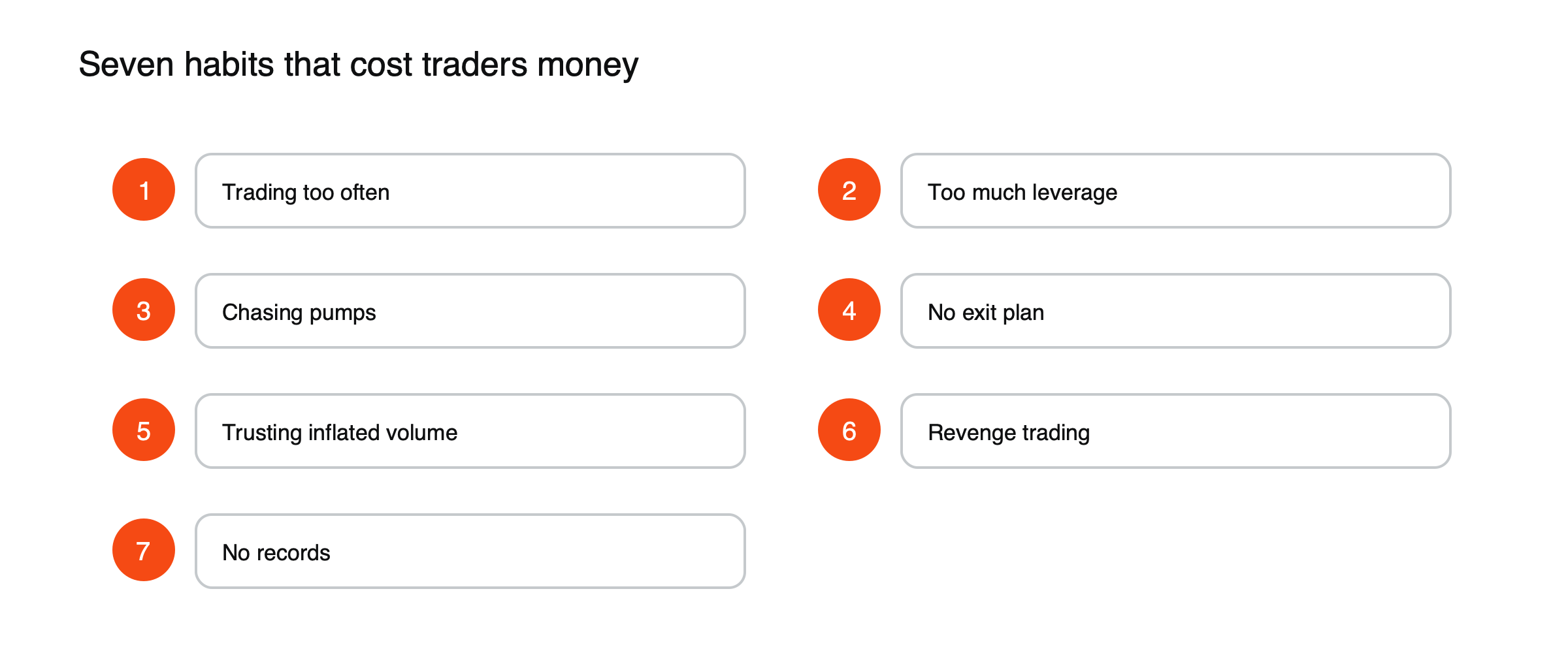
Figure: Seven habits behind most retail trading losses.
Paying less for the lessons
Every trader pays for some lessons. The aim is to pay small amounts, early, rather than large amounts later. Starting with small positions, keeping leverage low, writing down plans and reviewing results regularly turns expensive mistakes into cheap ones. Log the cost of each mistake you catch; the running total is a strong reason not to repeat it. The traders who last are rarely the ones who never make mistakes; they are the ones who make them at a size that leaves them able to keep learning.
For the basics of placing trades, read what spot trading is and what perpetual futures are.
This article is educational content and does not constitute financial, investment, legal or tax advice. Digital assets are volatile and you may lose the amount you invest.