
Crypto vs Fiat Money
Fiat money is issued and managed by governments; most crypto follows rules written into code. Compare supply, stability, protection and everyday use.
The biggest difference in crypto vs fiat is who controls the supply. Fiat money, such as the US dollar or the euro, is issued by central banks that can expand or shrink it to manage the economy. Most cryptocurrencies follow supply rules written into software that no single authority can change on its own.
What fiat money is
Fiat money is currency that has value because a government declares it legal tender and people accept it, not because it can be exchanged for gold or another commodity. Central banks set interest rates and manage how much money is created, and commercial banks hold most of it as deposits. Almost every salary, tax bill and price tag in the world is set in fiat.
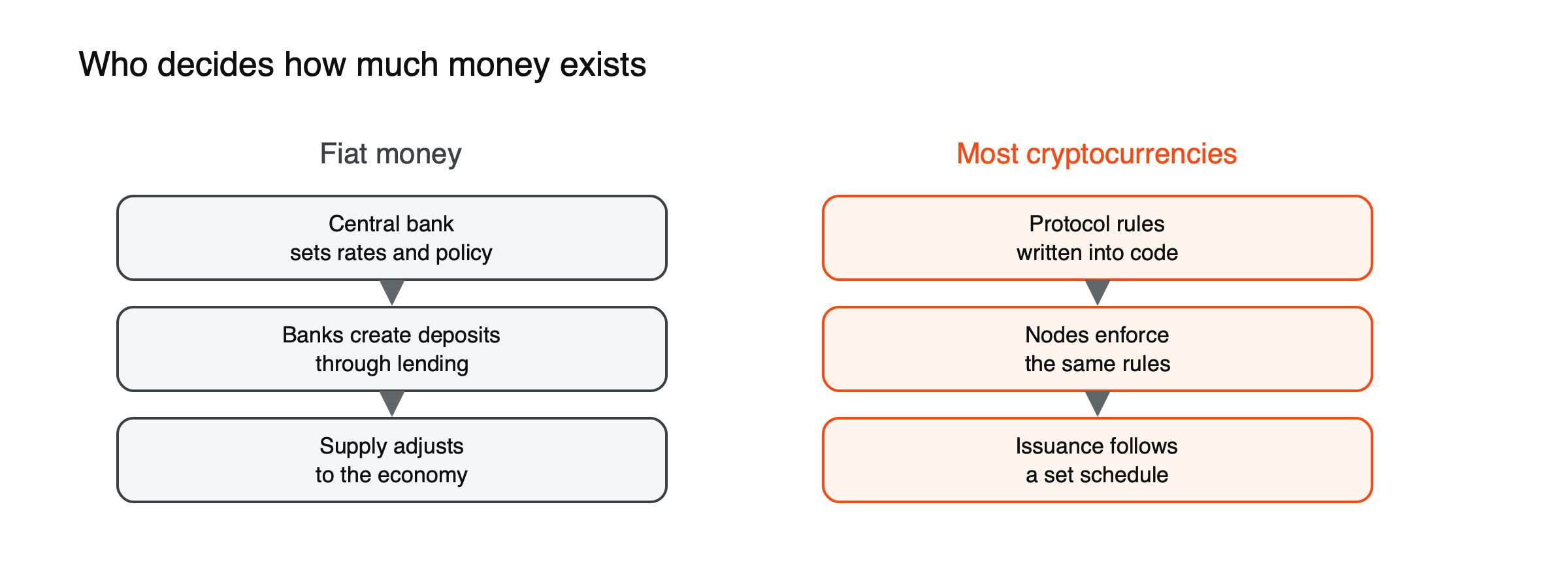
Figure: The core difference between the two: policy decides fiat supply, code decides most crypto supply.
How the two compare
| Fiat money | Cryptocurrency | |
|---|---|---|
| Issuer | Central bank and banking system | Usually no issuer; new coins follow protocol rules |
| Supply | Adjusted by policy | Set by code; fixed or predictable for many coins |
| Price stability | Designed to lose value slowly and predictably | Often highly volatile |
| Legal status | Legal tender; must be accepted for debts | Varies by country; rarely legal tender |
| Protection | Deposit insurance, chargebacks, bank regulation | Few protections; mistakes and theft are hard to reverse |
| Access | Needs a bank or cash | Needs an internet connection and a wallet |
| Payment finality | Card and bank payments can be reversed or frozen | Confirmed transactions cannot be reversed |
| Privacy | Banks see and report transactions | Public ledgers show transactions; identities are pseudonymous |
Two kinds of risk, measured differently
Fiat’s main risk is slow: inflation. At a steady 3% a year, money loses about half its purchasing power in roughly 23 years; at 2%, in about 35 years. The loss is predictable enough that people plan around it, and interest on savings can offset some or all of it.
Crypto’s main risk is fast: price swings. Bitcoin, the most established cryptocurrency, has fallen about 84% from its peak in 2018 and about 77% in 2022. Over a decade it has also risen enormously. The fixed supply protects against dilution, but it does nothing to stop the price swinging with demand.
The two are not opposites on a single scale. One erodes value gradually; the other can change it sharply in either direction within months.
Who can change the rules
A central bank’s committee can change interest rates at a scheduled meeting, and in a crisis it can create money on a large scale within days. That flexibility is the point of fiat: it lets policymakers respond to recessions and financial panics.
Changing the rules of a major cryptocurrency is much harder. On Bitcoin, any change to the supply schedule would need to be adopted by the people and businesses running the network’s software, and anyone who disagrees can keep running the old rules. In practice, this makes the supply schedule very difficult to alter. The trade-off is that there is no one to step in when conditions turn bad: no lender of last resort, no emergency rate cut and no bailout. Both systems ask users to trust something.
Is crypto money?
Economists usually describe money by three jobs: a medium of exchange, used to pay for things; a unit of account, used to price things; and a store of value, used to hold wealth over time. Fiat currencies do all three in their home economies. Cryptocurrencies do the first in some settings, such as cross-border transfers and online payments, but very few goods or wages are priced in them, so they rarely serve as a unit of account. Whether they are a good store of value is the most debated question, because a store of value that can halve in a year works only for people who can wait. By that standard, most cryptocurrencies are better described as assets that can be used as money in some situations than as money in the full sense.
Could crypto replace fiat?
For most economies, not in any foreseeable future. A currency people are paid in and pay taxes with needs a stable value in the short term, and the deep swings in crypto prices make that difficult. Crypto is more likely to sit alongside fiat: as an alternative store of value for some savers, as a payment network for specific uses such as cross-border transfers, and, through stablecoins, as a new way of moving fiat itself.
When fiat is the better tool
Fiat wins for everyday life in a country with a stable currency. Prices, wages and debts are set in it, its value moves slowly, and the banking system adds protections that crypto lacks: deposit insurance, fraud refunds and the ability to recover a forgotten password. Holding next month’s rent in a volatile asset is a risk most people do not need.
When crypto is the better tool
Crypto earns its place where fiat’s controls become the problem. Moving money across borders can be slow and expensive through banks, while a blockchain transfer settles in minutes at any hour. People who distrust a government’s handling of its currency, or who cannot open a bank account, can store value without asking permission. A fixed supply schedule, such as Bitcoin’s cap just under 21 million coins, appeals to those worried about long-term inflation.
When the safe choice reverses
In a country with high inflation or strict capital controls, the usual answer can flip. A local currency losing value quickly is a riskier place to keep savings than many people assume, and dollar-pegged stablecoins have become a way to hold dollars where bank access to them is limited.
The reversal works the other way too. A long-term holder in a stable-currency country who keeps savings mostly in crypto takes on far more short-term risk than inflation would have caused.
Stablecoins: fiat money on crypto rails
Stablecoins blur the line between the two categories. They run on crypto networks and move like crypto, at any hour and across borders, but they track fiat money and depend on reserves held in the traditional banking system. Their safety therefore rests on the issuer’s reserves and on regulation, not on code alone, as the brief slip of USDC in March 2023 showed. See what happened when USDC lost its peg.
The practical picture
Fiat is built for stability and protection; crypto is built for independence from intermediaries. Each one’s strength is the other’s weakness. Most people who use crypto still earn, spend and pay taxes in fiat, which is why converting between the two, and keeping records when you do, matters as much as choosing between them. See how to convert crypto to cash.
For the state-issued alternative, see what a central bank digital currency is, and for the basics, what cryptocurrency is.
This article is educational content and does not constitute financial, investment, legal or tax advice. Digital assets are volatile and you may lose the amount you invest.