
How to Track Crypto Whale Wallets
Find large wallets, check who they likely belong to, set alerts, read their moves against exchange flows and avoid the common traps of whale-watching.
Crypto whale tracking means finding addresses with large balances on an explorer or analytics site, checking whether they belong to exchanges, funds or individuals, setting alerts for large transfers and reading each move in context. Most large transfers are routine, so a single alert is rarely a trading signal.
Before you start
You need a block explorer for the network and, optionally, an analytics service that labels addresses. Glassnode, for example, defines bitcoin whales as entities holding 1,000 BTC or more. See what a blockchain explorer is.
What counts as a whale
There is no single threshold. For bitcoin, analytics firms commonly use 1,000 BTC or more; for a small token, a wallet holding 1% of supply may matter more than one holding millions of dollars of a large coin. What makes a holder a whale is the ability to move the market or its sentiment, so it is worth comparing a wallet’s balance with the token’s daily trading volume rather than with a fixed dollar amount.
Steps
1. Find the large holders
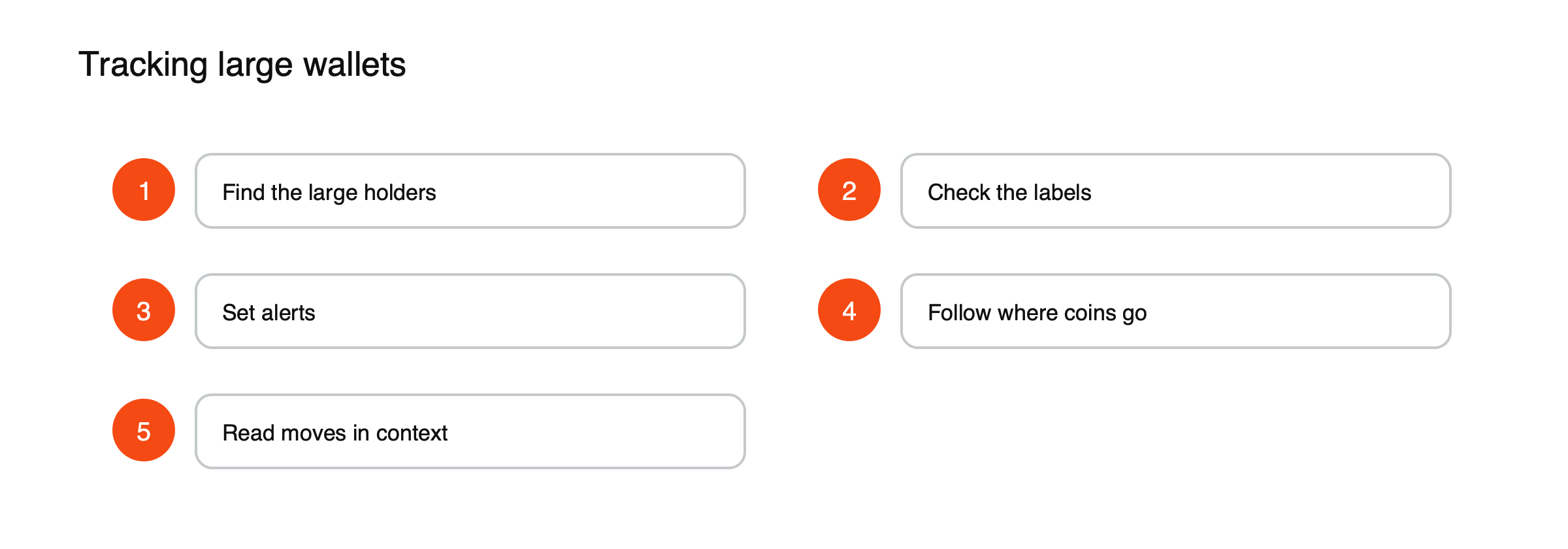
Figure: Five steps for tracking large wallets.
Explorers and analytics sites list the richest addresses. Many of the largest belong to exchanges, custodians and funds, not individuals.
2. Check the labels
Analytics firms attach names to known addresses. Labels are estimates; treat unlabeled addresses with caution, and remember that one owner can control many addresses.
3. Set alerts
Use alert services or explorer watchlists to be notified when watched addresses move more than a set amount.
4. Follow where coins go
A whale sending coins to an exchange deposit address may be preparing to sell. Coins moving to a new unlabeled address may simply be storage. See what exchange inflows and outflows show.
5. Read moves in context
Compare with price, overall exchange flows and news. A move by a known fund or government wallet means more than one by an unknown address. Short horizons make every number look important.
A whale move, read in context
Suppose an alert reports 2,500 BTC moving from an address that has not been active for six years. (Illustrative scenario.) The first check is the destination: if the coins go to a known exchange deposit address, the holder may be preparing to sell, and prices could feel pressure. If they go to a new address with no label, the owner may simply be upgrading security or reorganizing storage. The second check is size against the market: 2,500 BTC is meaningful, but a fraction of a single day’s trading in a busy market. The third is follow-through: whether the coins move again over the next days, and where.
Fund, company and government wallets
Some of the most informative wallets belong to known entities: exchange-traded fund custodians, public companies holding bitcoin and governments holding coins seized in criminal cases. Transfers from government wallets to exchanges or brokers have often drawn attention as signs of planned sales. Because these entities are identified, their moves carry more information than anonymous addresses, though they too may be shuffling coins between custodians rather than selling.
Tools: explorers, dashboards and alert bots
Block explorers show balances and transactions for free but require you to know which addresses to watch. Analytics dashboards add labels, rankings and history, often behind a subscription. Social media alert bots post large transfers automatically, which makes them fast but also noisy, since they rarely distinguish an exchange reshuffle from a real sale. Many traders use a bot for awareness and an explorer for checking.
Building a simple watchlist
Rather than reacting to every alert, many traders keep a short list of addresses that matter for what they hold:
- Exchange cold wallets for the assets you trade, to see large-scale movements in reserves.
- Fund and company custodians whose holdings are public.
- Team and investor wallets for any smaller token you hold, especially around unlock dates. See what token unlocks are.
- Known government wallets holding seized coins.
Ten to twenty well-chosen addresses, checked weekly, usually say more than a constant stream of alerts. Keeping a short note on why each address is on the list, and what a normal week looks like for it, makes unusual activity much easier to spot when it happens.
Whales in smaller tokens
For small tokens, whale tracking is less about reading the market and more about judging risk. Check what share of supply the top ten holders control after excluding exchanges and smart contracts, whether team wallets are locked, and whether any large holder also controls the main liquidity pool. A few wallets able to sell into a thin pool can move the price far more than any whale can move bitcoin.
A note on privacy
Watching public blockchain data is legal and widely practiced, but the addresses belong to real people and organizations. Publicly linking an address to a named individual, or sharing personal details alongside transaction data, can cause real harm. Focus on what addresses do, not on who might be behind them.
Common traps
- Exchange reshuffles look like huge whale moves but are internal transfers.
- Copy-trading whales: you see moves after they happen, and you do not know their reasons or hedges.
- Address poisoning: do not copy addresses from transaction lists you are watching. See what address poisoning is.
For more on reading blockchain data, see what on-chain analysis is.
This article is educational content and does not constitute financial, investment, legal or tax advice. Digital assets are volatile and you may lose the amount you invest.
Frequently asked questions
Can I find out who owns a whale wallet?
Sometimes. Exchanges, funds and some companies publish their addresses, and analytics firms infer ownership from patterns. Most individual owners remain unidentified, and labels are estimates that can be wrong.
Should I follow what whales do?
Copying them is risky. You see their transactions after the fact, without knowing their reasons, their other positions or whether they are hedged elsewhere. Whale activity is better used as one piece of context than as a trading signal.