
How ETFs Changed Price Discovery
ETFs trade all day even when their holdings barely trade, so ETF prices often lead. How creation and redemption work and what bond ETFs showed in 2020.

ETFs changed price discovery because they trade all day even when their holdings, such as corporate bonds, trade rarely. In fast markets, an ETF’s price can reflect news before its holdings are repriced. In March 2020, a major US bond ETF traded more than 6% below the stated value of its bonds, signaling where bond prices were heading.
How ETF prices stay close to value
Large dealers called authorized participants can create new ETF shares by delivering the underlying assets, or redeem shares for those assets. If the ETF trades above the value of its holdings, they create shares and sell them; if below, they buy shares and redeem them. This arbitrage normally keeps the price close to net asset value.
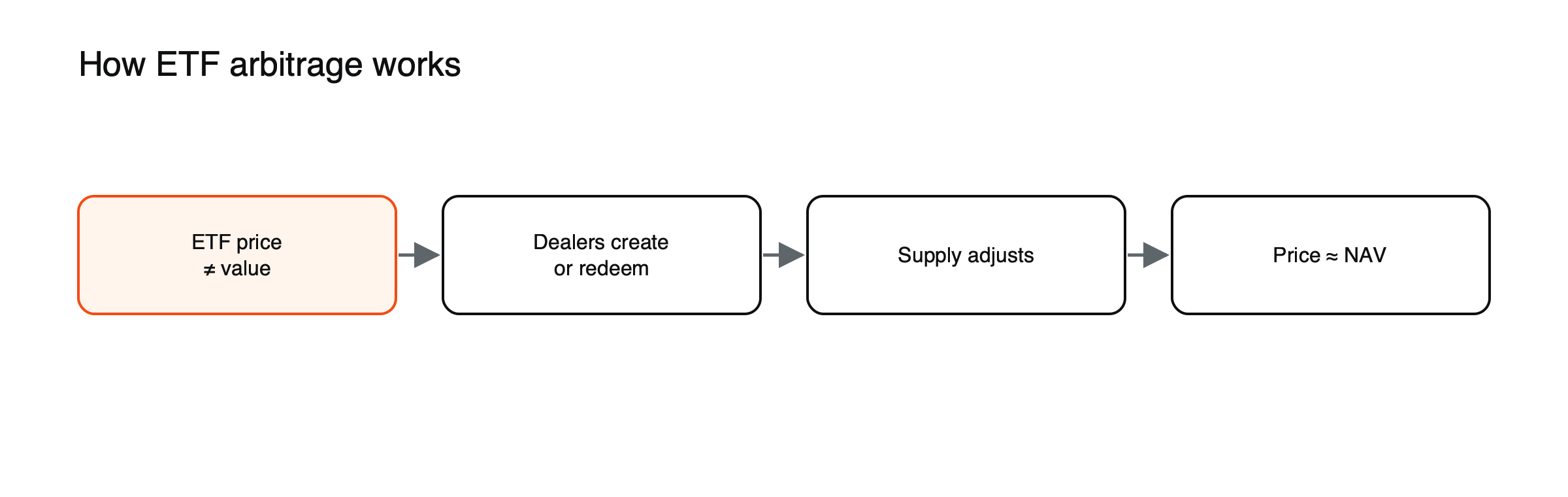
Figure: Creation and redemption keep ETF prices near value, until liquidity is strained.
A discount in stress, illustrated
Suppose a bond ETF reports net asset value of $80.00 a share, based on last available bond prices, but trades at $75.04 during a sell-off, a 6.2% discount. (Illustrative figures based on the March 2020 episode.) Part of the gap reflects real difficulty selling the underlying bonds; part reflects that the reported bond prices are stale and will fall when they next trade. A few days later, as bond prices update, the net asset value may fall toward the ETF price, showing that the ETF had already priced the decline. In such cases, the ETF price is often the more accurate signal.
When ETFs lead
Bonds. Many bonds trade only occasionally, so their official prices can be stale. In a sell-off, the ETF price falls first, and the “discount” partly reflects that the underlying values have not caught up.
Bitcoin. Spot bitcoin ETFs, launched in January 2024, quickly became a major venue for bitcoin exposure; options on BlackRock’s IBIT overtook Deribit as the largest bitcoin options market by open interest within about a year. See how bitcoin ETFs changed who owns bitcoin.
The growth of ETFs
Global ETF assets reached a record of about $23 trillion in May 2026, with more than $1 trillion of inflows in 2026 by that point. As ETFs have grown, a larger share of trading in shares, bonds and commodities has happened through fund shares rather than the underlying assets. That shift has made ETF prices more central to price discovery in many markets. See what an ETF is.
Concerns
- Liquidity mismatch: an ETF can be easy to sell while its underlying assets are not.
- Flows drive prices: large ETF inflows or outflows can push the underlying market.
- Passive concentration: money tracking indexes may pay less attention to company-specific information.
Why it matters
ETF prices can be the market’s best real-time estimate in stress, but discounts and premiums tell you liquidity is strained. See why institutional traders care about market depth and why correlations go to one in a crisis.
Indexing and individual shares
When money flows into index ETFs, the funds buy all the shares in the index in proportion to their weights, regardless of each company’s prospects. Critics argue that heavy passive investing can weaken price discovery for individual shares, as fewer investors analyze companies. Supporters respond that active investors still set prices at the margin and that index funds lower costs for millions of savers.
ETF flows and the underlying market
Large inflows or outflows can move underlying prices, especially in less liquid markets such as small-cap shares, high-yield bonds or commodities. On days of heavy redemptions, authorized participants may sell underlying assets, adding pressure. Watching ETF flows has therefore become part of reading many markets, from bitcoin to corporate bonds. See how bitcoin ETFs changed who owns bitcoin.
What traders can use
Premiums and discounts to net asset value, published daily, show when liquidity is strained. Unusually large ETF trading volume can signal shifting sentiment before underlying markets react. Options on popular ETFs reveal how investors are positioned. Each offers a window into price discovery that did not exist before ETFs.
Authorized participants under stress
The arbitrage that keeps ETF prices close to value depends on authorized participants being willing to trade. In calm markets, they step in quickly. In stress, they may hesitate if the underlying assets are hard to buy or sell, or if their own balance sheets are stretched, allowing larger premiums or discounts. That is why discounts widened sharply in bond ETFs in March 2020 and narrowed again once the Federal Reserve supported bond markets.
Commodity ETFs
Gold ETFs hold physical metal and have become a major channel for investment demand, with their holdings tracked as a sign of investor sentiment. Other commodity ETFs hold futures and can diverge from spot prices because of rolling costs. Both kinds influence price discovery in their markets. See what moves gold prices.
Leveraged and inverse ETFs
Some ETFs aim to deliver two or three times the daily move of an index, or the inverse. To do this, they rebalance at the end of each day, buying after rises and selling after falls. In volatile markets, these rebalancing flows can add to moves near the close, another way ETFs affect underlying prices.
Common misreadings
- Treating an ETF discount as a pricing error.
- Assuming ETF liquidity equals underlying liquidity.
Different trading hours
Some ETFs trade when their underlying markets are closed. A US-listed ETF holding Japanese shares trades during New York hours, when Tokyo is shut, so its price reflects investors’ best estimate of where Japanese shares will open. The next morning, Japanese prices often move toward the level implied by the ETF. Bitcoin ETFs work the other way: they trade only during exchange hours, while bitcoin trades around the clock, so the ETFs open each day reflecting overnight moves in bitcoin.
ETFs and bitcoin’s market
Within about a year of launch, options on BlackRock’s bitcoin ETF overtook the largest crypto-native options venue by open interest. That shift moved a meaningful part of bitcoin price discovery and hedging into regulated US markets during US hours. Traders now watch ETF flows, ETF options positioning and spot bitcoin markets together.
Premiums in hot markets
ETFs can also trade above the value of their holdings when demand surges and the underlying assets are hard to buy quickly, as with some newly popular themes or assets with limited supply. Authorized participants usually create new shares to close the gap, but premiums can persist briefly in fast-moving markets. Buyers paying a premium risk losing it when it closes.
Using ETF signals, illustrated
Suppose a high-yield bond ETF falls 3% in a day and trades at a 2% discount, while reported bond prices barely move. (Illustrative scenario.) A trader might read this as an early sign of stress in credit markets that bond prices have not yet reflected, and check credit spreads and share markets for confirmation. If the discount closes the next day as bond prices fall, the ETF led; if it closes as the ETF recovers, the move was a temporary liquidity squeeze. See what credit spreads tell equity traders.
A checklist
- What is the ETF’s premium or discount to net asset value?
- How liquid are its underlying assets?
- Are flows unusually large?
- Is the underlying market open or closed?
ETFs and closing prices
Many ETFs and index funds trade near the market close to track their benchmarks, contributing to the heavy volume in closing auctions. Large rebalancing days, such as when indices change their membership, can move prices of affected shares sharply at the close as funds buy additions and sell deletions. Traders who know the rebalance calendar can anticipate these flows, and companies added to major indices often see their shares rise ahead of inclusion. These flows can briefly distort prices around rebalance dates. See what index rebalancing is.
Frequently asked questions
Should I trust the ETF price or the NAV in a crisis?
For assets that trade rarely, the ETF price is often closer to what holdings could actually be sold for.
Do ETFs make markets more volatile?
They can transmit flows quickly, but they also give investors a liquid way to trade assets that would otherwise be hard to buy or sell.
This article is educational content and does not constitute financial, investment, legal or tax advice. Digital assets are volatile and you may lose the amount you invest.
Sources
- 14 weeks and 12 numbers (Vanguard Total Bond Market ETF at a 6.2% discount to NAV on March 12, 2020) — Monevator
- IBIT: the ETF that made bitcoin a blue chip (IBIT options overtook Deribit by open interest within about a year) — BIT Knowledge Hub, August 2026
- The impact of US spot bitcoin ETFs on the market (redemption pressure in turmoil) — Value the Markets
- Global ETF assets hit record $23T in May (over $1 trillion of inflows in 2026 by May, per ETFGI) — The Daily Upside, 2026