
What Are Euro Stablecoins?
Euro stablecoins are tokens pegged to the euro and regulated in the EU as e-money tokens under MiCA. How they work, who issues them and why the market is small.
Euro stablecoins are tokens designed to stay worth one euro, backed by euro cash and short-term euro government debt. In the EU they are regulated as e-money tokens under MiCA, which requires authorized issuers, segregated reserves and redemption rights. The largest is Circle’s EURC. The whole market was worth under $1 billion in 2026, roughly 0.3% of all stablecoins.
How euro stablecoins work
They work like dollar stablecoins, only in euros. An authorized issuer receives euros, creates the same number of tokens and holds reserves to redeem them. Under MiCA, the issuer must be an authorized electronic money institution or bank, keep reserves separate from its own money, and let holders redeem at par. MiCA also bars issuers from paying interest to holders for keeping the token. Our guide to what MiCA is covers the wider rules.
Rights MiCA gives holders
The EU rules give euro stablecoin holders protections that go further than the terms many dollar stablecoins offer outside regulated regimes. Holders have a right to redeem their tokens with the issuer at any time and at par value, one euro per token, and the regulation bars issuers from charging a fee for that redemption except in limited cases. Reserves must be kept separate from the issuer’s own money and invested in safe, liquid assets. Issuers must also publish a white paper describing the token and its risks. In practice, direct redemption still runs through the issuer’s onboarding and verification process, but the right itself is written into law. National supervisors oversee each issuer, and the largest tokens face additional supervision at EU level, which gives holders a clearer picture of who is responsible if something goes wrong.
Who issues them
- EURC (Circle) is the largest, with roughly half or more of the euro stablecoin market by most 2026 counts.
- EURCV is the second largest among MiCA-compliant tokens, with about a quarter of that segment.
- Smaller issuers include EURI, EURe from Monerium, and others.
- Banks are entering: Crédit Agricole launched a MiCA-compliant euro token in July 2026, and a consortium of nine European banks, including BBVA, ING and UniCredit, planned a joint euro stablecoin for late 2026.
By mid-2026, ESMA had recorded 19 authorized e-money token issuers across 11 member states.
Why the market is so small
By mid-2026 the euro stablecoin market was around $770 million to $900 million, depending on the count, while dollar stablecoins exceeded $250 billion. A few reasons stand out:
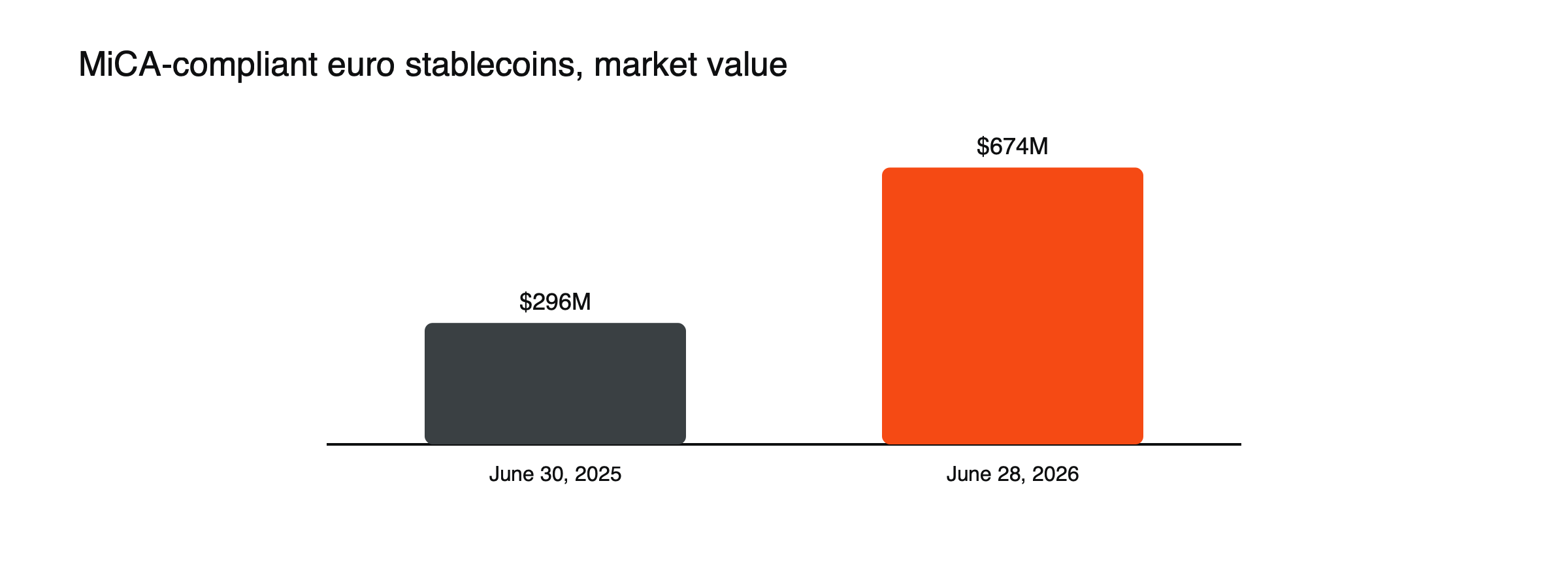
Figure: MiCA-compliant euro stablecoins more than doubled in a year, but remain about 0.2–0.3% of all stablecoins. Source: Decta via Cointelegraph, July 2026.
- Trading pairs are priced in dollars. Most crypto markets quote against USDT or USDC, so traders hold dollars.
- No yield. Like dollar stablecoins under MiCA, euro tokens cannot pay holders interest.
- Fewer integrations. Exchanges, wallets and DeFi apps support euro tokens less widely.
Growth has picked up under MiCA. The market passed its early-2022 peak of $721 million in 2026, and the combined value of MiCA-compliant euro tokens more than doubled in the year to June 2026.
What they are used for
Euro stablecoins are used mainly for payments, remittances, payroll and treasury transfers within Europe, and for moving between euros and dollars on-chain without waiting for bank hours. Visa and Mastercard have added settlement support for EURC in parts of their networks.
A payment in practice
Consider a company in Spain paying a supplier in the Netherlands on a Sunday evening. A standard bank transfer would wait until banks reopen unless both banks support instant payments. With a euro stablecoin, the company sends tokens from its wallet and the supplier receives them in minutes, then redeems them through its own provider or keeps them for its next payment. The value never leaves euros, so there is no exchange-rate cost, though both sides need access to a regulated platform that converts the tokens to bank euros when they want cash.
Euro and dollar stablecoins compared
| Euro stablecoins | Dollar stablecoins | |
|---|---|---|
| Market size, mid-2026 | Under $1 billion | Over $250 billion |
| Main use | Payments and treasury in Europe | Crypto trading and global payments |
| EU regulation | E-money tokens under MiCA | Restricted unless authorized; caps on payment use |
| Liquidity | Thinner; wider spreads | Deep across most venues |
Switching between euros and dollars on-chain
Moving between a euro and a dollar stablecoin is a currency exchange. Suppose you swap 10,000 EURC for USDC when one euro buys $1.08, on a venue charging a 0.2% spread. You receive about $10,778. (Illustrative figures.) Because euro stablecoin markets are smaller, the spread on large swaps can be wider than on major bank or broker currency markets, so comparing the effective rate with the official exchange rate before trading is worthwhile. For regular conversions, splitting large amounts across several trades or using a platform with deep euro liquidity usually narrows the gap, and checking whether fees are charged on top of the spread avoids a second surprise.
Risks to know
- Thin liquidity: smaller markets mean wider spreads and bigger price impact.
- Exchange-rate exposure for anyone whose costs are in dollars.
- Issuer risk, as with any stablecoin: the token is only as good as its reserves and redemption process.
For how dollar stablecoins compare, read USDT vs USDC. For the basics, see what a stablecoin is.
This article is educational content and does not constitute financial, investment, legal or tax advice. Digital assets are volatile and you may lose the amount you invest.
Frequently asked questions
Can I use euro stablecoins outside the EU?
The tokens themselves move on public blockchains and can be held anywhere. Access to issuers and regulated platforms depends on where you live, and protections such as MiCA’s redemption rights apply to the issuer’s obligations rather than to every platform you might use.
Will the digital euro replace euro stablecoins?
Not necessarily. A digital euro would be issued by the European Central Bank and is aimed mainly at everyday retail payments, with holding limits under discussion. Euro stablecoins are issued by private firms and work on public blockchains alongside other crypto applications. The two could coexist. See what a central bank digital currency is.
Sources
- The state of euro stablecoins in 2026 (MiCA-compliant market $767 million; EURC just under 60%, EURCV 25%; Crédit Agricole EURXT, July 2026) — FXC Intelligence, September 2026
- Euro Stablecoins Hit Record Highs Under MiCA (~$900 million; early-2022 peak $721 million; 19 EMT issuers in 11 states; bank consortium) — BeInCrypto via Yahoo Finance, 2026
- MiCA-compliant euro stablecoins grew 128% (from $295.6 million to $673.9 million) — Cointelegraph, July 2026
- Euro stablecoins dominate non-dollar market (payments use; Visa and Mastercard EURC settlement) — Cointelegraph, March 2026
- MiCA’s €200M daily cap (Article 50 bars interest) — BlockEden, May 2026
- Regulation (EU) 2023/1114 on markets in crypto-assets (MiCA): e-money token redemption at par, at any time and without fee (Article 49) — EUR-Lex