
What Is an Exchange Token?
Exchange tokens are issued by crypto exchanges for fee discounts, perks and gas. How they work, what supports their value and what FTT's collapse showed.
An exchange token is a cryptocurrency issued by a crypto exchange, usually to give holders fee discounts and other perks on that platform. Some also pay gas on the exchange’s own blockchain. Because its value depends on the company behind it, a crisis at the exchange hits the token directly, as FTX’s FTT showed in 2022.
What exchange tokens are used for
- Fee discounts when paying trading fees with the token.
- Access to perks, such as early access to new token sales on the platform.
- Gas on an exchange-linked blockchain, as with BNB on BNB Chain.
- Staking or loyalty programs that pay rewards for holding.
Our profile of BNB covers the largest example in detail.
What supports their value
Exchange tokens draw demand from the exchange’s users: the more trading on the platform, the more people want the discounts. Many exchanges also buy back and burn tokens using part of their revenue, which reduces supply over time. In effect, an exchange token is a bet on one company’s business, without the legal rights of a share in that company.
Buybacks and burns in numbers
Suppose an exchange commits 20% of its quarterly profit to buying back its token and burning it. If it earns $100 million in a quarter, it spends $20 million; at a token price of $5, that removes 4 million tokens. With 200 million tokens in existence, supply falls by 2% that quarter. (Illustrative figures.) The program supports the token only while the exchange stays profitable and keeps the commitment, and the exchange can usually change the terms.
Exchange tokens versus exchange shares
Owning an exchange token is not the same as owning part of the exchange. A share in a listed exchange gives a legal claim on its profits and assets, voting rights at shareholder meetings and the protections of securities law. An exchange token gives perks and, sometimes, the indirect benefit of buybacks, with no claim on the company. When an exchange fails, shareholders and token holders both suffer, but token holders usually have even weaker standing.
What the FTT collapse showed
FTT was the exchange token of FTX, then one of the largest crypto exchanges.
- November 2, 2022: CoinDesk reported that about $5.2 billion of the $14.6 billion in assets held by Alameda Research, a trading firm owned by FTX’s founder, consisted of FTT.
- November 6: Binance said it would sell its FTT holdings, about 23 million tokens worth around $529 million.
- By November 8: FTX had halted withdrawals, and FTT had fallen more than 85% since the CoinDesk report.
- November 11: FTX, Alameda and more than 130 affiliated entities filed for bankruptcy.
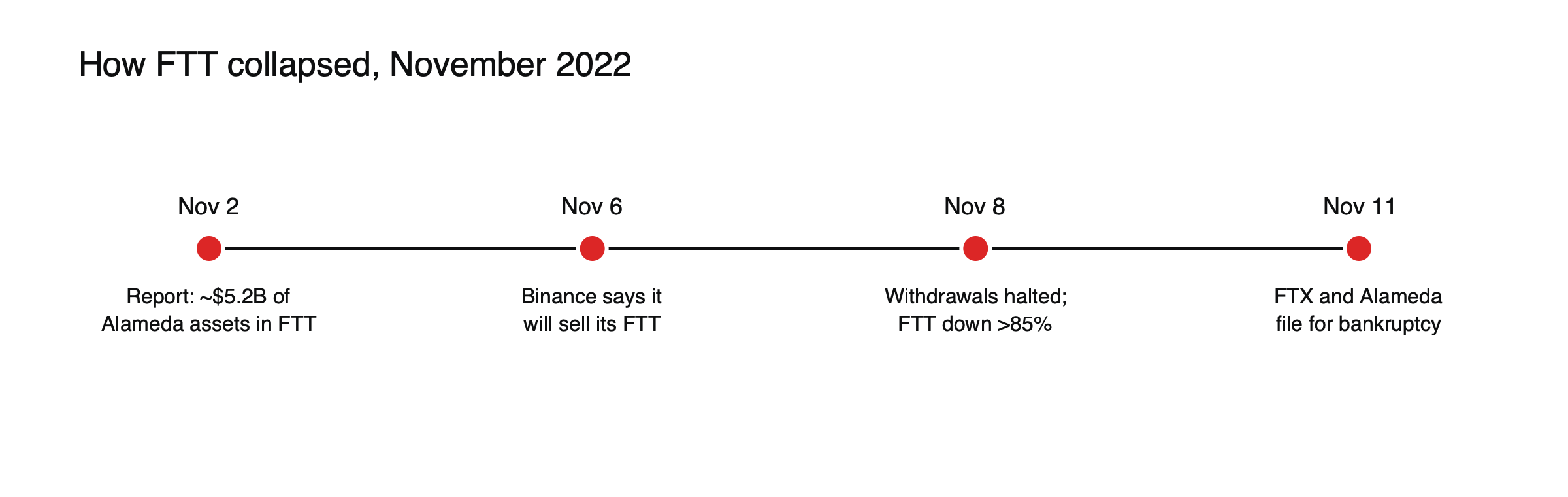
Figure: Ten days from a news report to bankruptcy. Source: 21Shares, November 2022.
Why FTT failed so fast
The token had been used as collateral inside the same group of companies that issued it. When its price fell, the collateral vanished at the moment it was needed most.
Exchange tokens after FTX
FTX’s failure changed how the market views exchange tokens. Investors pay far more attention to whether a token is held on the issuer’s own balance sheet or used as collateral, and regulators in several jurisdictions have scrutinized tokens issued by trading platforms. Fewer exchanges launch new tokens, and those that already exist face more questions about disclosure and conflicts of interest.
How to judge an exchange token
- Is the exchange regulated, audited and transparent about reserves and finances?
- Who holds the supply? A token mostly held by the exchange or its insiders can be moved or sold in large amounts.
- Is the token used as collateral inside the company’s own balance sheet?
- What real benefits does it provide, and would you hold it without them?
Not all exchange tokens are alike
Exchange tokens fall into a few broad groups. Some, like BNB, also act as the gas token of a blockchain, which gives them uses outside the exchange. Others offer only platform perks, such as fee discounts and access to promotions, so their demand depends entirely on the exchange’s own customers. A third group adds buyback or burn programs funded by the exchange’s revenue. The more a token’s demand depends on a single company’s decisions, the more its holders are effectively betting on that company.
Questions about the issuer, not just the token
Because an exchange token is only as strong as the exchange behind it, the most important checks concern the company. Is it licensed in the places it serves? Does it publish audited financial statements or reliable proof of reserves? Does it hold large amounts of its own token, and are those tokens used as collateral or counted as assets? Has it faced regulatory action, and how was it resolved? A token can look attractive while the business behind it is fragile, as FTT showed.
When perks change
Exchanges can and do change the benefits attached to their tokens, by reducing discounts, ending programs or redirecting buybacks. Holders have little say. A sensible approach is to treat perks as a temporary bonus, check the platform’s announcements regularly and reassess the holding whenever the terms change, rather than assuming today’s benefits will last.
In a portfolio, exchange tokens are best treated as a concentrated bet on one company rather than as a diversified crypto holding. Their prices tend to fall with the wider market and can fall very much further if the exchange runs into trouble, so they add risk on top of the general swings of crypto. Keeping any holding small relative to the rest of your crypto, and avoiding keeping both the token and large balances on the same exchange, limits how much a single failure can cost.
The risks that matter most
- Single-company risk: legal, financial or operational trouble at the exchange can sink the token.
- Concentration: exchanges often control most of the supply.
- Changing benefits: the exchange can change or remove perks at any time.
For how exchanges hold customer funds, read what proof of reserves is. For the wider category, see what an altcoin is.
This article is educational content and does not constitute financial, investment, legal or tax advice. Digital assets are volatile and you may lose the amount you invest.
Frequently asked questions
Is it worth holding an exchange token just for fee discounts?
Only if the discounts outweigh the risk of the token falling in value. Someone who trades heavily on one exchange may save enough to justify a small holding; for occasional traders, the discount rarely compensates for the extra exposure.
What happens to an exchange token if the exchange is acquired or closes?
It depends on the terms and the new owner. Perks can be withdrawn, and if the exchange closes, the token may lose its main source of demand entirely.