
The Digital Cash Projects That Came Before Bitcoin
DigiCash, e-gold, b-money and Bit Gold tried to build digital cash before Bitcoin. See what each solved, why they failed and what Bitcoin took from them.
The history of digital cash before Bitcoin spans more than two decades of attempts to build money for the internet. DigiCash went bankrupt in 1998, and e-gold was indicted by US prosecutors in 2007. Each early system either depended on a company that could fail or be shut down, or never solved double spending without one.
Digital payments vs digital cash
By the late 1990s, money already moved online. Card payments and services such as PayPal let people pay over the internet, but they were digital payments, not digital cash. They moved balances held at banks, which meant every payment passed through institutions that could see it, block it or reverse it.
Digital cash aimed for something closer to a banknote: a bearer asset that changes hands directly, settles finally and does not need a bank account on either side. That goal turned out to be much harder, and the attempts to reach it shaped almost every idea that later appeared in Bitcoin.
The problem every project had to solve
Digital files can be copied perfectly. A digital coin is a file, so something has to stop its owner from spending the same coin twice. Before 2008, the only practical answer was a trusted operator that kept the ledger and approved every payment. That operator solved double spending, and it was also the system’s weak point: it could go bankrupt, be pressured to block payments, or be shut down by authorities.
Timeline: from blind signatures to Bitcoin
- Early 1980s: cryptographer David Chaum describes blind signatures, a method that lets a bank sign a digital coin without seeing which coin it signed. It allowed payments the bank could verify but not trace.
- 1989: Chaum founds DigiCash in Amsterdam to bring the technology to market.
- 1991: researchers Stuart Haber and W. Scott Stornetta publish a method for timestamping digital documents by linking each record to the one before, an idea Bitcoin’s white paper later cites.
- 1996: Douglas Jackson launches e-gold, a digital currency backed by gold held in storage, with accounts denominated in weight of gold.
- 1998: DigiCash files for Chapter 11 bankruptcy, with about 5,000 users and 300 merchants. The same year, Wei Dai describes b-money, a proposal for money run by a network of participants rather than a company, and Nick Szabo begins developing his Bit Gold concept.
- 2005: Szabo publishes the Bit Gold design, combining proof-of-work puzzles with a chain of timestamped results.
- April 2007: a federal grand jury indicts e-gold’s operating companies and owners for money laundering conspiracy and operating an unlicensed money transmitting business. The companies plead guilty in July 2008.
- October 31, 2008: Satoshi Nakamoto publishes the Bitcoin white paper, citing b-money, Adam Back’s Hashcash proof-of-work system and the Haber–Stornetta timestamping work.
- January 2009: the Bitcoin network starts running.
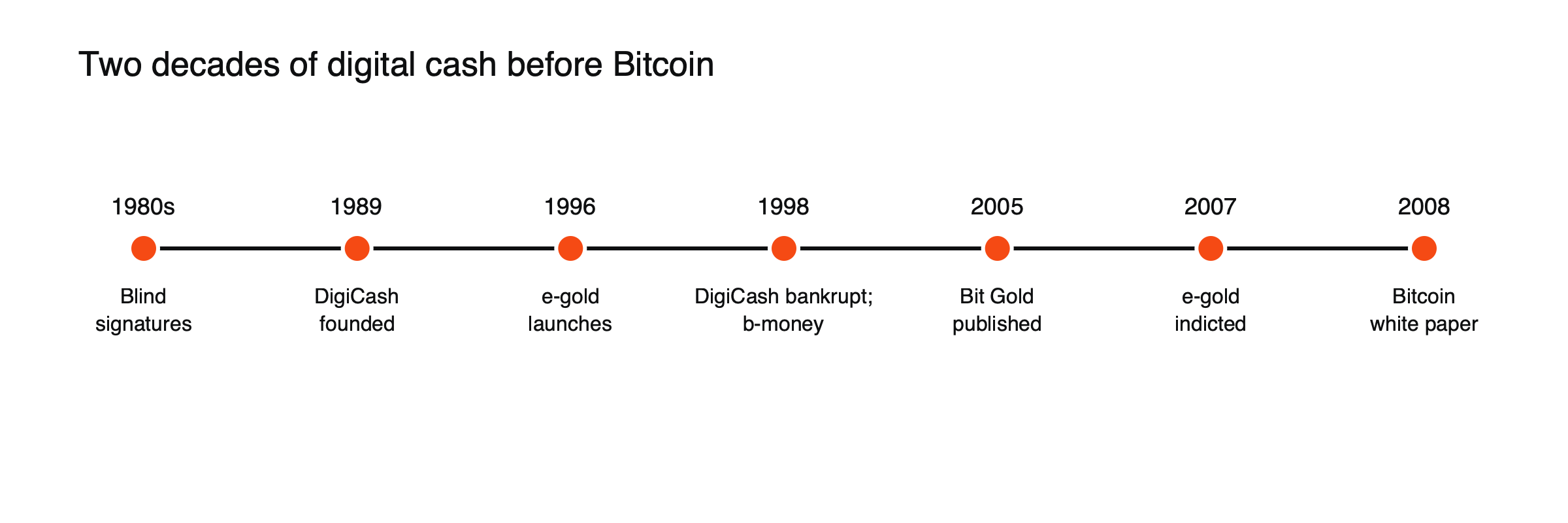
Figure: The main projects and events covered in this article.
Four projects, four partial answers
| Project | Started | What it contributed | Why it did not last |
|---|---|---|---|
| DigiCash | 1989 | Private, cryptographically signed payments | Needed banks to adopt it; too few did, and the company went bankrupt |
| e-gold | 1996 | Real-world use at scale, value backed by gold | A single company ran it; prosecutors could shut it down |
| b-money | 1998 | Money maintained by a network, not a firm | A proposal; never fully specified or built |
| Bit Gold | Designed from 1998, published 2005 | Proof of work and chained timestamps | Never launched; still relied on agreement about ownership records |
DigiCash: brilliant cryptography, wrong business
DigiCash had the most advanced privacy technology of its time. Its coins could be spent without the bank learning who paid whom, a property that public blockchains still lack. But the company chose to sell its system to banks, and banks were slow to adopt a product most customers did not yet want or understand. Online shopping was in its infancy, and card networks were already becoming the default. When DigiCash ran out of money, its currency disappeared with it.
e-gold: real users, single point of failure
e-gold had the opposite profile. It attracted large numbers of real users, many in countries with unstable currencies, who valued a gold-backed balance they could move online. But one company controlled every account. According to the US Justice Department, criminals used the system to move money, and once prosecutors acted, the business had to change how it operated. The lesson was that a popular digital currency with a central operator can be stopped by acting against that operator.
b-money and Bit Gold: the missing pieces
The designs that tried to avoid a central operator never became working systems. Wei Dai’s b-money imagined participants keeping copies of the ledger and creating money by solving computational problems. Szabo’s Bit Gold linked proof-of-work results into a chain. Both described important parts of the solution, but neither offered a complete, practical way for strangers who do not trust each other to agree on a single history of who owns what.
What Bitcoin changed
Bitcoin combined those pieces into a system that worked. Proof of work, similar to Hashcash and Bit Gold, made it costly to write history. A chain of blocks, building on the timestamping ideas of the early 1990s, ordered every transaction. And the rule that nodes follow the chain with the most accumulated work let a network of strangers agree on who owned what without any company in the middle. There was no operator to bankrupt, indict or switch off.
Why Bitcoin arrived when it did
The white paper appeared in the autumn of 2008, weeks after the collapse of Lehman Brothers and in the middle of the worst banking crisis in decades. Its opening argument was not about technology but about trust: online payments, it noted, rely on financial institutions acting as trusted third parties, which brings costs, reversible transactions and the need to collect information about customers. The proposal was a payment system based on cryptographic proof instead.
The timing gave that argument an audience it might not otherwise have had. The ideas themselves had been circulating for years among cryptographers and privacy advocates, and the white paper was first shared on a cryptography mailing list where many of them were discussed. What was new was a working combination of those ideas, released just as confidence in the existing financial system was at a low.
What Bitcoin gave up
The trade-off was privacy. Chaum’s system hid payment details from the bank; Bitcoin’s public ledger shows every transaction to everyone, which is why it is pseudonymous rather than anonymous. Bitcoin also gave up the stable value of e-gold’s gold backing. Its price floats freely, which made it a new kind of asset rather than a direct replacement for cash.
Why this history still matters
The questions those early projects faced are still open, and they map closely onto today’s market:
- Stablecoin issuers resemble e-gold: a company holds the reserves and can freeze accounts, so trust in the operator is everything.
- Central bank digital currencies resemble DigiCash’s bank-centered model, with the state in place of the bank. See what a central bank digital currency is.
- Exchanges reintroduce a central operator for most users, with the failure risks that come with it.
- Privacy-focused coins pick up Chaum’s goal of payments that cannot be traced. See what privacy coins are.
For how the system that finally worked operates, start with what Bitcoin is, then read the Bitcoin Pizza Day story for its first well-known purchase, and what cryptocurrency is for where this history led.
This article is educational content and does not constitute financial, investment, legal or tax advice. Digital assets are volatile and you may lose the amount you invest.
Sources
- DigiCash (Chapter 11 bankruptcy in 1998; 5,000 users and 300 merchants) — Wikipedia
- Digital Currency Business E-Gold Indicted for Money Laundering and Illegal Money Transmitting — US Department of Justice, April 2007
- DigiCash: Exploring its Origins, Innovations, and Impact (founded in Amsterdam in 1989) — SuperMoney
- Bitcoin History: Pre-Blockchain Digital Currencies (e-gold launched 1996) — Cointelegraph
- E-gold founders to plead guilty (guilty pleas, July 2008; UPI report) — Financial Cryptography, July 2008
- History of Digital Cash: From DigiCash to Bitcoin (b-money 1998; Bit Gold conceived ~1998, published 2005) — Ryan O’Connell Finance
- Bitcoin: A Peer-to-Peer Electronic Cash System (references to b-money and Hashcash) — Satoshi Nakamoto, 2008