
How to Stake ETH: Solo, Pooled and Exchange Options
Stake ETH by running a validator, joining a pool or liquid staking protocol, or using an exchange. Compare the steps, control, minimums and risks of each route.

To stake ETH, you can run your own validator with 32 ETH, join a pool or liquid staking protocol with any amount, or use an exchange. By the end of this guide you will know which route fits your amount and skills, and the steps for each. First confirm who will hold your keys.
Choose your route
| Solo staking | Pooled or liquid staking | Exchange staking | |
|---|---|---|---|
| Minimum | 32 ETH per validator | Usually any amount | Set by the exchange |
| Who runs the validator | You | Node operators chosen by the protocol | The exchange |
| Who holds the keys | You | Smart contracts and operators | The exchange |
| Technical effort | High | Low | Lowest |
| Extra risks | Setup errors, downtime, slashing | Smart-contract bugs, token depeg | Company failure, withdrawal limits |
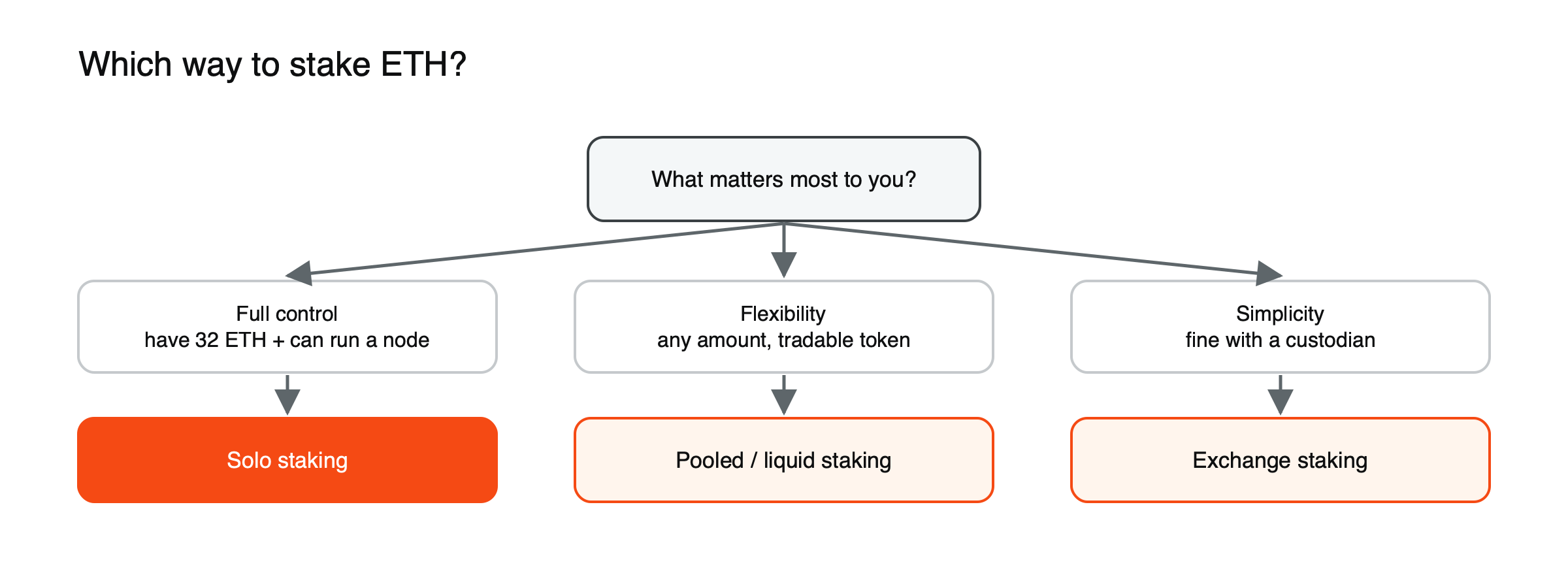
Figure: A quick way to choose a staking route. Rewards on every route are variable and not guaranteed.
Rewards on every route are variable, paid in ETH and never guaranteed.
What each route costs
- Solo staking: the hardware, electricity and a reliable internet connection, plus your time to maintain the setup. You keep all of the protocol’s rewards.
- Pooled or liquid staking: no hardware, but the protocol keeps a share of the rewards for its node operators and treasury.
- Exchange staking: no setup at all, but the exchange takes a commission from the rewards, often larger than a protocol’s share, and sets its own terms for unstaking.
If you have less than 32 ETH
Running your own validator requires 32 ETH. With less, the practical options are liquid staking protocols, which accept any amount, exchange staking, or pooled arrangements in which several people combine funds to run a validator together, sometimes using distributed validator technology so that no single participant controls the keys.
Running your own validator
- Prepare hardware: a dedicated computer that stays online, with enough storage for both an execution client and a consensus client.
- Install and sync both clients, choosing less common software where possible to support client diversity.
- Generate validator keys offline with the official tools, and store the mnemonic securely; it is the only way to recover withdrawal access.
- Set a withdrawal address you control, so rewards and your stake can be withdrawn later.
- Deposit 32 ETH through the official staking launchpad, checking the deposit contract address carefully.
- Run the validator and monitor it. Missed duties cost small penalties; running the same keys on two machines can cause slashing, as explained in what slashing is.
Since the Pectra upgrade, a single validator can hold an effective balance of up to 2,048 ETH, which lets large stakers consolidate instead of running many 32 ETH validators.
Withdrawal credentials, briefly
Every validator has withdrawal credentials that decide where its ether can go. Older validators sometimes still use a format with no withdrawal address, which must be updated before any ether can leave. Current setups point to an execution address you control, and since Pectra a compounding type lets rewards add to the validator’s effective balance above 32 ETH instead of being swept out automatically. Choosing the right type at the start avoids an extra migration later.
Your first week as a solo staker
- Check that the validator is attesting in every epoch on a public explorer.
- Set up alerts for missed duties and for disk space and connectivity.
- Write down a failover plan that never runs two copies of the same keys.
- Keep both clients updated, and follow announcements for scheduled network upgrades.
Using a pool or liquid staking protocol
- Choose a protocol and read how it selects operators, handles slashing and processes withdrawals.
- Connect your wallet to the protocol’s official site, typed in directly rather than from a link.
- Deposit ETH and receive a liquid staking token in return.
- Decide what to do with the token: hold it, or use it elsewhere knowing each extra protocol adds risk.
What liquid staking is covers why these tokens can trade below ETH.
Staking through an exchange
- Read the terms: fees taken from rewards, lockup or unstaking times, and what happens if the exchange pauses withdrawals.
- Check availability in your country; staking services are restricted in some jurisdictions.
- Opt in to staking for your ETH balance in the exchange’s app.
This is the simplest route, but your ETH is held by the exchange. Custodial vs non-custodial wallets explains what that means for you.
Plan your exit before you start
Unstaking passes through an exit queue on Ethereum and, depending on the route, a protocol or exchange queue as well. Liquid staking tokens can be sold instantly but possibly at a discount. Know how long your route takes to return ETH before you rely on that money.
Setup mistakes that cost the most
- Depositing through a fake launchpad. Copies of the official staking site circulate in ads and messages. Type the address yourself and confirm the deposit contract address against official sources before sending 32 ETH.
- Losing the validator mnemonic. Without it, you may be unable to change withdrawal settings or recover access. Store it offline, in more than one secure place.
- Setting an exchange deposit address as the withdrawal address. Some exchanges do not credit funds arriving from validator withdrawals; use an address in a wallet you control.
- Skipping a test on a test network. Running through the whole process on a test network first catches configuration errors without risking real ether.
If something goes wrong
- Validator offline: fix it calmly; small penalties stop once it is back. Never start a second copy while the first may still be running.
- Liquid staking token trading below ETH: decide between waiting for the protocol’s withdrawal queue and selling at a discount.
- Exchange withdrawals paused: contact support through official channels only and keep records of your balances.
For what staking is and why it exists, read what staking is in crypto. For the network itself, see what Ethereum is.
This article is educational content and does not constitute financial, investment, legal or tax advice. Digital assets are volatile and you may lose the amount you invest.