
What Are Meme Coins?
Meme coins are tokens driven by jokes, culture and attention rather than a product. How they are created, why prices spike and crash, and the risks to know.
Meme coins are cryptocurrencies built around a joke, a character or an internet trend rather than a product or network. Their price depends almost entirely on attention and community. That can produce extreme short-term gains, but most meme coins collapse within days or weeks, and creating one now takes minutes and costs almost nothing.
How meme coins are made
Most meme coins are tokens created on an existing blockchain with a standard contract. Launch platforms, such as pump.fun on Solana, let anyone name a token, upload an image and start trading it in a few clicks. The token usually trades against a liquidity pool first, and only a small minority ever reach a centralized exchange.
That ease explains the numbers. CoinGecko’s tracker went from about 428,000 tokens listed in 2021 to about 20.2 million by the end of 2025, with launch platforms driving most of the growth.
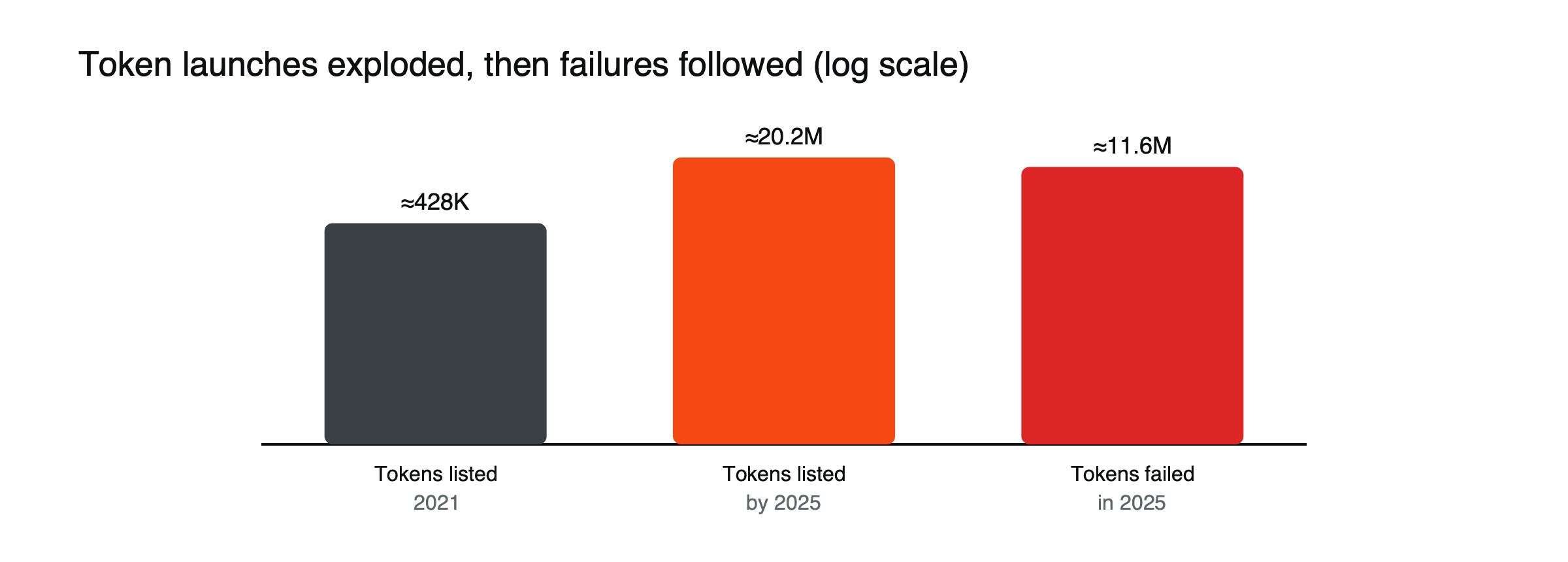
Figure: Easy launch platforms multiplied tokens, and failures followed. Data: CoinGecko via CryptoPotato, January 2026.
The first hour of a meme coin
Many launch platforms sell a new token along a bonding curve, a formula that raises the price automatically as more tokens are bought. Once enough has been raised, the token moves to a decentralized exchange where anyone can trade it. In the first minutes, automated bots often buy before most people even see the token. If the name or image catches on social media, more buyers arrive and the price climbs quickly. Within an hour, the token may have multiplied many times, or its creator and early bots may already have sold and moved on. Most tokens launched this way never attract a second wave of buyers, and their price drifts toward zero once the bots and early holders have sold.
Why prices spike
- Tiny starting value: a token that starts near zero can rise thousands of percent on modest buying.
- Attention loops: social posts, influencers and trending lists bring buyers, whose gains bring more posts.
- Thin supply on the market: early holders often control most of the supply, so little is available to buy.
- No anchor: with no revenue or usage to value, the price is whatever the next buyer pays.
Why most of them crash
The same forces work in reverse. Early holders and creators sell into the rally, attention moves to the next token, and liquidity disappears. CoinGecko classed 11.6 million tokens as failed in 2025 alone, meaning they stopped trading entirely, and it linked the surge to easy launch platforms and the collapse of the memecoin sector after the October 2025 sell-off.
The specific risks
- Insider supply: a few wallets holding most tokens can sell at any moment.
- Rug pulls: creators remove the liquidity or dump their holdings and disappear; see what a rug pull is.
- Contract traps: some tokens include code that blocks selling or charges huge sell taxes.
- Bots and snipers: automated traders buy in the first seconds of a launch and sell to later buyers.
- No recovery path: with no product, a fallen meme coin has nothing to rebuild on.
Who tends to make money
Money in a meme coin flows in a predictable direction. Creators can allocate themselves supply for almost nothing. Bots and fast traders buy in the first seconds. Launch platforms and decentralized exchanges collect fees on every trade, win or lose. Early holders who sell into the rally can take large profits. The buyers who arrive last, after a token trends on social media, provide the money everyone else takes out. That is why a meme coin market can be very profitable for a few participants while most buyers lose.
Meme coins also carry a risk that has nothing to do with the token itself: the wallet you use to trade them. Buying new tokens often means connecting to unfamiliar sites, approving contracts and following links shared in chat groups, which are exactly the conditions wallet drainers exploit. A separate wallet holding only what you are prepared to lose keeps a bad approval from reaching your main savings. Fake versions of popular meme coins, with the same name and image but a different contract address, are another very common trap, especially in the first hours after a token starts trending.
Celebrity and political tokens
Tokens linked to celebrities, influencers and political figures have followed the same pattern on a larger scale. Launches tied to famous names drew huge attention and volume in their first days, and many lost most of their value within weeks as insiders sold and attention moved on. A famous name brings buyers; it does not create anything that holds value once the attention fades.
Are any meme coins different?
A handful of meme coins have survived for years and built large communities, deep liquidity and listings on major exchanges. Even these move far more than bitcoin and depend on continued attention. Survival is the exception: for every long-lived meme coin there are millions that stopped trading.
If you choose to trade them
Treat any amount as money you can lose entirely, check holder concentration and liquidity on a block explorer, avoid tokens that cannot be sold in a test transaction, and never connect your main wallet to an unknown site. Our article on why most cryptocurrencies fail explains the wider pattern, and what an altcoin is puts meme coins in context.
This article is educational content and does not constitute financial, investment, legal or tax advice. Digital assets are volatile and you may lose the amount you invest.
A five-minute check before buying
- Holders: look at the top wallets on a blockchain explorer, excluding the liquidity pool, and see how much they control.
- Liquidity: check how much is in the trading pool and whether it is locked.
- Contract: look for owner powers to mint, pause trading or change taxes.
- Selling: read whether other buyers report failed or heavily taxed sales.
- Source: confirm the contract address from the project’s own channels rather than a link someone sent you.
None of these checks makes a meme coin safe; they only filter out the most obvious traps.
Frequently asked questions
Can a meme coin become a long-term investment?
Very few have. The survivors built large communities and wide exchange listings over years. Buying a new meme coin in the hope it will be the next one means betting against very long odds.
Why do meme coins keep launching if most fail?
Because creating them costs almost nothing, launch platforms earn fees on every trade, and a small number of spectacular winners keep attracting new buyers who hope to find the next one.
Sources
- Over Half of All Crypto Tokens Are Now Dead: CoinGecko Report (428,383 in 2021 to 20.2 million by 2025; 11.6 million failures in 2025; launchpads) — CryptoPotato via KuCoin, January 2026
- CoinGecko Reports Record Token ‘Mortality’ in 2025 (meme coin collapse; pump.fun; Q4 after the October crash) — ForkLog, January 2026