
What Is a Multisig Wallet?
A multisig wallet needs several keys to approve a transaction, such as 2 of 3. How multisig works, who uses it, its trade-offs and what the Bybit hack showed.
A multisig wallet, short for multi-signature, requires several separate keys to approve a transaction, such as any 2 of 3. No single stolen or lost key can move funds. Companies, DAOs and individuals use it to share control and avoid a single point of failure, but it cannot protect signers who approve a disguised malicious transaction.
How it works
The wallet is set up with a list of signers and a threshold, written as M of N:
- N is the total number of keys.
- M is how many must sign before a transaction goes through.
In a 2-of-3 setup, you might hold one key on a hardware wallet, a second on another device in a different place and a third with a trusted party or service. Any two can move funds; losing one key is not fatal.
On Bitcoin, multisig is built into the scripting system. On Ethereum, it is usually a smart contract wallet such as Safe.
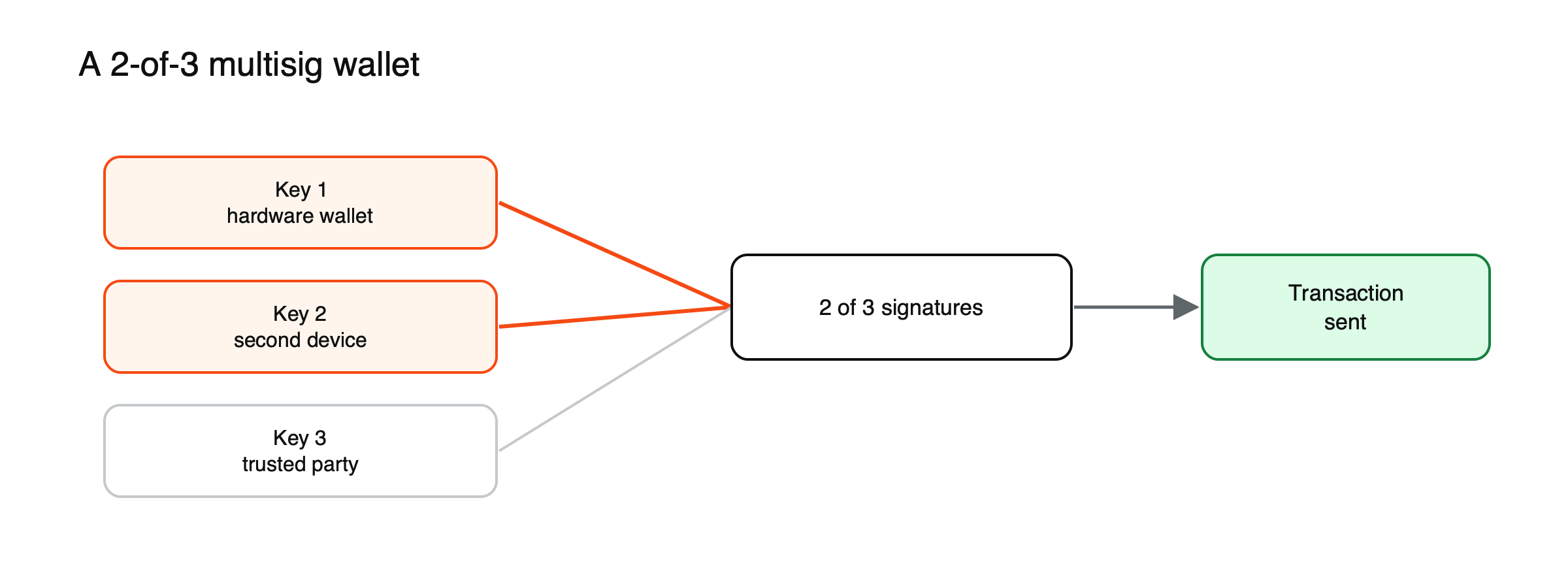
Figure: In a 2-of-3 setup, any two of the three keys can approve a transaction.
Choosing a threshold
| Setup | What it protects against | Main risk |
|---|---|---|
| 2 of 2 | Theft of either key alone | Losing either key locks funds |
| 2 of 3 | Theft of one key, loss of one key | Two keys held carelessly together |
| 3 of 5 | Several thefts or losses at once | More people and devices to coordinate |
For an individual, 2 of 3 is the most common balance: it tolerates one lost key and one stolen key. A 2-of-2 setup adds protection against theft but removes any room for loss, which makes it risky without a careful backup plan.
A 2-of-3 setup in practice
A typical personal setup uses three hardware wallets from different manufacturers, each with its own seed phrase. One stays at home, one in a separate secure location, and the third with a trusted person or a professional service that can co-sign when needed. To send funds, the owner creates a transaction in a coordinating wallet app, signs it with the home device, then signs with a second device. Neither device alone can move anything, and a burglar who finds one device and its seed phrase still cannot spend. If one device is lost, the owner uses the remaining two to move the funds into a new multisig with a replacement key, restoring the original level of protection. Label which device holds which key, without writing any seed words there.
The backup most people forget
In a Bitcoin multisig, the seed phrases are not the whole backup. To rebuild the wallet, you also need its configuration: which public keys are involved, in what order and with which threshold, usually stored as a “wallet descriptor” or the cosigners’ extended public keys. With two of three seed phrases but no record of the third key’s public information, rebuilding the wallet can be difficult or impossible. Keeping a copy of the configuration with each key’s backup avoids this. It does not let anyone spend, but it can reveal your balances, so it still deserves care.
Who uses it
- Individuals with large holdings who want no single point of failure.
- Companies and funds that need several people to approve payments.
- DAOs and protocols managing treasuries. See what a DAO is.
- Exchanges for cold storage.
Advantages
No single key loss or theft can drain funds; control can be shared; and it is useful for inheritance planning.
Drawbacks
It is more complex to set up and recover; every signer must protect their key; configuration mistakes can lock funds; and smart contract wallets add code risk.
Setup mistakes that defeat the purpose
- Keeping two keys in the same place, so one burglary or fire takes enough to spend or to lock you out.
- Using devices from one manufacturer, so a single flaw or supply-chain problem could affect every key.
- Skipping the configuration backup, leaving the wallet impossible to rebuild even with enough seed phrases.
- Never testing a recovery, so nobody knows whether the backups actually work.
- Choosing co-signers who may be unreachable, such as a relative abroad with no plan for being contacted in an emergency.
Multisig, MPC and collaborative custody
Multisig is not the only way to split control. Multi-party computation (MPC) wallets divide a single key into shares held by different parties, who combine their work to sign without ever reassembling the key. On-chain, the result looks like an ordinary single-signature transaction, which can lower fees and improve privacy, but the security depends on the provider’s software rather than on rules enforced by the blockchain. Collaborative custody services combine multisig with a company that holds one key and helps with recovery, so customers keep control of most keys while having a backstop if they lose one.
What the Bybit hack showed
On February 21, 2025, attackers stole about $1.5 billion in ETH from Bybit’s multisig cold wallet. They compromised a developer machine at the wallet provider Safe and altered what signers saw, so the required signers approved a malicious transaction that looked routine. Multisig stopped no one because every signature was given. The lesson: each signer must verify what they are signing on a trusted device. See what happened in the Bybit hack.
For storage basics, read hot wallet vs cold wallet, what crypto custody is and how to plan for crypto inheritance.
This article is educational content and does not constitute financial, investment, legal or tax advice. Digital assets are volatile and you may lose the amount you invest.
Frequently asked questions
Is multisig worth it for an individual?
It is most useful for large holdings, where the extra complexity is justified by removing any single point of failure. For smaller amounts, a single hardware wallet with a well-protected seed phrase is simpler and less prone to setup mistakes.
Does multisig cost more in fees?
On Bitcoin, multisig transactions are larger than single-signature ones, so they cost somewhat more, though modern formats reduce the gap. On Ethereum, smart-contract wallets pay extra gas for the contract logic. For long-term storage that moves rarely, the difference is usually minor.
Sources
- Lazarus hacked Bybit via breached Safe{Wallet} developer machine (multisig cold wallet; disguised malicious transaction) — BleepingComputer, February 2025
- SlowMist: Hacker techniques behind Bybit’s theft (Safe multisig; similar WazirX and Radiant cases) — DeFiHackLabs
- Seed Phrase (multisig backup schemes) — LearnBitcoin