
What Is an NFT?
An NFT is a unique blockchain token recording who owns a specific item. How NFTs work, what the 2021 boom and crash showed, and what buyers really own.
An NFT, or non-fungible token, is a unique blockchain token that records who owns a specific item, such as digital art, a collectible or an in-game object. Unlike bitcoin, where every unit is interchangeable, each NFT is one of a kind. Owning an NFT usually means owning the token, not the copyright to the image it points to.
Fungible and non-fungible
A fungible asset is interchangeable: one bitcoin is worth the same as any other. A non-fungible asset is unique: a concert ticket for seat 12A is not the same as one for seat 30F. NFTs bring that uniqueness to blockchains, using token standards that give each token its own ID.
How an NFT works
- A creator mints the NFT, writing a new token with a unique ID into a smart contract.
- The token points to the item, usually through a link to an image or file stored elsewhere.
- Ownership is recorded on-chain, so anyone can verify which address holds it.
- The NFT can be sold or transferred on marketplaces, and some contracts ask for a royalty to the creator on resale.
A mint, step by step
Suppose an artist releases a collection of 1,000 images. A smart contract following a common NFT standard is deployed, with a function that creates a new token with the next available ID each time someone mints. A buyer connects a wallet, pays the mint price plus the network fee and receives, say, token number 417. The contract records that the buyer’s address owns token 417 and stores a link to a small metadata file describing it: its name, traits and the location of the image. The image itself usually lives on a decentralized storage network or an ordinary web server. Marketplaces read the contract and the metadata to display the token, its owner and its sales history.
What you actually own
The token itself, and the record that you hold it. The image or file is usually stored off-chain, and if that storage disappears, the token can point to nothing. Rights to reproduce or use the artwork depend on the license the creator grants, which varies widely. Buying an NFT of a picture does not normally make you the owner of the picture’s copyright.
The boom and the crash
NFTs reached mainstream attention on March 11, 2021, when Christie’s sold Beeple’s “Everydays: The First 5000 Days” for $69.3 million including fees. Trading surged through 2021 and into early 2022.
Then demand collapsed. Monthly NFT trading volume fell roughly 97% from about $17 billion in January 2022 to about $466 million by September 2022. Christie’s own NFT sales fell 96% in 2022, to $5.9 million. Art NFT trading volume dropped from about $2.9 billion in 2021 to about $197 million in 2024, according to DappRadar. Most collections from the boom lost nearly all their trading activity.
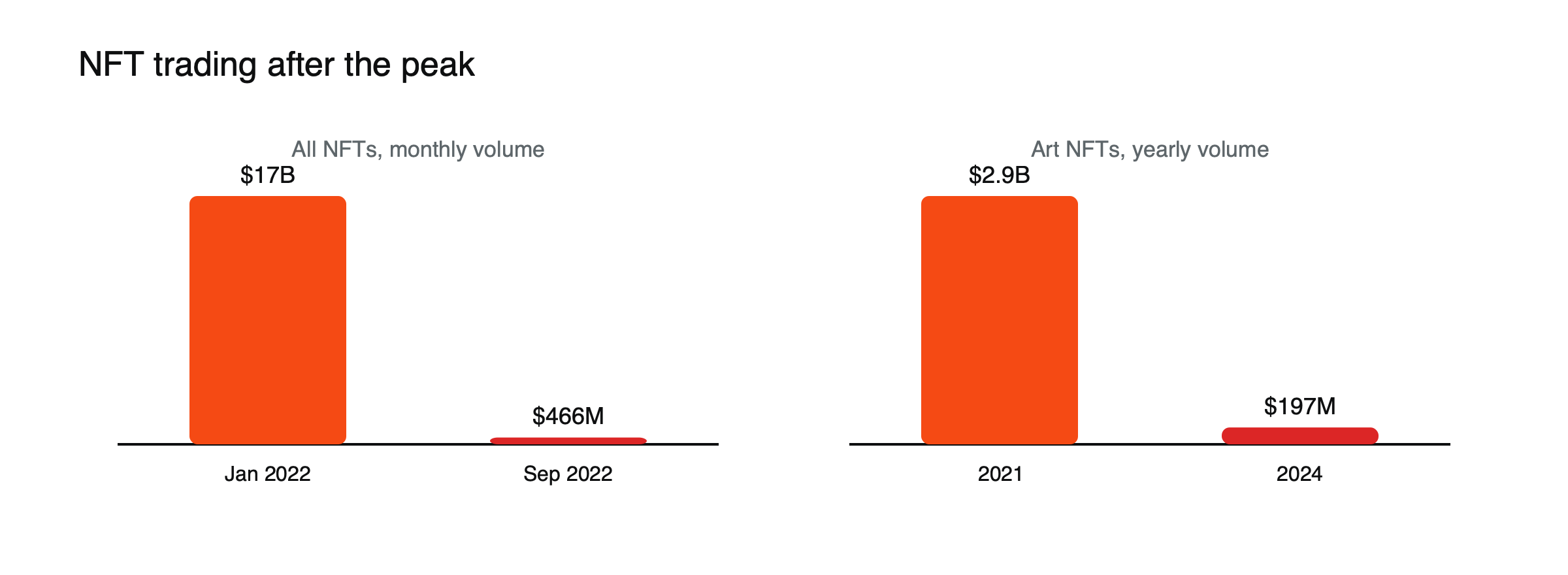
Figure: How far NFT trading fell after the peak. Sources: DappRadar and Bloomberg via Masterworks; DappRadar art NFT report.
Royalties: promised and enforced
Early marketplaces paid creators a royalty, often a few percent, each time an NFT was resold. Royalties were usually a marketplace policy rather than a rule enforced by the token’s contract, so when competition among marketplaces intensified in 2022 and 2023, several made royalties optional or reduced them. Some collections responded with contracts that block trading on marketplaces that ignore royalties, with mixed results. For creators, royalty income became far less reliable than the early boom suggested; for buyers, it is worth checking what fees a sale actually involves.
Wash trading and misleading volume
NFT markets have been prone to wash trading, in which the same person or group buys and sells an item between their own wallets to inflate its apparent price or volume, sometimes to collect marketplace rewards. Headline sales figures can therefore overstate real demand. Looking at how many distinct wallets have bought from a collection, and whether large sales happen between connected addresses, gives a more honest picture.
NFT markets are also far smaller than at their peak. Annual sales of NFT art fell to about $197 million in 2024, a fraction of the boom-era totals, so liquidity for most collections is thin and prices can drop sharply when a few holders decide to sell. Checking recent completed sales, not asking prices, shows what buyers are actually willing to pay.
Where NFTs are still used
Beyond speculative art, NFTs work as tickets, memberships, in-game items, domain names and proof of attendance. Some tokenization projects use similar standards to represent real-world assets. These uses depend less on resale prices and more on whether the token does a job.
Checking an NFT before you buy
- Confirm the collection’s contract address from the project’s official site; copies with the same images are common.
- Look at the sales history for patterns of trades between the same few wallets.
- Check where the image and metadata are stored, and whether the creator can change them.
- Read the license, to see what you may and may not do with the artwork.
- Consider who would buy it from you, by looking at recent sales and open offers rather than asking prices.
Owning a token is not owning the copyright
Buying an NFT usually gives you the token and whatever license the creator grants, not the copyright in the artwork. Some collections allow commercial use of the image; many allow only personal display. Disputes have arisen when buyers assumed rights they did not have, so the license terms deserve as much attention as the price.
Risks to know
- Illiquidity: many NFTs have no buyers at any price.
- Off-chain storage: the linked file can disappear or change.
- Fakes and copies: anyone can mint a copy of an image; checking the original contract matters.
- Wallet drainers: fake mint sites and malicious approvals are common NFT scams.
- Unclear rights: the license may give you far less than you expect.
For the wider family of tokens, read what an altcoin is and what tokenization is. For the contracts behind NFTs, see what a smart contract is.
This article is educational content and does not constitute financial, investment, legal or tax advice. Digital assets are volatile and you may lose the amount you invest.
Frequently asked questions
Can an NFT’s image change after I buy it?
It can, if the metadata is stored somewhere the creator controls and the contract allows updates. Collections that store metadata on decentralized storage and fix it in the contract offer more certainty than those served from a regular website.
Are NFTs only used for art?
No. They also serve as event tickets, memberships, in-game items, domain names and records of ownership for some tokenized assets. Art and collectibles drew the most attention, but they are only one use.
Sources
- Beeple NFT work sells for $69.3m at Christie’s — The Art Newspaper, March 11, 2021
- The most expensive NFTs and what happened to them (monthly volume ~$17B in January 2022 to ~$466M by September 2022; DappRadar, Bloomberg) — Masterworks, June 2026
- NFT Art’s Collapse: From $2.9 Billion Boom to $23.8 Million Bust ($197 million in 2024) — DappRadar, 2025
- Christie’s NFT sales slump 96% in 2022 ($5.9 million) — ForkLog