
Why Payroll Data Can Move Bonds Before Stocks
Jobs reports change expectations for interest rates, so short-term Treasury yields often react first. How payroll data flows through bonds to stocks and crypto.
Payroll data moves bonds first because the US jobs report changes expectations for Fed rate decisions, and short-term Treasury yields track those expectations most directly. Stocks react to growth and rates at once, so their response is slower and more mixed. Strong jobs data pushed risk assets lower in 2022 because it implied more hikes.
How the jobs report flows through markets
- Release: the monthly nonfarm payrolls report, with the unemployment rate and wages.
- Rates repricing: a strong report raises expected rates; short-term yields jump within minutes.
- Currency: higher expected rates tend to lift the dollar.
- Stocks and crypto: weigh better growth against higher rates; which wins depends on the inflation backdrop.
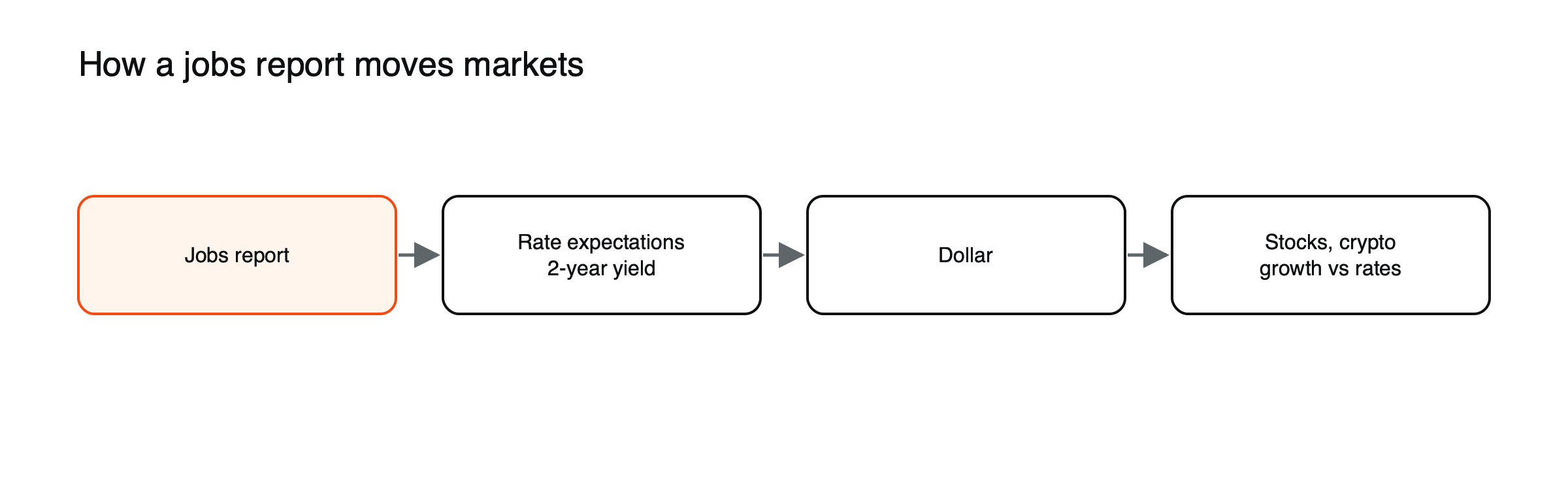
Figure: How payroll data reaches each market.
Why bonds are cleaner. A 2-year Treasury yield is mostly a bet on the Fed’s path over two years, so it reacts directly. Stocks also reflect earnings, sector mix and sentiment, which blur the signal.
What the report contains
The monthly US employment report, usually released on the first Friday of the month, combines two surveys. The establishment survey of employers produces the nonfarm payrolls figure and average hourly earnings; the household survey produces the unemployment rate. Revisions to previous months can be as important as the headline, because they change the picture of recent trends. Wages matter for inflation, and the unemployment rate for recession risk.
A jobs-day move, illustrated
Suppose economists expect 150,000 new jobs and the report shows 280,000, with wages rising faster than forecast. (Illustrative scenario.) Within minutes, traders reduce bets on rate cuts, the 2-year Treasury yield jumps perhaps 0.15 points, the 10-year less, the dollar strengthens and share index futures dip. If instead the report shows 20,000 jobs and rising unemployment, the 2-year yield may fall sharply as markets price faster cuts. The 2-year moves most because it is closest to the Fed’s next decisions.
When good news is bad news
When inflation is the main worry, a strong labor market means more tightening, so stocks can fall on good jobs data, as in October 2022 when strong payrolls pushed risk assets lower. When growth is the worry, the same report can lift stocks.
When bad news is bad news
When markets fear recession rather than inflation, weak jobs data can hit shares hard. In early August 2024, a weaker-than-expected US jobs report added to growth worries in the days before the global sell-off of August 5, when Japan’s Nikkei fell 12.4%. Bond yields fell sharply as investors sought safety and priced faster rate cuts. See why volatility in one market spills into others.
Crypto’s reaction is fading
One 2026 study found that a 100,000-job surprise moved bitcoin only about 0.16% in the following hour, and that its reaction to payrolls was weakening while its reaction to inflation data strengthened. See inflation surprise vs inflation trend.
For the policy context, read what markets listen for in a central bank meeting and soft landing vs hard landing vs no landing.
Revisions and noise
Monthly payroll figures are estimates, and revisions can be large, sometimes changing the story of the previous months. Annual benchmark revisions can shift job counts by hundreds of thousands. Traders who react strongly to one month’s headline can be caught out when the next report revises it, which is why many focus on three-month averages and trends.
Payrolls and the dollar
A strong report usually lifts the dollar as rate expectations rise, and a weak one weakens it. Currency moves can be sharp in the minutes after the release, with spreads widening. See why nonfarm payrolls move the dollar.
Trading around the release
Liquidity can thin and prices can gap in the seconds after the release. Many traders reduce positions beforehand, avoid tight stops and wait for the first move to settle. Comparing the headline, revisions, wages and unemployment together, rather than reacting to one figure, gives a fuller picture of what the report means for rates. See how to read an economic calendar.
Wages and inflation
Average hourly earnings matter because wage growth feeds into services inflation, which central banks watch closely. Wages rising much faster than productivity can keep inflation high, prompting tighter policy. In periods when inflation is the main worry, the wage figure can move bond yields more than the headline job count.
The unemployment rate
The unemployment rate signals whether the labor market is tightening or loosening. A rising rate has historically been an early sign of recession, and rapid increases from a low level have often preceded downturns. Markets therefore react strongly when unemployment rises more than expected, especially when inflation is already easing.
Other labor data
The monthly report is only one source. Weekly jobless claims give a faster read on layoffs; job openings data show demand for workers; private payroll estimates arrive a few days before the official report. Traders use these to adjust expectations before payroll day, so the official report’s surprise is measured against an updated consensus.
Seasonal and one-off effects
Payroll figures are seasonally adjusted, but weather, strikes, natural disasters and government hiring can distort individual months. Analysts often look through such effects, focusing on underlying trends.
Common misreadings
- Reacting only to the headline job count.
- Ignoring revisions to earlier months.
Payrolls in 2022
Throughout 2022, strong job growth convinced markets that the Fed could keep raising rates without causing an immediate recession. Strong payroll reports often pushed short-term yields higher and shares lower, because they implied more tightening. The October 2022 report, showing continued strength, pushed risk assets lower, a clear example of good economic news being bad for markets.
The 2-year and 10-year on jobs day
The 2-year yield usually moves most on jobs day, because it reflects expectations for Fed policy over the next two years. The 10-year moves less, because it also reflects long-term growth, inflation and the term premium. A strong report can therefore flatten the curve, with short yields rising more than long yields; a weak report can steepen it. See why yield curve steepening can mean very different things.
Payrolls and gold
Gold often reacts to payrolls through yields and the dollar: a strong report that lifts real yields and the dollar tends to weigh on gold, while a weak report that lowers them tends to support it. The reaction can reverse if weak data raise recession fears strongly enough to boost safe-haven demand. See what usually happens to gold when the Fed starts cutting.
Payrolls in a soft landing
In a soft landing, job growth slows gradually without collapsing, wages cool and unemployment rises only slightly. Markets often welcome moderate reports in that phase, because they suggest inflation can fall without a recession. Very strong or very weak reports both create risks: the first for inflation, the second for growth. Reports in the middle range have tended to support both shares and bonds. See soft landing vs hard landing vs no landing.
A jobs-day checklist
- What is the consensus for jobs, unemployment and wages?
- Did earlier labor data shift expectations?
- Are revisions changing the trend?
- Is the Fed more focused on inflation or growth?
Payrolls and share sectors
Within share markets, strong reports tend to favor cyclical sectors such as industrials and banks when growth is the worry, while weak reports favor defensive sectors and bond-like shares such as utilities. When inflation is the worry, strong reports can hurt rate-sensitive sectors most, including technology and property. Watching sector moves on jobs day shows which concern dominates. It also helps distinguish a genuine shift in the outlook from a temporary reaction that may fade once the details, including revisions and wages, have been digested by the market.
Frequently asked questions
Why do bonds react faster than stocks?
Short-term bond yields track expected central bank rates directly; shares must weigh rates against growth and earnings, which takes longer to settle.
Which part of the report matters most?
It depends on the Fed’s focus: payrolls and unemployment when growth is the worry, wages when inflation is.
This article is educational content and does not constitute financial, investment, legal or tax advice. Digital assets are volatile and you may lose the amount you invest.
Sources
- Bitcoin falls to start the week (strong jobs data pushed risk assets lower) — CNBC, October 10, 2022
- Is Bitcoin showing greater sensitivity to US CPI releases again? (100K payroll surprise moved BTC about 0.16% in an hour; reaction fading) — Block Scholes, 2026
- The Yen Carry Trade that Crashed the Markets in August 2024 (Nikkei −12.4% on August 5) — Money by CJ