
What Are Perpetual Futures?
Perpetual futures are crypto contracts with no expiry that track the spot price through funding payments. How perps work, margin and leverage, costs and risks.
Perpetual futures, or perps, are crypto derivative contracts that let traders bet on an asset’s price rising or falling, usually with leverage, without an expiry date. Instead of converging at expiry, they stay close to the spot price through funding payments between buyers and sellers. BitMEX launched the first widely used crypto perpetual in May 2016.
Where perpetual futures came from
Traditional futures contracts expire on a set date, which forces traders to close or roll their positions. In May 2016, the exchange BitMEX launched a bitcoin contract that never expired, using regular funding payments to keep its price close to the spot market. The design spread to almost every major crypto exchange and became the most traded instrument in crypto, with daily volumes often far larger than spot trading. Decentralized exchanges later built on-chain versions of the same idea.
How perps work
You open a long position if you expect the price to rise or a short if you expect it to fall. You never own the underlying coin; your profit or loss is the change in the contract’s value. Positions stay open until you close them or until they are liquidated.
Margin and leverage
To open a position you post margin, a deposit that backs it. With 10x leverage, $1,000 of margin controls a $10,000 position. Gains and losses are calculated on the full $10,000, so a 10% move against you wipes out the $1,000. Exchanges close positions automatically before losses exceed the margin; this is liquidation. See how to calculate a liquidation price.
Isolated margin limits the risk to the margin assigned to one position. Cross margin uses your whole account balance to support all positions, which delays liquidation but puts more money at risk.
A long trade, worked through
Suppose bitcoin is at $60,000 and you open a long position worth $10,000 with $1,000 of margin, which is 10x leverage. (Illustrative figures.) Your position is equivalent to about 0.1667 BTC.
- If bitcoin rises 5% to $63,000, the position gains about $500, a 50% return on your margin.
- If bitcoin falls 5% to $57,000, it loses about $500, half your margin.
- At 10x leverage, a fall of roughly 9.5% would trigger liquidation, wiping out most of the margin once fees are counted.
If funding is 0.01% every eight hours and longs are paying, you pay about $1 per period on $10,000, roughly $3 a day. Held for a year at that rate, funding alone would cost about $1,095, nearly 11% of the position’s value.
Hedging with a short
Perps are not only for speculation. Someone holding bitcoin who expects a temporary fall can open a short perp of the same size, so gains on the short offset losses on the coins. A miner expecting to sell future output can lock in the current price the same way. The hedge costs funding when shorts pay, and it needs margin that can be liquidated if the price rises sharply, so it must be managed rather than forgotten.
Funding: how perps track the spot price
Every few hours, usually every 8, traders on one side pay the other a funding payment. When the perp trades above spot, longs pay shorts; when below, shorts pay longs. This pulls the contract price back toward spot. See how funding rates are calculated.
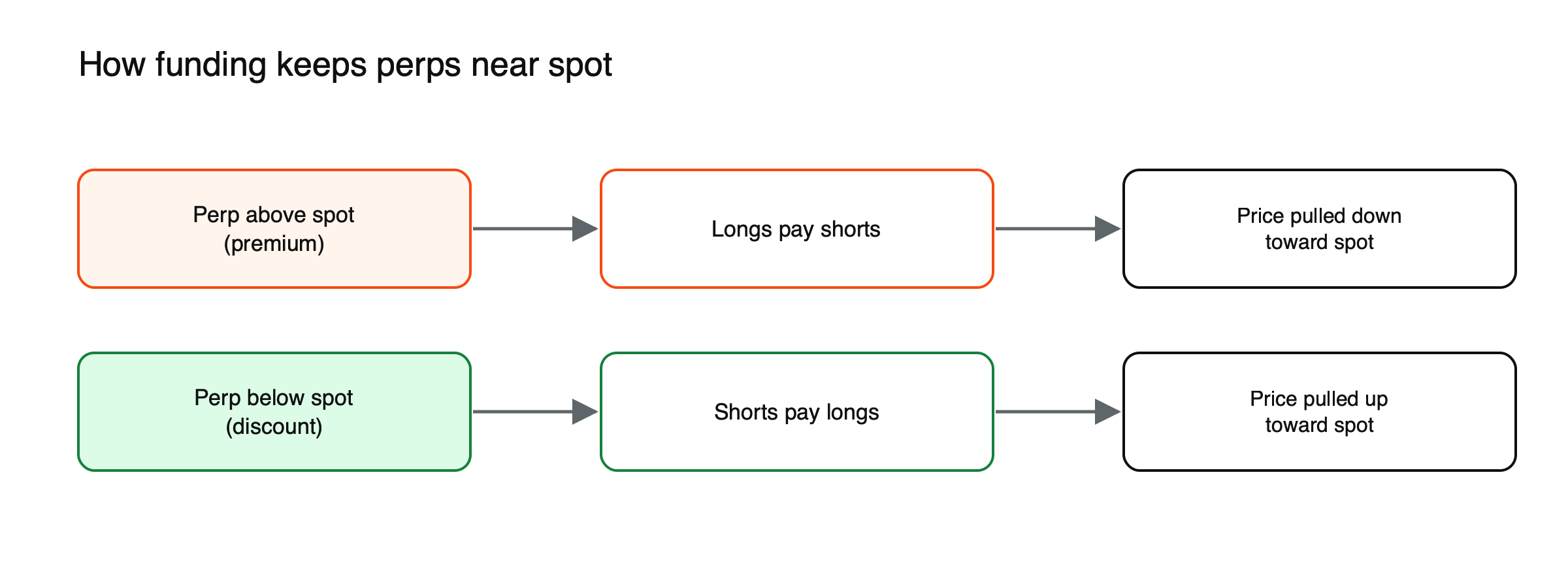
Figure: Funding payments pull the perpetual’s price back toward spot.
Mark price and liquidation
Exchanges use a mark price, based on prices from several spot markets, to decide liquidations, so a brief spike on one exchange does not liquidate everyone. Your position is liquidated when the mark price reaches your liquidation price.
Isolated and cross margin, compared
Suppose you have $5,000 in your account and open a $10,000 long with $1,000 of margin. (Illustrative figures.) With isolated margin, only that $1,000 backs the position: if the trade goes badly, you lose at most the $1,000 and the other $4,000 is untouched. With cross margin, the whole $5,000 supports the position, so it can survive a much larger move before liquidation, but if the move keeps going, you can lose far more than $1,000. Isolated margin caps each trade’s damage; cross margin trades that cap for more room.
Insurance funds and auto-deleveraging
When a position is liquidated at a worse price than its bankruptcy price, the exchange’s insurance fund normally covers the gap, funded partly by liquidation fees. In extreme moves, when the insurance fund is not enough, some exchanges use auto-deleveraging: they close part of the most profitable opposing positions to cover the shortfall. Traders on the winning side can therefore see their positions reduced without choosing to. Checking how a platform handles these cases is part of understanding its risk.
Order types worth knowing
- Limit orders set the price you are willing to pay or accept and often pay lower fees.
- Market orders fill immediately at the best available prices, which can be poor in fast markets.
- Stop-loss orders close a position if the price reaches a level you set, before liquidation does it for you.
- Take-profit orders close a position at a target gain.
- Reduce-only orders can only shrink a position, which prevents accidentally opening a new one in the opposite direction.
Perps, dated futures and options
| Perpetual futures | Dated futures | Options | |
|---|---|---|---|
| Expiry | None | Fixed date | Fixed date |
| How price stays near spot | Funding payments | Converges at expiry | Priced from spot, time and volatility |
| Maximum loss for a buyer | Margin, through liquidation | Margin, through liquidation | The premium paid |
| Typical use | Short-term trading, hedging | Hedging, basis trades | Hedging, defined-risk bets |
Open interest and what it signals
Open interest is the total value of perp positions that remain open. Rising open interest during a rally means new money and leverage are entering; very high open interest combined with high funding rates suggests a crowded trade, which can unwind violently. Falling open interest during a sell-off often reflects positions being closed or liquidated. See what open interest is.
Choosing leverage
The maximum leverage an exchange offers says nothing about what is sensible. At 50x, a move of about 2% can wipe out a position; at 3x, it takes a move of roughly 30%. Many experienced traders use low leverage, or none, and size positions so that a loss on any single trade is a small share of their account. The goal is to survive the moves you did not expect, because crypto produces them often.
Funding rates in practice
In calm markets, funding often sits near a small positive rate, because more traders want to be long than short. During strong rallies it can climb several times higher as demand for leveraged longs grows, making it expensive to hold long positions for long. In sharp sell-offs it can turn negative, so shorts pay longs. Traders watch funding as a gauge of positioning: persistently high funding has often preceded sharp corrections, as crowded longs become vulnerable. See how funding rates are calculated.
Why perps dominate crypto trading
Perpetual futures combine several features traders want: leverage, the ability to go short easily, no expiry to manage and trading around the clock. Exchanges also earn substantial fees from them. As a result, perp volumes on major exchanges have often been several times larger than spot volumes, which means perp positioning, funding and liquidations can drive short-term price moves in the spot market as well.
Costs of trading perps
- Trading fees on entry and exit.
- Funding payments, which can add up when you hold for days or weeks.
- Liquidation fees when a position is force-closed.
Perps vs spot vs dated futures
Spot gives you the asset itself. Dated futures expire on a set date and converge to spot then; see how to calculate the annualized basis on crypto futures. Perps never expire and use funding instead. For spot, see what spot trading is.
Perpetuals on decentralized exchanges
On-chain perp exchanges let traders open positions from their own wallets, with margin held in smart contracts and liquidations run by code. They remove the risk of an exchange freezing customer funds but add smart-contract and oracle risk, and liquidity can be thinner. Funding, margin and liquidation work in much the same way.
Who can trade them
Access depends on where you live. Many regulators restrict or ban leveraged crypto derivatives for retail customers, and large offshore exchanges block users from certain countries. Regulated brokers in some regions offer price exposure to crypto through contracts for difference instead, often with lower leverage limits for retail clients. Checking what is permitted where you live, and who regulates the platform, matters before opening an account. See what a CFD is.
Risks to know
- Liquidation from small moves at high leverage.
- Cascades of liquidations in fast markets. See what causes liquidation cascades.
- Funding costs on long holds.
- Exchange risk, since positions and margin sit on the platform.
Trading with leverage magnifies losses as well as gains and can lead to the rapid loss of your entire margin.
This article is educational content and does not constitute financial, investment, legal or tax advice. Digital assets are volatile and you may lose the amount you invest.
A checklist before opening a position
- How much of your account would you lose if the trade went straight to your stop or liquidation price?
- What is your liquidation price, and how far is it from the current price?
- What is the current funding rate, and how long do you plan to hold?
- Is there major news, such as a central bank decision or a token unlock, due soon?
- Is the platform regulated where you live, and how does it handle extreme moves?
Practising with a very small position first, on the same platform and settings you plan to use, shows how margin, funding and fees behave in practice.
Frequently asked questions
Can I lose more than my margin?
On most crypto exchanges, liquidation and insurance funds are designed to stop losses at your margin. In extreme moves, some platforms have used mechanisms that reduce profitable traders’ gains to cover shortfalls. Losses beyond your deposit are rare but the rules differ by platform.
Why does the perp price differ from the spot price?
Because perps trade on their own order books, driven by traders’ demand for leverage in either direction. Funding payments push the price back toward spot, but gaps can persist when one side is much more crowded than the other.
Do I own bitcoin when I buy a perp?
No. A perp is a contract on bitcoin’s price. You cannot withdraw coins from it, and your position exists only on the platform where you opened it.
Sources
- Funding rate (BitMEX launched the first widely used crypto perpetual in May 2016; funding roughly every 8 hours) — BIT Knowledge Hub
- Funding Rate (BitMEX XBTUSD; settlement at 00:00, 08:00 and 16:00 UTC on major exchanges) — Spark
- Liquidation Price (mark price; isolated vs cross margin; 10x ≈ 9.5% move) — Spark