
Perpetual Futures Mistakes That Lead to Liquidation
Perpetual futures mistakes sorted by how fast they hurt: high leverage, no stop, cross margin, funding, adding to losers and thin contracts.
The perpetual futures mistakes that cause most liquidations are using high leverage, trading without a stop-loss, ignoring funding, misusing cross margin, trading thin contracts and adding to losing positions. Some can end an account in minutes; others drain it over weeks. Sorting them by speed shows which to fix first.
Sorted by how fast they hurt
Not all mistakes are equally dangerous. A few can wipe out an account in a single move. Others work slowly, through costs that build up while a position stays open. A last group rarely causes a disaster on its own but quietly worsens every result. Fixing the fast ones first protects the account long enough to work on the rest.
Mistakes that can end an account in minutes
Using high leverage
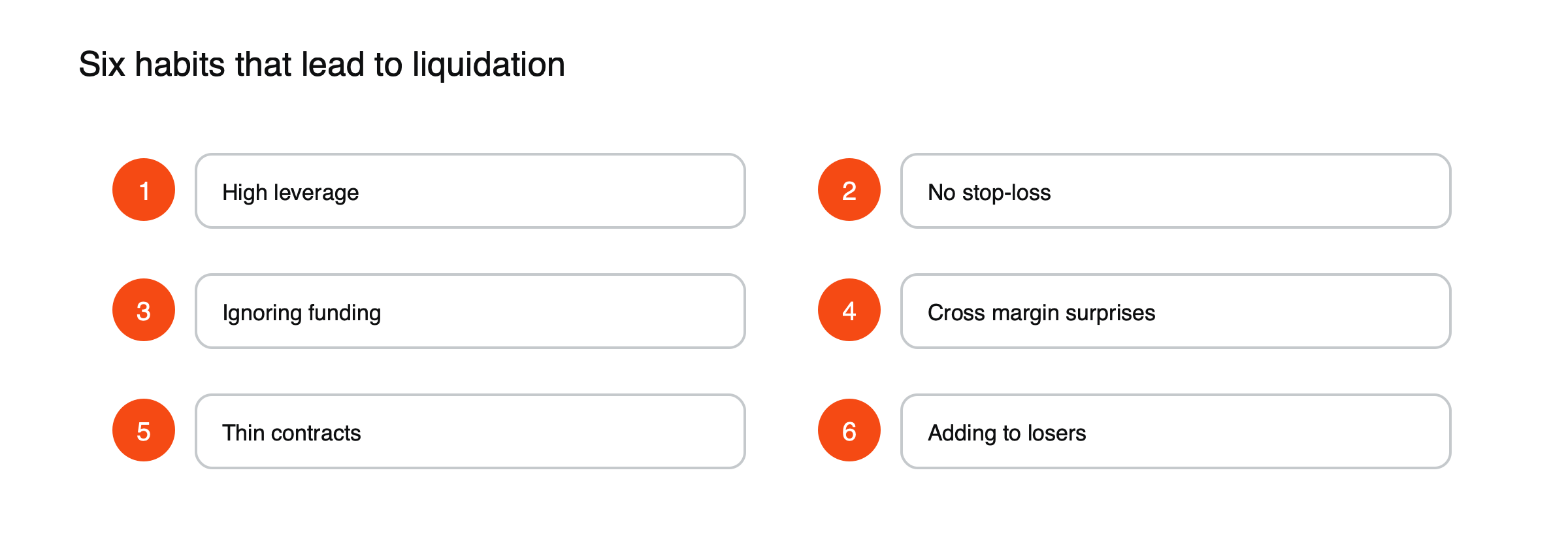
Figure: Six habits that shorten the road to liquidation.
At 10x, a move of about 9.5% against a long liquidates it; at 50x, about 1.5% is enough. Crypto regularly moves several percent in an hour, so high leverage turns normal volatility into liquidation. The damage is immediate and total for that position. The remedy is to choose leverage from the size of loss you can accept, not from the maximum the exchange offers. See how to calculate a liquidation price.
Trading without a stop-loss
Without a stop, the exchange’s liquidation engine becomes your exit, at the worst moment and with an extra fee. A stop placed well before the liquidation price, at the point where your idea is clearly wrong, keeps the loss to a size you chose. In fast markets, stops can fill below their trigger price, so leave a buffer between the stop and liquidation rather than placing them side by side.
Using cross margin without understanding it
Cross margin uses your whole account balance to support open positions. That delays liquidation, but if a trade keeps going against you, it can consume funds you meant to keep safe, and one losing position can drag down others. Isolated margin caps each position’s loss at the margin assigned to it, which is why most beginners are better served by it. See what perpetual futures are.
Mistakes that drain an account over days and weeks
Ignoring funding
Funding is paid every few hours for as long as a position is open. In crowded markets it can be large: at 0.25% every 8 hours, a $10,000 position pays $75 a day. Over a couple of weeks, funding can cost more than the price move earns, turning a correct view into a losing trade. Checking the current rate before opening, estimating the cost over your planned holding period and watching it while you hold prevents the slow leak. See how funding rates are calculated.
Adding to losing positions
Averaging down with leverage increases the size of the position and can move the liquidation price closer, not further away. A trade that should have been a small, accepted loss becomes a large one. Deciding the maximum position size before the first entry, and treating a stop as final rather than as an invitation to add, keeps one bad idea from growing.
Trading too often because it is easy
Perpetuals make opening and closing positions effortless, and fees are charged on the full position value, not on the margin. Frequent trading at leverage multiplies those costs quickly. A trader opening and closing a 10x position many times a day can pay a large share of their margin in fees within weeks, even if the trades roughly break even.
Mistakes that quietly erode results
Trading thin contracts
Smaller-coin perpetuals often have shallow order books. Prices can spike to liquidation levels on little volume, and market orders can fill far from the quoted price. Checking open interest, volume and order book depth before trading a contract shows whether it can handle your size. See what open interest is.
Not knowing how the exchange measures price
Liquidations use the exchange’s mark price, built from several markets, not the last trade on the chart you are watching. Stops may trigger on a different price from liquidations, depending on settings. Not understanding which price controls what leads to surprises: a stop that did not fire, or a liquidation that seemed to happen early.
Overlooking how extreme moves are handled
In violent markets, some exchanges reduce profitable traders’ positions automatically to cover losses that their insurance funds cannot absorb. Traders who never read these rules can find a winning position closed without warning. Knowing a platform’s rules for extreme events is part of knowing its risks.
Why these mistakes travel together
These mistakes rarely appear alone. High leverage makes a stop feel unnecessary, because the position seems small in margin terms. A trade without a stop invites adding to it as it moves against you. Cross margin lets that growing position borrow from the rest of the account, and funding quietly adds cost the whole time. One decision, usually about leverage, sets off the rest. That is why many experienced traders set their leverage and maximum loss first, before looking at any chart, and treat those limits as fixed for the session. Breaking the chain at its first link prevents most of what follows.
One account, three mistakes
Suppose a trader with a $5,000 account opens a $50,000 long, 10x leverage, on cross margin and without a stop, while funding runs at 0.05% every 8 hours. (Illustrative figures.) Over three days, funding costs about $225. The price then falls 6%, a $3,000 loss, leaving about $1,775 of equity. Hoping for a bounce, the trader adds $20,000 more, bringing the position to about $67,000. A further 4% fall costs about $2,680, more than the remaining equity, and the whole account is liquidated. The same view, expressed as a $10,000 position with isolated margin and a stop 5% below entry, would have cost about $500 plus fees, leaving the account almost intact for the next idea. The difference was not the market view, which was the same in both cases, but the size, the margin mode, the missing stop and the decision simply to add. Each of those was chosen before the price moved, which is exactly why they can be fixed in advance, at no cost at all.
Before opening any position
- What is the liquidation price, and how far is it from the current price?
- Where is the stop, and how much would hitting it cost?
- What is funding now, and what will it cost over the planned holding period?
- Is the position using isolated or cross margin?
- Is the contract liquid enough for the size?
Trading with leverage magnifies losses as well as gains and can lead to the rapid loss of your entire margin.
This article is educational content and does not constitute financial, investment, legal or tax advice. Digital assets are volatile and you may lose the amount you invest.