
What Are Privacy Coins?
Privacy coins hide senders, receivers or amounts on-chain. How Monero and Zcash work, why exchanges delist them and what EU rules change in 2027.
Privacy coins are cryptocurrencies designed to hide who sent a payment, who received it or how much was sent, unlike bitcoin, whose ledger shows all of that. The best known are Monero and Zcash. Their privacy has legitimate uses but is hard to monitor, so many exchanges have delisted them and EU rules restrict them from July 2027.
Why privacy coins exist
Bitcoin is pseudonymous, not anonymous: every payment is public, and analysts can often link addresses to people. Our guide to whether Bitcoin is anonymous explains how. Privacy coins aim to make digital payments as private as cash, protecting businesses’ and individuals’ financial information from competitors, criminals and surveillance.
How the main privacy coins work
Monero (XMR) makes privacy the default for every transaction. Ring signatures hide the real sender among a group of decoy keys, one-time addresses hide the receiver, and amounts are concealed.
Zcash (ZEC) makes privacy optional. Users can send ordinary transparent transactions or shielded ones that use zero-knowledge proofs, called zk-SNARKs, to prove a payment is valid without revealing the sender, receiver or amount. Our article on zero-knowledge proofs explains the idea.
Dash offers an optional privacy feature on top of otherwise transparent transactions.
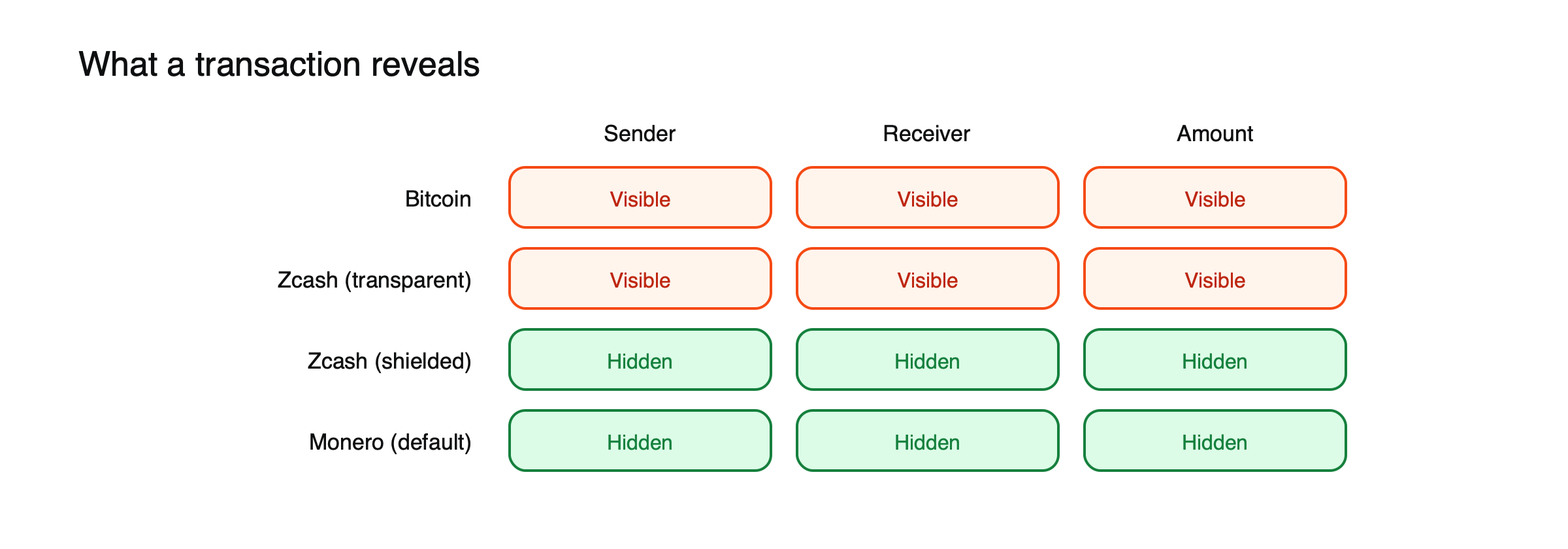
Figure: What a typical transaction reveals on each network. Monero hides by default; Zcash only when shielded.
How a Monero payment stays private
When someone sends Monero, three techniques work together. The sender’s signature is mixed with signatures from several other past outputs on the blockchain, so an observer cannot tell which one is actually being spent. The receiver gets a one-time address generated for that payment alone, so their public address never appears on the blockchain. And the amount is hidden using cryptographic commitments that let the network check that no new coins were created without revealing how much moved. The result is a ledger that proves payments are valid while revealing very little about who paid whom, or how much.
Optional privacy in practice
Zcash’s model gives users a choice, which changes how privacy works in practice. Shielded transactions hide sender, receiver and amount, but transparent ones look much like Bitcoin’s. When most activity is transparent, the shielded pool is smaller, and people moving funds between the two can leave traces that reduce privacy. Privacy is strongest when many users choose it at the same time, which is why default privacy, as in Monero, and optional privacy, as in Zcash, lead to different results even when the cryptography is sound.
Why exchanges delist them
Regulated exchanges must monitor transactions for money laundering and sanctions, which is difficult when amounts and parties are hidden. In January 2024, OKX delisted Monero, Zcash and Dash. Binance delisted Monero in February 2024, and Kraken removed it for customers in Ireland and Belgium later that year. Attackers have also used privacy coins to move stolen funds, including in laundering proceeds of the 2025 Bybit hack, according to CertiK.
What changes in the EU in 2027
The EU’s Anti-Money Laundering Regulation will apply from July 10, 2027. It prohibits crypto-asset service providers from providing accounts for privacy coins, which in practice ends their trading on regulated platforms in the EU. Holding privacy coins in a personal wallet is not banned by this rule, but access through regulated services will close.
Buying and holding privacy coins today
With fewer centralized exchanges listing them, people who want privacy coins increasingly use decentralized exchanges, swap services or peer-to-peer trades, each with its own risks around fees, counterparties and scams. Holding them in a self-custody wallet that supports the coin’s privacy features is the norm. Anyone planning to hold them should also think about how they would convert them back to ordinary money later, since that exit route is exactly what regulation is narrowing.
Legitimate reasons for financial privacy
Privacy coins are often discussed only in the context of crime, but ordinary people and businesses have reasons to keep payments private. A public blockchain can reveal a person’s salary, savings and spending to anyone who learns their address, and businesses may not want suppliers, competitors or customers to see their payments. Visible wealth can also make people targets for theft. Supporters of privacy coins argue that cash has always offered this kind of privacy and that digital money should too. Regulators weigh that against the difficulty of tracing illicit funds.
Privacy tools on other networks
Privacy is not limited to dedicated privacy coins. Litecoin added optional confidential transactions through its MWEB upgrade, and some Ethereum applications let users break the link between deposits and withdrawals. Mixing services that pool funds from many users have faced sanctions and prosecutions in some countries when authorities concluded they were used for laundering. The legal and practical position of each tool differs, so understanding where you live and which platforms you use matters before relying on any of them. See Litecoin vs Bitcoin.
The debate over restricting them
Supporters of restrictions argue that coins designed to hide every payment make it too easy to launder stolen funds and evade sanctions, pointing to cases in which hackers converted proceeds into privacy coins. They see exchange delistings and the EU’s coming rules as a reasonable response that still leaves individuals free to hold the coins. Opponents argue that privacy is a normal expectation for financial life, that criminals also use cash and ordinary banks, and that pushing privacy coins off regulated platforms moves activity to less transparent venues without stopping it. Some suggest middle paths, such as allowing exchanges to support privacy coins with extra checks on deposits and withdrawals. For holders, the practical result is the same either way: fewer convenient places to buy and sell, which affects liquidity and pricing over time. Watching which exchanges in your country still list a coin, and how its trading volume shifts between platforms, gives a useful early warning of shrinking access.
Risks to know
- Shrinking access: fewer exchanges list privacy coins, so liquidity is thinner and converting them is harder.
- Regulatory change: rules differ by country and are tightening.
- Privacy depends on use: optional privacy only protects transactions that use it, and user mistakes can still reveal information.
For the rules that already apply to crypto transfers, read what the crypto travel rule is. For the wider category, see what an altcoin is.
This article is educational content and does not constitute financial, investment, legal or tax advice. Digital assets are volatile and you may lose the amount you invest.
Frequently asked questions
Is it illegal to own privacy coins?
In most countries, owning them is not illegal. What is changing is access: regulated exchanges in many places have stopped listing them, and from July 2027 EU crypto service providers may not offer accounts for them. Rules differ, so check where you live.
Can privacy coins be traced at all?
Monero is designed to make tracing very difficult, though researchers and analytics firms continue to study weaknesses and user mistakes. Optional-privacy coins such as Zcash are traceable for any transaction that does not use the shielded features.
Sources
- What is a Privacy Coin? (Monero ring signatures and one-time addresses; Zcash zk-SNARKs; Binance delisting February 20, 2024) — CertiK
- Privacy Coins are Neutral Tools but Carry Risks (Lazarus used Monero after the Bybit hack, per CertiK) — Crowdfund Insider, 2025
- Kraken set to delist Monero in Ireland and Belgium (OKX January 2024; AMLR ~2027) — The Block, April 2024
- EU to Ban Trading of Privacy Coins from 2027 (Regulation 2024/1624 applies from July 10, 2027) — BitcoinBlog.de, May 2025