
What Is a Synthetic Dollar Stablecoin?
A synthetic dollar holds its value with crypto collateral and offsetting short futures, not cash. How Ethena's USDe works and what happened in October 2025.
A synthetic dollar stablecoin aims to stay worth $1 without holding dollars. It holds crypto, such as ether, plus an equal short futures position so price moves cancel out. The best known is Ethena’s USDe. Its income comes from futures funding payments, which can turn negative, and it briefly hit $0.65 on one exchange in 2025.
How the hedge works
- A user deposits crypto or stablecoins to mint USDe.
- The protocol holds crypto collateral, largely staked ether and bitcoin.
- It opens a short perpetual futures position of the same size on large centralized exchanges.
- Price moves offset each other: if ether falls, the collateral loses value but the short gains, and the reverse when it rises. This is called a delta-neutral position.
Because the position has no net exposure to price, its dollar value should stay roughly constant.
The hedge in numbers
Suppose the protocol holds 1 ETH worth $3,000 and a short perpetual futures position on 1 ETH. If ether falls to $2,400, the collateral loses $600 and the short gains about $600, so the combined position is still worth about $3,000. If ether rises to $3,600, the collateral gains $600 and the short loses about $600. (Illustrative figures, ignoring fees and funding.) The dollar value stays put in both directions, which is what lets the protocol issue a dollar-denominated token against it.
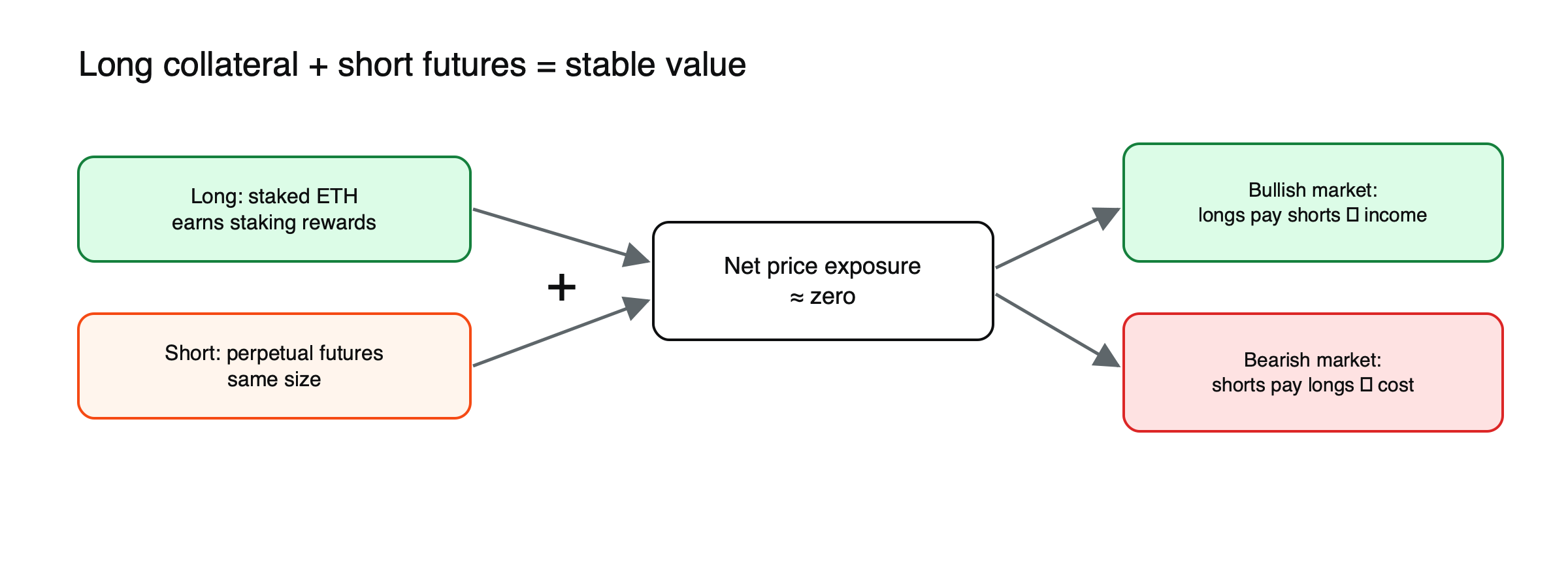
Figure: How a synthetic dollar cancels out price moves, and where its income comes from.
Where the income comes from
Perpetual futures use a funding rate to keep their price close to the spot price. When most traders are betting on rising prices, those holding long positions pay shorts. A synthetic dollar sits on the short side, so in bullish markets it collects funding, plus staking rewards on its ether. Holders who stake USDe receive sUSDe, which collects that income. Plain USDe earns nothing.
When the market turns bearish, funding can become negative, meaning shorts pay longs. Ethena keeps a reserve fund to absorb such periods, but a long stretch of negative funding would cost the protocol money.
Funding in numbers
On that same $3,000 position, an average funding rate of 10% a year paid to shorts would bring in about $300 a year, before staking rewards and costs. If funding turned negative at 5% a year, the position would instead cost about $150 a year, which the protocol would have to cover from its reserve fund or from staking income. (Illustrative.) That swing explains why the yield on staked versions of these tokens can move from double digits to near zero within months.
The October 2025 stress test
During the market crash of October 10–11, 2025, which wiped out more than $19 billion of leveraged positions, USDe fell to about $0.65 on Binance while trading much closer to $1 on decentralized exchanges. About $1.59 billion of USDe was redeemed over those two days, roughly 11% of supply.
What happened to supply afterward
USDe’s market value peaked at about $14.8 billion in early October 2025 and fell to about $3.9 billion by August 2026 as funding income shrank and holders left. The decline shows how closely demand for a synthetic dollar tracks the yield it pays: when funding income fell, many holders moved to reserve-backed stablecoins or left crypto altogether, and the protocol shrank with them. A reserve-backed stablecoin used for payments does not depend on paying a yield to keep its users.
How it differs from other stablecoins
| Reserve-backed (USDT, USDC) | Synthetic dollar (USDe) | |
|---|---|---|
| Backing | Cash and Treasury bills | Crypto plus short futures |
| Income for holders | None | Variable, from funding and staking (via sUSDe) |
| Main risks | Issuer, banks, regulation | Funding rates, exchanges, collateral, liquidity |
Where the design can break
The hedge removes price risk but adds others. The short positions sit on centralized exchanges, so an exchange failure or freeze could leave part of the hedge stranded; off-exchange custody arrangements reduce, but do not remove, that exposure. Staked ether used as collateral can itself trade below ether in a crisis, opening a gap the futures hedge does not cover. Futures and spot prices can diverge sharply in fast markets, briefly breaking the offset. And a wave of redemptions forces the protocol to unwind spot and futures positions at the same time, exactly when liquidity is thinnest, which is what happened in miniature in October 2025.
Signals worth watching
- Funding rates on the major perpetual futures markets, which drive income and show whether the hedge is being paid or paying.
- The reserve fund’s size relative to supply, which shows how long the protocol could absorb negative funding.
- Supply trend, since steady redemptions often signal falling income or confidence.
- Collateral mix, including how much is staked ether, bitcoin or other stablecoins, and where it is held.
- The token’s price across venues, because gaps between exchanges, as in October 2025, are an early sign of strain.
Before holding a synthetic dollar, it is worth reading the protocol’s own transparency page, which typically lists collateral, open hedges, exchange exposure and the size of the reserve fund. If any of these are missing or out of date, treat that as a warning sign in its own right.
Risks to know
- Funding rate risk: income depends on traders being net long.
- Exchange risk: the hedges sit on centralized exchanges, which can fail or freeze.
- Liquidity and pricing gaps in fast markets, as October 2025 showed.
- Regulatory limits: Germany’s BaFin acted against Ethena’s German entity in 2025, and Ethena withdrew its application for authorization under MiCA.
For the wider category, read what yield-bearing stablecoins are and centralized vs decentralized stablecoins. For the basics, see what a stablecoin is.
This article is educational content and does not constitute financial, investment, legal or tax advice. Digital assets are volatile and you may lose the amount you invest.
Frequently asked questions
Is a synthetic dollar the same as an algorithmic stablecoin like TerraUSD?
No. TerraUSD was backed by a token it could print, so its support collapsed with confidence. A synthetic dollar is backed by real crypto collateral hedged with futures. It can still lose its peg under stress, but its backing does not vanish in the same self-reinforcing way. See what happened in the TerraUSD collapse.
Who can hold USDe?
Availability depends on where you live and the platform you use. Following action by Germany’s financial regulator in 2025, Ethena’s products have not been offered to retail users in the EU under MiCA, and some exchanges restrict them in other regions.
Sources
- Ethena and the Mechanics of USDe (delta-neutral design; sUSDe) — Coin Metrics, 2025
- Ethena Labs: How USDe Works (negative funding; reserve fund) — Portals
- Ethena Under Pressure (low of $0.65 on Binance; $1.59 billion redeemed October 10–11) — Kaiko via Brainsum, December 2025
- USDe synthetic dollar supply (peak $14.8 billion; $3.9 billion by August 2026) — DIA
- ¿Qué es Ethena? (BaFin measures, 2025; not available to EU retail) — Rankia
- Ethena’s USDe Depeg (held steady on DEXs; $19 billion crash) — Netcoins