
What Are Tokenized Stocks?
Tokenized stocks are blockchain tokens that track shares, usually without voting rights. How they are structured, who can buy them and what to check first.
Tokenized stocks are blockchain tokens that track the price of listed shares, usually backed by real shares held with a custodian. Holders typically get price exposure and sometimes dividends, but not voting rights or a shareholder’s legal standing. Availability depends on where you live: major products in 2026 excluded US retail investors.
Why tokenize shares at all?
For many investors outside the United States, buying US shares means opening a foreign brokerage account, paying currency conversion costs and trading only during US market hours. Tokenized stocks offer fractional exposure from a crypto account, often around the clock, and can sit next to stablecoins in the same wallet. Some products can also be used in on-chain applications, for example as collateral. The trade-off is that holders accept a claim on an issuer rather than direct share ownership, along with the risks that come with it.
How they are structured
There are three common models:
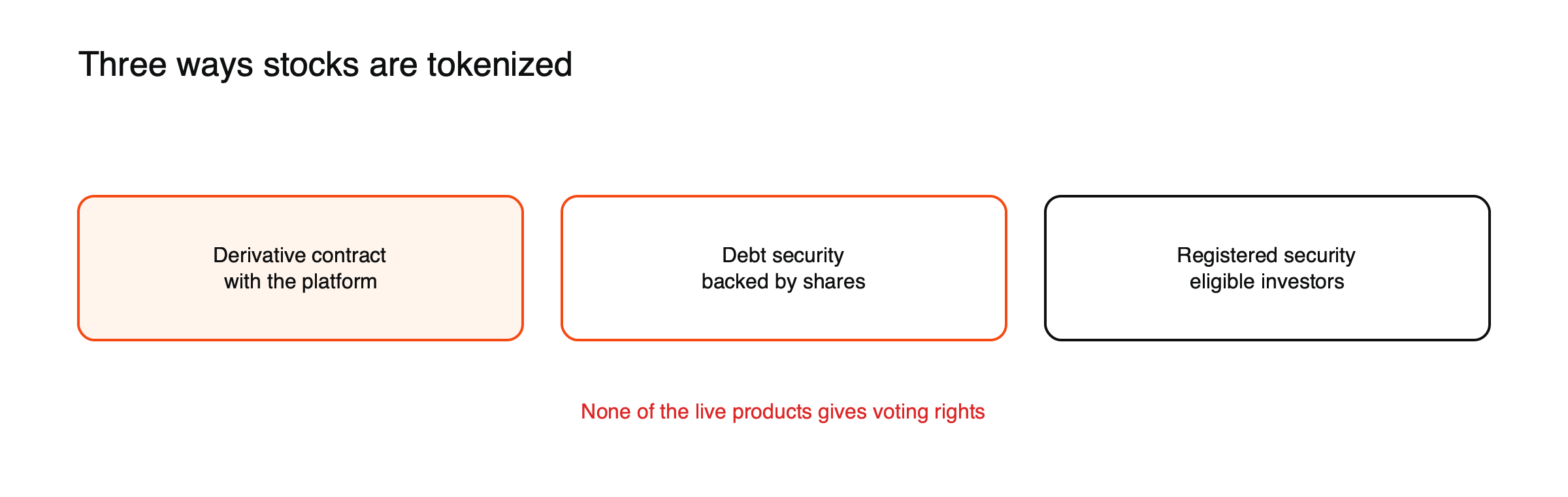
Figure: In each model, the token is a claim on someone, not the share itself.
- Derivative contracts: the token is a contract with the platform that follows a share’s price. Robinhood’s original EU stock tokens, launched June 30, 2025, work this way.
- Debt securities backed by shares: an issuer holds shares and issues tokens, often through a special-purpose company. Robinhood’s newer Stock Tokens from July 2026 and Backed’s xStocks, distributed by Kraken, follow this approach.
- Registered securities: a few issuers work within securities registration for eligible investors.
In all of these, the token is not the share itself.
What holders usually get
- Price exposure, often with fractional amounts and longer trading hours.
- Dividends passed through as cash, stablecoins or extra tokens, depending on the issuer.
- No voting rights and no direct shareholder rights in the live products.
When the market is closed
Tokenized stocks often trade when the stock exchange is shut, which creates a price-discovery problem. Suppose a share closes at $200 on Friday, and bad news breaks on Saturday. (Illustrative scenario.) On a token platform, market makers may quote the token at $190 on Sunday, with a wider spread than usual because they cannot hedge until Monday. If the share opens at $185, weekend buyers at $190 have lost money; if it opens at $195, weekend sellers have. Extended hours add convenience and the chance to react to news, but prices outside exchange hours are thinner and less reliable.
Dividends, splits and other corporate actions
Because the token is not the share, every corporate action has to be handled by the issuer. Cash dividends are usually passed on after tax is withheld, sometimes in stablecoins or extra tokens. Stock splits, mergers, spin-offs and rights issues require the issuer to adjust the token, and the terms decide how. Reading how a product treats these events matters, especially for long-term holders.
Tokenized stocks, CFDs and owning shares
| Tokenized stock | Share CFD | Owning the share | |
|---|---|---|---|
| What you hold | A token tracking the share, often backed by it | A contract with a broker on the price | The share itself |
| Voting rights | No | No | Yes |
| Trading hours | Often extended, sometimes 24/7 | Broker’s hours | Exchange hours |
| Leverage | Usually none | Available, with margin | None, unless borrowing |
| Main extra risk | Issuer and custodian | Broker and leverage | Broker, if held in a brokerage |
See what a CFD is for how contract-based price exposure works.
Liquidity and spreads
Tokenized stock markets are much smaller than the stock exchanges they track. Prices are kept in line mainly by market makers who can buy or sell the real shares, so spreads are tightest when the stock market is open and widest overnight and at weekends. Large orders can move the token’s price more than they would move the share. Limit orders, rather than market orders, protect against filling at a price far from the share’s last trade, and checking the token’s price against the stock exchange quote during market hours shows how closely it tracks. Some platforms also pause trading in a token around major corporate events or when the underlying share is suspended, which can leave holders unable to sell at the moment they most want to. Reading the platform’s published rules for halts and suspensions is as important as checking the spread, especially for smaller companies with very volatile shares. Checking the quoted spread and order book depth before trading, especially outside exchange hours, avoids paying far more than the share’s actual price.
If the issuer fails
Most tokenized stocks are designed so that the shares backing them sit with a custodian and, ideally, are ring-fenced from the issuer’s own creditors, sometimes with a trustee or collateral agent acting for token holders. How well that protection works has not been widely tested in an insolvency. Until it is, holders should assume that recovering value from a failed issuer could be slow and uncertain.
Who can buy
Robinhood offered its EU product to verified users in the EU and EEA, with the US blocked. xStocks target non-US retail customers. The US SEC’s position is that tokenized securities fall under the same rules as the underlying securities. See who can buy tokenized assets.
Risks to know
- Issuer and custodian risk: your claim depends on the company holding the shares.
- Legal uncertainty about what happens if the issuer fails.
- Price gaps when tokens trade while the stock market is closed.
- Unapproved tokens: OpenAI publicly rejected tokens linked to its shares in 2025, showing that a company may not endorse tokens tied to it.
The market was small, about $1 billion in the second half of 2025. For the wider category, read what RWA tokenization is and how to check what backs a tokenized asset.
This article is educational content and does not constitute financial, investment, legal or tax advice. Digital assets are volatile and you may lose the amount you invest.
Frequently asked questions
Can I move a tokenized stock to my regular brokerage account?
Generally no. The token lives on a blockchain and represents a claim against its issuer; it cannot be transferred into a brokerage account as a share. To change from one to the other, you sell the token and buy the share separately.
Are tokenized stocks available in the United States?
Not to most retail investors in the live products described here, which are offered mainly to non-US customers. US securities rules apply to tokenized securities in the same way as to the underlying shares.
Sources
- Robinhood Tokenized Stocks (June 30, 2025 launch; no voting rights; US blocked; about $1 billion in H2 2025) — Eco
- Robinhood’s new tokenized stock playbook (Classic Stock Tokens as derivatives; new Stock Tokens July 1, 2026 as debt instruments) — Four Pillars
- Tokenized Equities 2026 (Backed xStocks for non-US retail; SEC staff: tokenized securities subject to same rules) — Eco
- OpenAI rejects Robinhood’s unauthorised tokenised shares — AI News, July 2025