
What Happened When USDC Lost Its Peg in March 2023?
In March 2023 USDC fell to about $0.87 after $3.3 billion of its reserves were caught in the Silicon Valley Bank collapse. How it happened and recovered.
The USDC depeg 2023 traders remember began on March 10, when Silicon Valley Bank failed holding $3.3 billion of the roughly $40 billion in reserves behind USDC. USDC fell to about $0.87 on March 11, dragging DAI with it. After US authorities guaranteed the bank’s deposits on March 12, USDC returned to about $1.
Why a bank failure hit a stablecoin
USDC is backed by reserves held by its issuer, Circle, mostly in cash and short-term US government debt. Part of the cash sat in bank deposits. When Silicon Valley Bank was closed and placed under the control of the Federal Deposit Insurance Corporation (FDIC), Circle could not access the $3.3 billion held there, about 8% of its reserves. Nobody knew how much of that money would come back, so holders rushed to sell.
Inside USDC’s reserves
USDC was created by Circle together with Coinbase and launched in 2018. By early 2023 it was the second-largest stablecoin, with a market value above $43 billion before the crisis. Its reserves were held mostly in short-term US Treasury securities, with roughly a quarter in cash spread across six banks. Circle’s March attestation showed $9.88 billion in cash, and Silicon Valley Bank held $3.3 billion of it. The Treasuries were never in question; the problem was a slice of cash at one bank that, for a few days, nobody could be sure of recovering in full.
How the peg normally holds
Under normal conditions, USDC stays near $1 because of redemption arbitrage. Approved customers can send USDC to Circle and receive dollars, or send dollars and receive newly minted USDC, one for one. If USDC trades at $0.98 on an exchange, a trader can buy it there and redeem it with Circle for $1, pocketing the difference; that buying pushes the market price back up. The mechanism works only if two things are true: redemptions are open, and holders believe each USDC is fully backed. In March 2023, the second assumption was suddenly in doubt, and the first was limited by the calendar.
Timeline
- Week of March 6: Silvergate Bank, another bank used by crypto firms, announces it will wind down.
- March 10: Silicon Valley Bank’s shares collapse and regulators close the bank, appointing the FDIC as receiver.
- March 10, evening: Coinbase pauses conversions between USDC and US dollars over the weekend while banks are closed, removing one of the main routes for holders to swap back to dollars.
- March 10–11, overnight: Circle confirms that $3.3 billion of USDC reserves are held at the bank. USDC trades as low as about $0.87; DAI, which relied heavily on USDC, falls to about $0.88.
- March 11: borrowers repay more than $2 billion of loans on Aave and Compound, many in discounted USDC.
- March 12: the Treasury, the Federal Reserve and the FDIC announce that all depositors of Silicon Valley Bank will be made whole.
- March 13: USDC trades back between $0.99 and $1.01.
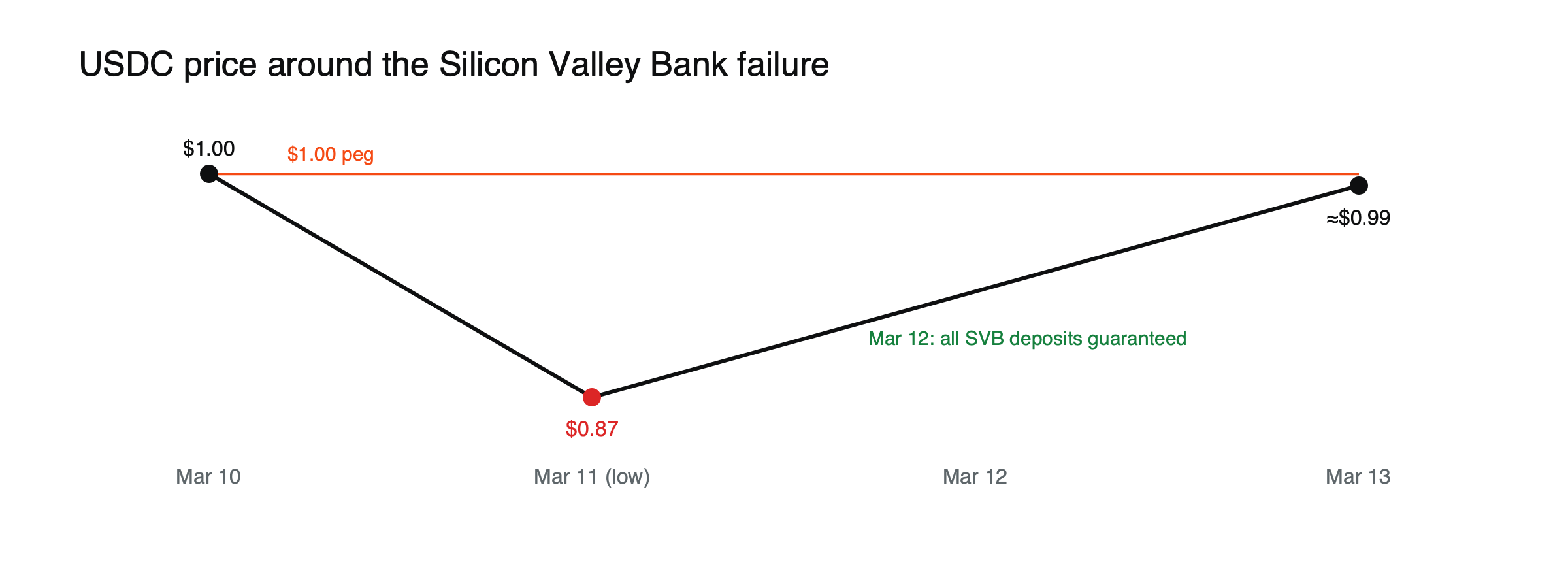
Figure: USDC’s weekend below the peg, March 2023. Sources: The Block; FXStreet.
The rush in numbers
The exit was fast. In the first 24 hours after the disclosure, blockchain data showed Circle burning about $2.34 billion of USDC as it processed redemptions, against only about $366 million newly minted, and USDC’s market value fell by about 13% in under a day. Prices first slipped on smaller exchanges, then spread across the market, with most venues quoting USDC between $0.90 and $0.98 that night before the deeper lows on March 11. Other stablecoins that used USDC as collateral, including DAI and FRAX, were pulled down with it.
The weekend problem
Silicon Valley Bank failed on a Friday. Crypto markets trade all weekend; banks do not. With dollar transfers unavailable until Monday, the redemption arbitrage that normally holds the peg could not fully operate, so USDC’s market price was set by fear rather than by the value of the reserves. Coinbase and Binance both paused conversions from USDC to dollars over the weekend, which removed another support and, for some holders, deepened the fear it was meant to calm. The episode showed that a stablecoin can be fully backed and still trade far below $1 when the route from the token to the dollars behind it is temporarily closed.
Who gained and who lost
Holders who panicked and sold near the low locked in a loss of around 13%. Those who could wait got $1 back days later. Traders who bought at the bottom made a quick profit: buying at $0.87 and redeeming at $1 is a gain of about 15%, a bet that paid off only because authorities stepped in. Borrowers on lending platforms took advantage too, repaying loans denominated in USDC with tokens bought at a discount. The same event that cost some holders money rewarded others for taking on the risk that the peg would not return.
Why DAI fell too
DAI is issued by a decentralized protocol, but about half of its backing at the time was USDC. When USDC dropped, so did the value behind DAI, and the protocol’s mechanism for swapping USDC into DAI hit its 3.1 billion USDC limit during the rush. A «decentralized» stablecoin turned out to share the same bank risk as a centralized one. Our comparison of centralized vs decentralized stablecoins looks at this in more detail.
What it showed
Reserve quality matters, not just reserve size. USDC was fully backed, but part of its backing was briefly out of reach.
Stablecoins inherit risks from the traditional system. Bank deposits, payment rails and weekend closures all affect how quickly a peg can be defended.
Redemption timing matters. Arbitrage that normally holds the peg cannot work if redemptions are paused or slow.
Contagion travels through collateral. Stablecoins backed by other stablecoins carried the shock further.
The episode became a reference point in later debates about how and where stablecoin reserves should be held. Rules adopted since in the EU and the US put weight on exactly these questions: what reserves may consist of, how much can sit in any one bank, and how quickly holders must be able to redeem. See stablecoin regulation in the EU vs the US.
For the broader risks, read stablecoin risks and what USDC is. For the basics, see what a stablecoin is.
This article is educational content and does not constitute financial, investment, legal or tax advice. Digital assets are volatile and you may lose the amount you invest.
Frequently asked questions
Could the same thing happen again?
The exact trigger, a large share of cash at one failing bank over a weekend, is less likely now that issuers and regulators pay close attention to where cash reserves sit. But any stablecoin that depends on banks, custodians or payment rails can face a gap between its backing and its market price when those systems are stressed or closed. Full backing does not guarantee a steady price at every moment.
How can I check a stablecoin’s reserves myself?
Look for regular reserve reports from an independent accounting firm, a breakdown of what the reserves hold and where, and clear redemption terms. Our guide on how to check a stablecoin’s reserves walks through what to read and what to look out for.
Sources
- USDC and DAI remain at about $0.90 following Circle’s disclosure ($3.3 billion of $40 billion, about 8.25%; lows near $0.88; DAI peg stability module cap 3.1 billion USDC; Silvergate) — The Block, March 11, 2023
- USDC regained its dollar peg (low of $0.87; March 12 joint statement) — FXStreet, March 13, 2023
- USDC depegged, but it’s not going to default ($0.99–$1.01 by March 13) — Cointelegraph, March 2023
- Debtors saved over $100M using depegged stablecoins (more than $2 billion repaid on Aave and Compound on March 11; Kaiko) — Today in the Markets, March 2023
- USDC got depegged following the SVB collapse (DAI about 51% backed by USDC) — HackerNoon, March 2023
- Coinbase halts conversion feature between US dollars and USDC (weekend pause; Circle uses six banks for ~25% of reserves held in cash; USDC launched with Coinbase in 2018) — The Block, March 2023
- USDC loses peg to the dollar amid SVB collapse (market cap down ~13% in under 24 hours; Nansen: $2.34 billion burned vs ~366 million minted) — ForkLog, March 2023
- Circle reveals $3.3 billion stuck at Silicon Valley Bank ($9.88 billion cash in March attestation; over $1 billion redeemed) — Fortune, March 2023
- USDC loses peg to the dollar ($43 billion market cap before outflows; prices of $0.90–$0.98 on most exchanges; FRAX and DAI exposure) — Web3 Is Going Just Great