
Why Altcoin CFDs Move More Than Bitcoin CFDs
Altcoins have smaller markets, thinner liquidity, more speculation and higher failure rates, so their CFDs swing far more than bitcoin's. Why, and how to size.
Altcoin CFDs move more than bitcoin CFDs because the coins behind them have smaller markets, thinner trading, more speculative buyers and a higher chance of failure. The same flows move a small market further, and one project’s news can change its outlook. Over half of all tokens launched had failed by 2025, CoinGecko data show.
Smaller markets
Bitcoin is by far the largest crypto asset; most altcoins are a small fraction of its size, so flows move them more.
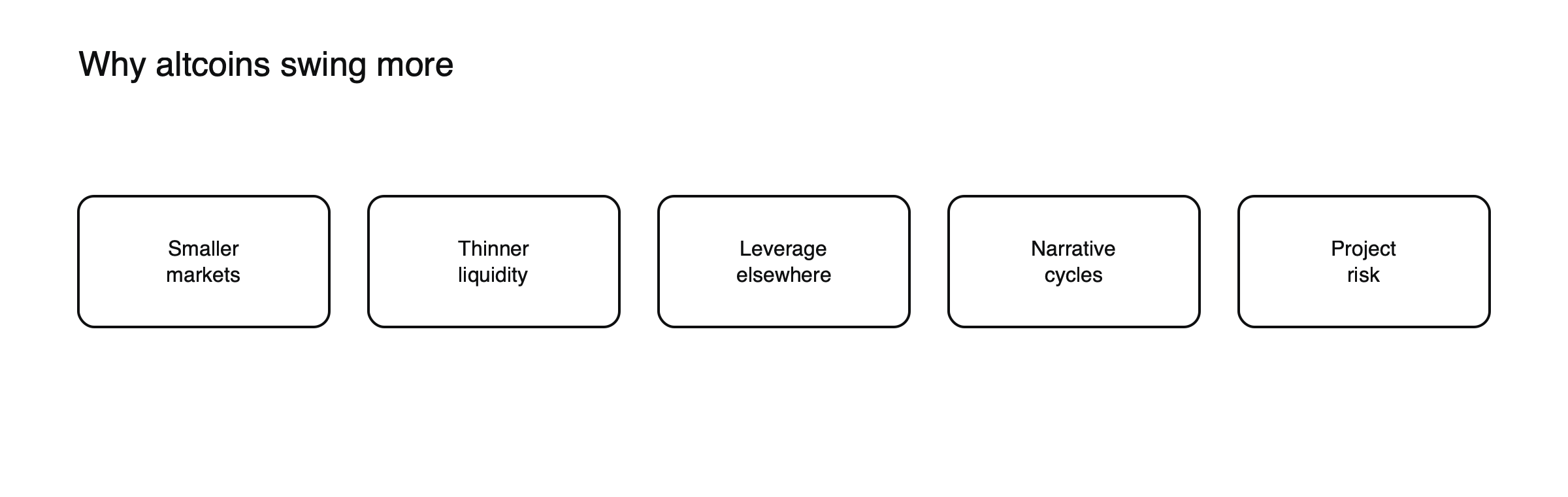
Figure: Why altcoins move more.
Typical moves compared, illustrated
| Asset | Typical daily move in a volatile period |
|---|---|
| Bitcoin | About 3% |
| Ether | About 4% |
| A large altcoin | About 6% |
| A small altcoin | 10% or more |
(Illustrative figures; actual volatility changes over time.) The same position size therefore carries very different risk across coins.
Bitcoin’s share of the market
Bitcoin dominance, its share of the total value of all crypto assets, was around 57% to 59% in September 2026. In 2021, it fell from about 70% to about 38% as money poured into altcoins, before recovering. When dominance falls quickly, altcoins are usually outperforming; when it rises, money is often retreating to bitcoin, and altcoins tend to fall harder.
Thinner liquidity
Fewer buyers and sellers mean wider spreads and bigger gaps, especially outside peak hours. See why crypto CFD spreads widen at certain times.
Leverage in the wider market
Heavy use of leverage on crypto exchanges amplifies swings when liquidations cascade. See what a liquidation cascade is.
Narrative and cycles
Altcoins tend to outperform in “altseasons” and fall hardest when risk appetite drops. See what altcoin season is.
Project risk
Hacks, token unlocks, delistings and failed upgrades can hit one coin hard.
Token unlocks
Many projects release tokens held by founders, early investors or treasuries on a set schedule. Large unlocks increase the supply available for sale, and prices often weaken around them as recipients sell. Unlock calendars are published, so traders can check upcoming dates before holding an altcoin CFD.
Many coins fail
According to CoinGecko data, more than half of all tokens ever launched, about 53.2%, had failed by 2025. Even among larger coins, a project’s decline can be gradual and then sudden. That background risk is part of why altcoins swing more than bitcoin.
How to size for it
Use smaller positions on altcoin CFDs than on bitcoin for the same risk per trade. See how to size a crypto CFD position for high volatility and what a crypto CFD is.
Altcoins in a sell-off, illustrated
Suppose bitcoin falls 10% in a day of broad selling. (Illustrative scenario.) Ether might fall 14%, a large altcoin 20% and a small one 30% or more, as leveraged positions are liquidated and buyers step back. On the way up, the pattern can reverse, with altcoins rising faster. That asymmetry of size, rather than direction, is what makes altcoin CFDs riskier per dollar of exposure.
Sizing for the difference, worked through
With the same $100 risk per trade, a bitcoin position with an 8% stop can be about $1,250, while an altcoin position needing a 20% stop to avoid normal swings should be about $500. (Example values.) Using equal dollar sizes across coins would give the altcoin trade two and a half times the risk. See how to size a crypto CFD position for high volatility.
Correlation does not disappear
Altcoins move more than bitcoin, but usually in the same direction during broad market moves. Holding several altcoin CFDs is not diversification against a crypto-wide fall; it is concentrated exposure to the most volatile part of the market.
Listings and delistings
Altcoins depend heavily on being listed on major exchanges. A new listing on a large exchange can bring a surge of buyers; a delisting, often prompted by regulatory concerns or declining activity, can cut liquidity sharply and send prices down. CFD providers may stop offering a coin if its exchange liquidity dries up, which can force positions to close.
Leverage cascades
Traders on crypto exchanges often use high leverage on altcoins. When prices fall, liquidations force sales into thin order books, pushing prices lower and triggering further liquidations. In the October 10, 2025 crash, more than $19 billion of leveraged positions were wiped out, and many altcoins fell far more than bitcoin within hours before partly recovering. CFD prices follow these exchange moves.
Narratives move altcoins
Altcoins often rise and fall with themes, such as decentralized finance, gaming, artificial intelligence tokens or memecoins. When a theme attracts attention, coins linked to it can rise sharply together; when attention moves on, they can fall just as quickly. Following which themes are in favor helps explain moves that have little to do with any single project’s progress.
Signals of altcoin strength
Traders watch bitcoin dominance and altcoin season indices, which measure how many large altcoins have outperformed bitcoin over a recent period. Rising altcoin strength often appears late in strong crypto rallies, when risk appetite is high, and can reverse abruptly.
Holding altcoin CFDs
Because altcoins are volatile and financing applies every night, holding altcoin CFDs for long periods combines high risk with steady costs. Many traders use them for shorter-term trades and use owned coins for longer-term views.
Common misreadings
- Treating a low price per coin as a sign of cheapness.
- Assuming several altcoins provide diversification.
A volatile week, illustrated
Suppose a trader holds $2,000 each of bitcoin and a mid-sized altcoin over a week in which bitcoin rises 5% on Monday, falls 8% on Wednesday and recovers 4% by Friday. (Illustrative scenario.) The altcoin might rise 12%, fall 20% and recover 9%. The bitcoin position ends slightly up; the altcoin position, after its larger swings, ends down about 2%, and its stop may well have been hit on Wednesday. Volatility affects not just the size of moves but the path, which decides whether stops survive.
Choosing which altcoins to trade
Larger, more liquid altcoins with listings on many major exchanges tend to have tighter spreads, more reliable prices and lower risk of sudden delisting than small coins. Many traders limit altcoin CFD trading to a handful of the largest coins, accepting fewer opportunities in exchange for more predictable trading conditions.
Stops on altcoins
Tight stops on volatile altcoins are often hit by normal swings. Wider stops, combined with smaller positions to keep the same risk, give trades room. In crashes, even wide stops can be skipped, which is why position size is the main defense.
Thin markets and manipulation
Small coins with thin trading can be pushed around by large holders or coordinated buying, producing sharp rallies that collapse once the buying stops. Such moves often look like breakouts on charts but have little lasting support. Treating sudden spikes in small coins with suspicion avoids chasing them.
When a coin is withdrawn
If a provider stops offering a coin, for example after major exchanges delist it, open CFD positions may be closed at the last available price, sometimes after a sharp fall. Checking a provider’s policy on withdrawing instruments is worthwhile before holding positions in smaller coins.
A note on new coins
Newly launched coins are usually the most volatile of all, with short price histories, concentrated ownership and frequent token unlocks. CFD providers also rarely offer them, and when they do, margins and spreads tend to be high. Waiting for a track record of at least several months before trading them is a common precaution.
Frequently asked questions
Are altcoin CFDs always more volatile than bitcoin?
Usually, though not every day. Some large coins occasionally move less than bitcoin, but over time smaller coins tend to swing more.
Why do providers offer fewer altcoins?
Because thin markets make them harder to price and hedge, providers often limit the range or set higher margins and wider spreads.
This article is educational content and does not constitute financial, investment, legal or tax advice. Digital assets are volatile and you may lose the amount you invest.
Sources
- Over half of all crypto tokens are now dead (53.2% failed by 2025) — CryptoPotato via KuCoin, January 2026
- Altseason (bitcoin dominance swings; altcoin cycles) — Spark
- DeFi TVL drops 39% in 2026 (October 10, 2025 crash erased more than $19 billion of leveraged positions) — Cointelegraph
- Altcoin Market Dominance — September 2026 update (BTC dominance about 57%–59%; above 60% early in 2026; about 55% in Q2) — Binance Square