
What Moves EUR/USD?
EUR/USD is driven by the gap between ECB and Fed policy, growth, energy prices and risk sentiment. How each factor works, with the 2022 parity break.
EUR/USD, the most traded currency pair, moves mainly on the expected gap between ECB and Fed policy, with relative growth, energy prices and risk sentiment also mattering. In 2022, as the Fed raised rates faster than the ECB and Europe faced an energy shock, the euro fell below parity with the dollar.
Policy divergence
When markets expect US rates to rise faster or stay higher than euro area rates, EUR/USD tends to fall; when the ECB looks more hawkish, it tends to rise. See how interest rate differentials drive currency pairs and how the ECB and the Fed differ in moving markets.
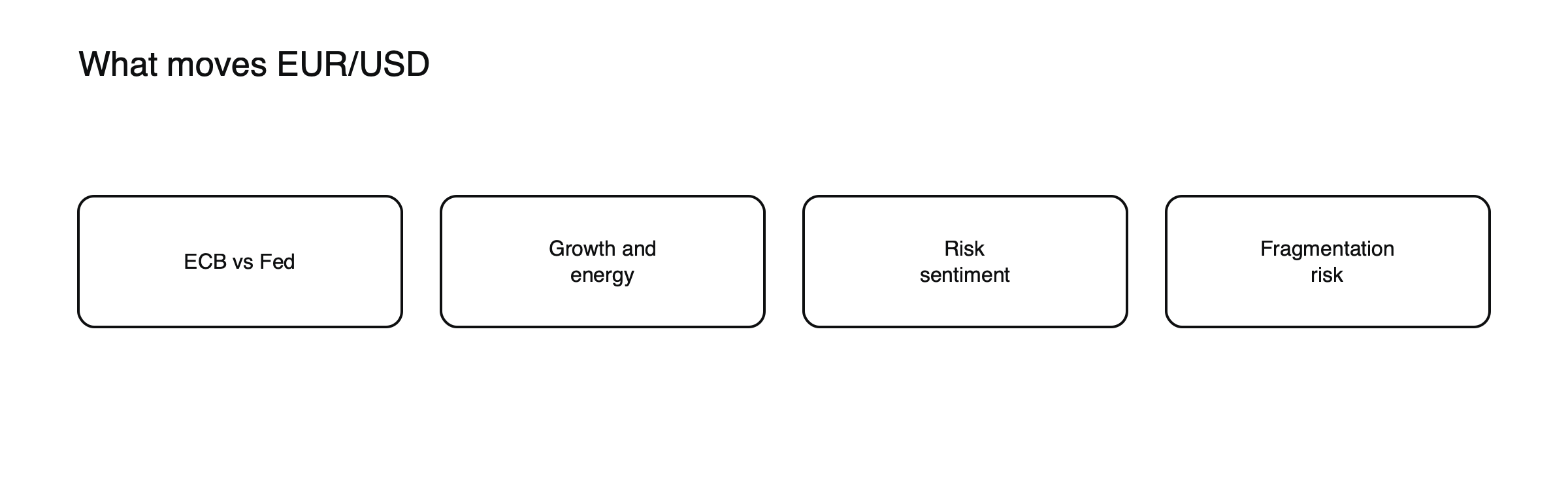
Figure: The main EUR/USD drivers.
Reading the rate gap
Traders often watch the difference between two-year government bond yields in the United States and Germany, because short-term yields reflect where markets expect each central bank’s policy rate to go. Suppose the US two-year yield is 4.5% and Germany’s 2.5%, a gap of 2 percentage points in favor of the dollar. (Illustrative yields.) If US data weaken and the gap narrows to 1.5 points, holding dollars instead of euros pays less than before, and EUR/USD tends to rise. If the gap widens, the pair tends to fall. The relationship is not exact from day to day, but over weeks and months it explains a large part of the pair’s direction.
Growth and energy
The euro area imports much of its energy. Energy price spikes worsen its trade balance and growth outlook, weighing on the euro, as in 2022. See how energy shocks travel through inflation, rates and currencies.
Risk sentiment and the dollar
In global sell-offs, demand for dollars usually pushes EUR/USD down. Because the euro makes up 57.6% of the US Dollar Index, the DXY largely mirrors EUR/USD. See what the US Dollar Index is.
The data calendar for EUR/USD
| Release | Why it matters |
|---|---|
| US jobs report | Shapes expectations for the Federal Reserve |
| US consumer price inflation | Moves US rate expectations sharply |
| Euro area flash inflation | Shapes expectations for the ECB |
| Euro area business surveys | Early read on growth, especially in Germany and France |
| Fed and ECB decisions and press conferences | Set the rate path and the tone |
The pair often reacts more to US releases than to European ones, because US data move global rate expectations and the dollar against every currency at once.
Fragmentation risk
Concerns about borrowing costs in weaker euro members, such as Italy, can weigh on the euro; the ECB launched a dedicated tool in July 2022 to address this.
Politics in the euro area
Elections and budget disputes can weigh on the euro when they raise doubts about government finances or about cooperation within the bloc. Concerns usually show up first in the gap between Italian or French and German bond yields, then in the currency. Because the euro is shared by many countries, political risk in one large member can move the currency for all of them.
The 2022 move, driver by driver
Several drivers lined up against the euro in 2022. The Federal Reserve began raising rates in March and moved quickly, while the ECB started only in July, so the rate gap favored the dollar. Russia’s invasion of Ukraine sent European gas and electricity prices soaring, hurting the euro area’s trade balance and growth outlook far more than America’s. As stocks and bonds fell worldwide, investors sought the safety of dollars. Together these pushed EUR/USD below parity, to around 0.96 in September 2022, before falling energy prices and ECB rate rises helped it recover. See the euro’s launch and long swings.
EUR/USD through the trading day
The pair is most active when European and US markets overlap, in the European afternoon. Spreads are usually tightest then, and major US data releases arrive in that window. The Asian session is generally quieter for EUR/USD, though it can move on global news or Asian demand for dollars. See forex trading sessions.
What to watch
ECB and Fed meetings, euro area and US inflation reports, US jobs data, energy prices and Italian-German bond spreads. See what moves currency prices.
Practical notes for trading EUR/USD
EUR/USD usually has the tightest spreads of any currency pair, so it suits strategies that trade often. One standard lot moves about $10 per pip, and retail leverage in the EU, UK and Australia is capped at 30:1. Its average daily range is modest compared with crosses and exotics, but it can move more than 1% around major central bank decisions or surprising US data. Because so many traders watch the same levels, stops cluster around round numbers such as 1.1000 and recent highs and lows. See what a pip is and how much the spread costs on a forex trade.
A Fed surprise, illustrated
Suppose markets expect the Federal Reserve to cut rates by a quarter of a percentage point, and it cuts by half a point instead, signalling more cuts to come. (Illustrative scenario.) Within minutes, the US two-year yield falls sharply, the gap with German yields narrows and EUR/USD jumps, perhaps by close to 1%, as traders reprice how much dollars will earn relative to euros. If the ECB’s next meeting then brings an equally surprising cut, much of the move can reverse. The pair is, in effect, a running vote on which central bank will move faster.
Slower, longer-term forces
Over years rather than months, other forces matter more. Differences in inflation erode or support each currency’s purchasing power. The euro area has often run a current account surplus, earning more from the rest of the world than it spends, which supports demand for euros over time. Productivity growth, demographic trends and how central banks around the world split their reserves between dollars and euros all shape the pair’s long-run level, even if they rarely explain a single day’s move. See what purchasing power parity is.
Common misreadings
- Treating a rise in EUR/USD as good news for Europe, when it often reflects dollar weakness.
- Reacting to the headline number in a release rather than how it compared with expectations.
- Ignoring the press conferences after ECB and Fed decisions, which often move the pair more than the decisions themselves.
- Assuming the pair will hold at any single round number.
Frequently asked questions
Does a strong European economy always lift EUR/USD?
Not always. What matters is how the euro area is doing relative to the United States and what that means for the gap between ECB and Fed policy. Strong European data can be outweighed by stronger US data.
Why does EUR/USD fall when markets panic?
Because investors tend to buy dollars in a crisis, both as a safe haven and because many debts and trades worldwide are settled in dollars.
This article is educational content and does not constitute financial, investment, legal or tax advice. Digital assets are volatile and you may lose the amount you invest.
Sources
- USA forex market statistics (EUR/USD the most traded pair, about $853 billion a day at US desks in 2025) — Compare Forex Brokers, citing BIS data
- Austerity follows Russian audacity (euro fell below parity with the dollar in 2022) — PKF Malta
- U.S. Dollar Index (euro weight 57.6%) — Wikipedia
- The ECB’s TPI (July 2022; Italy–Germany spreads) — Model Diplomat
- What happens when the euro hits parity with the dollar (0.96 in September 2022; recovery above 1.10 by mid-2023) — ConvexTrade