
How to Calculate Yield to Maturity
Yield to maturity is the annual return if you buy a bond today and hold it to maturity. A 5% 5-year bond bought at $950 yields about 6.19%. How to calculate it.
Yield to maturity (YTM) is the annual return if you buy a bond at today’s price, collect all coupons and hold it to repayment: the discount rate that makes future payments’ present value equal the price. A 5-year 5% bond bought at $950 yields about 6.19%, above its coupon because you also gain $50 at maturity.
The idea
Price = sum of coupons and face value, each discounted at the YTM. Solving for YTM needs a calculator or spreadsheet, but a quick approximation works for most bonds.
Quick approximation
YTM ≈ [coupon + (face − price) ÷ years] ÷ [(face + price) ÷ 2]
Worked example
- Face $1,000, coupon 5% = $50 a year, 5 years, price $950
- Approximation: [50 + (1,000 − 950) ÷ 5] ÷ [(1,000 + 950) ÷ 2] = 60 ÷ 975 ≈ 6.15%
- Exact YTM (solved): ≈ 6.19%
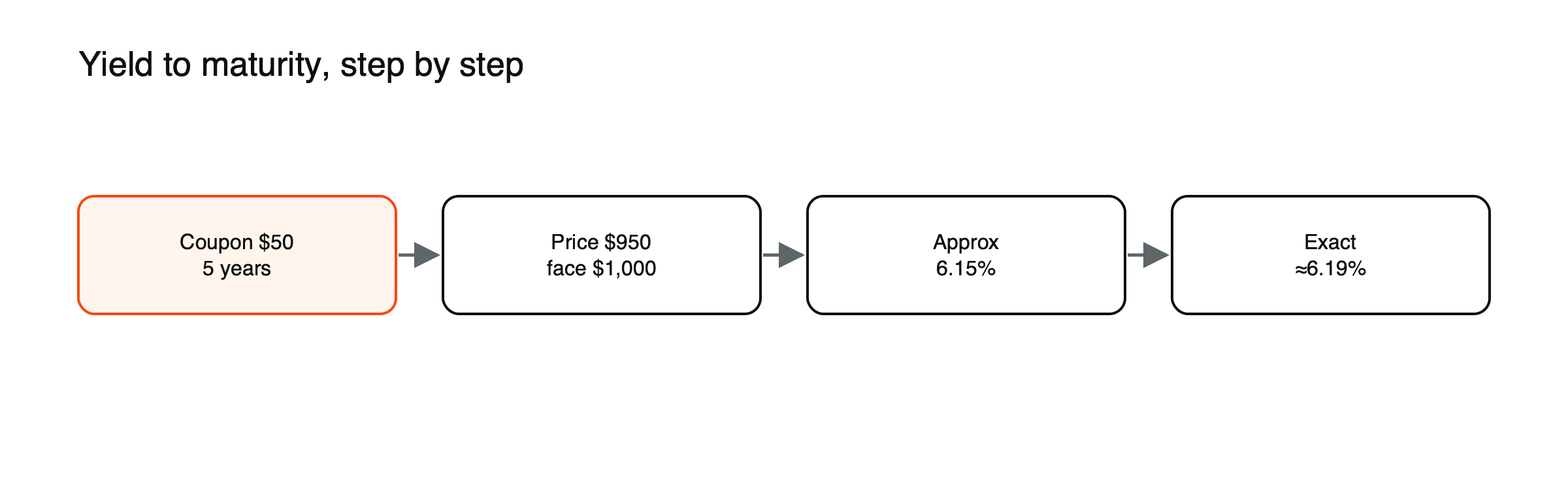
Figure: YTM from price (example values).
(Example values.)
YTM at different prices
| Price of a 5-year 5% bond | Yield to maturity |
|---|---|
| $900 | About 7.47% |
| $950 | About 6.19% |
| $1,000 | 5.00% |
| $1,050 | About 3.88% |
| $1,100 | About 2.83% |
(Example values, annual coupons.) A $50 change in price moves the yield by more than a full percentage point on a five-year bond, because the gain or loss to face value is spread over only five years.
Price, coupon and YTM
- Price below face value → YTM above coupon.
- Price above face value → YTM below coupon.
- Price at face value → YTM equals coupon.
Current yield versus YTM, worked through
The current yield is simply the annual coupon divided by the price: $50 ÷ $950, about 5.26%. It ignores the $50 gain to face value at maturity, so it understates the return on a bond bought below par and overstates it on one bought above par. YTM, at about 6.19% for the same bond, includes that gain and is the better measure for comparing bonds.
Semi-annual coupons
Many bonds, including US Treasuries, pay coupons twice a year. Their yields are usually quoted on a bond-equivalent basis, calculated with half-yearly periods and then doubled. For the bond above with semi-annual payments of $25, the YTM is about 6.18%, very close to the annual-coupon figure. Spreadsheet functions handle the frequency automatically if it is entered correctly.
A spreadsheet shortcut
Spreadsheet functions such as RATE or YIELD solve for YTM exactly: enter the number of periods, the coupon payment, the price as a negative value and the face value.
Yield to call and yield to worst, worked through
Suppose a 10-year 5% bond trades at $1,050 but the issuer can repay it at $1,000 in two years. (Example values.) Its YTM, assuming it runs to maturity, is about 4.37%. But if it is called in two years, the buyer receives only two coupons and $1,000, a yield to call of about 2.41%, because the $50 premium is lost over just two years. Issuers tend to call bonds when rates have fallen, which is exactly when the lower figure applies. The yield to worst, the lowest of the possible yields, is the safer figure to use.
Limits
YTM assumes you hold to maturity, the issuer pays in full and coupons are reinvested at the same rate. For callable bonds, also check yield to worst.
See why bond prices fall when yields rise, how bond duration predicts price moves and how bonds work.
The reinvestment assumption
YTM assumes every coupon is reinvested at the same yield until maturity. If rates fall, coupons are reinvested at lower rates and the realized return falls short of the YTM; if rates rise, it can exceed it. The effect is small for short bonds and larger for long, high-coupon bonds. Zero-coupon bonds avoid it entirely, because there are no coupons to reinvest.
The yield of a bond fund
Bond funds publish an average yield to maturity or yield to worst for their holdings, a guide to their future income if rates stay unchanged. After the losses of 2022, the average bond in the main US bond index traded around $93 per $100 of face value, with yields to worst of about 4% to 5%, far higher than before. Unlike an individual bond, a fund never matures, so its actual return also depends on future rate changes.
Comparing bonds with YTM
YTM lets bonds with different coupons, prices and maturities be compared on one basis. A bond with a 3% coupon priced below par may offer a higher YTM than a 5% coupon bond priced above par. Comparing YTMs, then adjusting for credit risk, maturity and taxes, gives a fairer picture than comparing coupons.
Real yield to maturity
Subtracting expected inflation from YTM gives an approximate real yield, the return in purchasing power. A YTM of 5% with inflation expected at 3% suggests a real yield of about 2%. Inflation-linked bonds quote real yields directly. See what real yield is.
A zero-coupon bond, worked through
For a bond with no coupons, YTM has a simple formula: YTM = (face ÷ price)^(1 ÷ years) − 1. A 10-year zero priced at $675.56 yields (1,000 ÷ 675.56)^(1/10) − 1, about 4.0% a year. Because there are no coupons, there is no reinvestment assumption: the yield is locked in if the bond is held to maturity. (Example values.)
How price reacts when YTM changes
If the market’s required YTM on the 5-year 5% bond rises from 6.19% to 7.47%, its price falls from $950 to about $900. Duration estimates the size of such moves without repricing every cash flow: a bond with a modified duration of about 4.3 loses roughly 4.3% for each point of yield. See how bond duration predicts price moves.
A spreadsheet example
In a spreadsheet, the RATE function with 5 periods, a payment of 50, a present value of −950 and a future value of 1,000 returns about 6.19%. For semi-annual coupons, use 10 periods and a payment of 25, then double the result. The YIELD function accepts settlement and maturity dates directly and handles accrued interest, which matters for bonds bought between coupon dates.
Common misreadings
- Confusing YTM with the coupon or current yield.
- Using YTM for callable bonds without checking yield to worst.
YTM versus total return, illustrated
An investor buys the 5-year 5% bond at $950, a YTM of about 6.19%, and sells it after one year. If yields have fallen to 5%, the bond, now with four years left, is worth $1,000, so the one-year return is the $50 coupon plus a $50 price gain, about 10.5%. If yields have risen to 7.5%, it is worth about $916, and the return is about 1.7%. (Example values.) YTM describes the return to maturity; the return over shorter periods depends on what happens to yields.
Buying between coupon dates
A bond bought between coupon payments costs its quoted price plus accrued interest owed to the seller. YTM calculations that use exact dates account for this, which is why spreadsheet functions ask for the settlement date. Ignoring accrued interest slightly overstates the yield.
YTM across markets
Yields on government bonds of similar maturity differ between countries because of interest rates, inflation and currency. Comparing YTMs across currencies without considering exchange rates can be misleading.
Inflation-linked bonds
The yield to maturity on an inflation-linked bond is a real yield, a return above inflation. Comparing it with the YTM on an ordinary bond of the same maturity shows the inflation rate the market expects. See what breakeven inflation is.
A YTM checklist
- Is the bond priced above or below face value?
- How often are coupons paid?
- Can the issuer repay early, and what is the yield to worst?
- How likely is the issuer to pay in full?
- How does the yield compare after tax and inflation?
Answering these questions turns a single headline yield into a realistic estimate of what the bond may actually return over the period you plan to hold it. A few minutes with a spreadsheet usually settles the question for any ordinary bond.
Frequently asked questions
Is YTM the return I will actually get?
Only if you hold to maturity, the issuer pays in full and coupons are reinvested at the same yield. Selling early exposes you to price changes.
Why can a bond’s YTM be negative?
If its price is high enough that total payments are less than the price paid, as happened with some European and Japanese government bonds in the 2010s.
Leverage, margin and cost figures in this article are example values for illustration. Actual terms depend on the provider, the instrument and the rules in your country.
This article is educational content and does not constitute financial, investment, legal or tax advice. Digital assets are volatile and you may lose the amount you invest.