
How Much Does It Cost to Hold a Bitcoin CFD for a Month?
A bitcoin CFD's monthly cost is the spread plus daily financing on the full position. At 18% a year, 0.1 BTC at $60,000 costs about $89 over 30 days.
Holding a bitcoin CFD for a month costs the entry spread plus daily financing on the full position: daily financing = position value × annual rate ÷ 365. On 0.1 BTC at $60,000, a $6,000 position, an 18% annual rate costs about $2.96 a day, or about $89 over 30 days. Crypto rates often exceed those on currencies.
The formula
- Daily financing = position value × annual rate ÷ 365
- Monthly cost ≈ spread + 30 × daily financing
Worked example
- 0.1 BTC at $60,000 = $6,000 position
- Annual financing rate: 18% (example; check your provider)
- Daily: 6,000 × 0.18 ÷ 365 ≈ $2.96
- 30 days: ≈ $88.77
- Plus spread on entry, for example 0.1% = $6
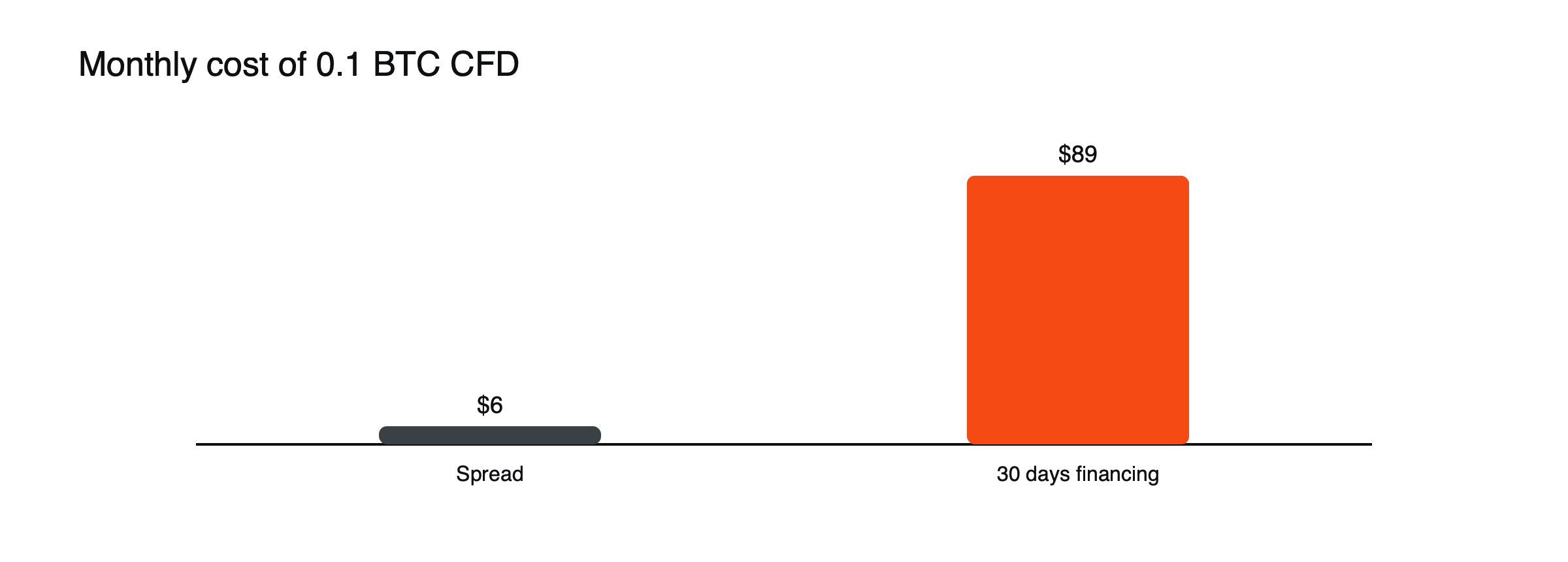
Figure: One month’s costs (example values).
Total ≈ $95, or about 1.6% of the position in a month. (Example values.)
Rates compared, illustrated
Financing rates on crypto CFDs vary widely between providers, so the same position can cost very different amounts to hold. On the $6,000 position above, held for 30 days:
| Annual rate | Daily cost | 30-day cost |
|---|---|---|
| 8% | About $1.32 | About $39 |
| 18% | About $2.96 | About $89 |
| 25% | About $4.11 | About $123 |
(Illustrative rates.) Comparing rates across providers before holding positions for weeks can save more than choosing the tightest spread.
The break-even move
At 18%, the month’s financing plus the entry spread comes to about $95, or about 1.6% of the position. Bitcoin therefore needs to rise about 1.6% over the month for a long position just to break even. Over six months, financing alone would be about $539, nearly 9% of the position, a high hurdle even for a strong market.
Cost relative to margin
The position needs $3,000 of margin at 2:1, so $89 of monthly financing is about 3% of the money committed, every month. Because financing is charged on the full position value, leverage magnifies its effect on returns in the same way it magnifies price moves.
Why crypto financing is high
Providers charge for funding a position whose underlying is volatile and costly to hedge; rates and weekend treatment vary widely by provider.
Weekends and short positions
Because crypto trades every day, many providers charge financing every night, including Saturday and Sunday, so a month means about 30 charges rather than the roughly 21 weekday charges on many other CFDs. Some providers charge short positions too, rather than paying them interest, reflecting the cost of hedging. Rates for longs and shorts can differ. Checking the provider’s schedule shows exactly when and how often charges apply.
How it compares
A spot bitcoin ETF charges an annual fee on assets instead of daily financing, which is usually cheaper for long holds. See bitcoin CFD vs bitcoin ETF.
How to reduce it
Hold for shorter periods, size smaller, and compare providers’ financing rates. See how overnight financing works and what a crypto CFD is.
Holding costs compared
| Route | How the holding cost works | Typical effect over a year |
|---|---|---|
| Bitcoin CFD | Nightly financing on full position value | Can be a large share of the position |
| Spot bitcoin ETF | Annual fee on assets | Usually well under 1% |
| Bitcoin held in your own wallet | No ongoing fee | Only security and transaction costs |
The CFD’s costs buy flexibility, short selling and leverage; for long-term holding, they are usually the most expensive route.
Checking your provider’s rate
Look for the financing rate in the provider’s contract specification or fee page, note whether it applies to longs, shorts or both, and check whether weekends are included. Many platforms also show the overnight charge for each open position, which makes it easy to confirm the real cost.
Holding through a rally, illustrated
Suppose bitcoin rises 10% over three months, from $60,000 to $66,000, on the 0.1 BTC position. (Example values.) The gross gain is $600. At 18%, financing over 90 days is about $266, and the entry spread $6, leaving a net gain of about $328. Financing has consumed more than 40% of the gain. Had bitcoin risen only 4% over the same period, the trade would have ended roughly flat or slightly negative. Long holding periods turn financing from a minor cost into a major factor.
Financing grows with the position
Because financing is calculated on the position’s current value, it rises as the price rises. At $66,000, the same 0.1 BTC costs about $3.25 a day at 18%, compared with $2.96 at $60,000. A winning long therefore becomes slightly more expensive to hold as it gains. A falling price reduces the daily charge, but the losses outweigh the savings.
Reducing costs in practice
Practical ways to keep holding costs down include closing positions before the daily cut-off when a trade is meant to be short-term, choosing providers with lower crypto financing rates, avoiding holding through quiet periods with no clear catalyst and using spot ownership or an ETF for long-term views. Each option trades some flexibility for lower cost.
Holding cost and strategy
Strategies that hold positions for days or weeks, such as swing trading, need the expected move to be large compared with financing. Strategies that close within the day avoid financing entirely but pay spreads more often. Matching the instrument to the holding period is part of planning a trade.
Common misreadings
- Calculating financing on the margin rather than the position value.
- Ignoring weekend charges.
- Assuming shorts are never charged.
Long and short holding costs
On many CFDs, short positions receive a small credit when interest rates are high, but crypto is often different: providers frequently charge both longs and shorts, sometimes at different rates. A trader expecting a gradual decline over several months may find that financing on a short eats much of the gain. Checking the short rate is as important as checking the long rate for anyone planning bearish trades. See how shorting bitcoin with CFDs works.
Reviewing open positions
A simple weekly review of each open crypto CFD, asking whether the original reason for the trade still holds, how much financing it has cost so far and how much more it will cost if held another month, helps avoid positions that drift on simply because closing them feels like admitting a mistake. Positions without a clear reason to stay open are often the most expensive to keep.
The question to ask
Before holding a crypto CFD beyond a few days, it helps to ask whether the expected move is several times larger than the expected financing. If it is not, the trade’s odds are poor even if the view is right, and a cheaper route to the same exposure, or a shorter holding period, may make more sense. A quick calculation before entering is usually enough to make that judgment.
Frequently asked questions
Why is bitcoin CFD financing higher than on stock indices?
Because providers face higher costs and risks in hedging crypto, and many set a fixed crypto rate rather than a benchmark interest rate plus a small markup.
Can financing ever be zero?
Positions opened and closed on the same day, before the daily cut-off, usually incur no financing.
Leverage, margin and cost figures in this article are example values for illustration. Actual terms depend on the provider, the instrument and the rules in your country.
This article is educational content and does not constitute financial, investment, legal or tax advice. Digital assets are volatile and you may lose the amount you invest.