
Bitcoin CFD vs Bitcoin ETF
A spot bitcoin ETF holds bitcoin and trades like a share with an annual fee; a bitcoin CFD offers leverage and shorting with daily financing. How they compare.
A bitcoin CFD and a spot bitcoin ETF differ in structure and cost. A spot bitcoin ETF, such as those launched in the US in January 2024, holds bitcoin with a custodian, trades like a share and charges an annual fee. A bitcoin CFD is a leveraged contract that can be long or short, often trades 24/7 and charges financing.
Side by side
| Spot bitcoin ETF | Bitcoin CFD | |
|---|---|---|
| Underlying | Bitcoin held by a custodian | Contract on the price |
| Trading hours | Exchange hours | Often 24/7, provider-dependent |
| Leverage | None (unless on margin) | Yes, capped for retail |
| Short selling | Possible through a broker | Built in |
| Costs | Annual expense ratio | Spreads and overnight financing |
| Best for | Longer-term holding | Shorter-term trading and hedging |
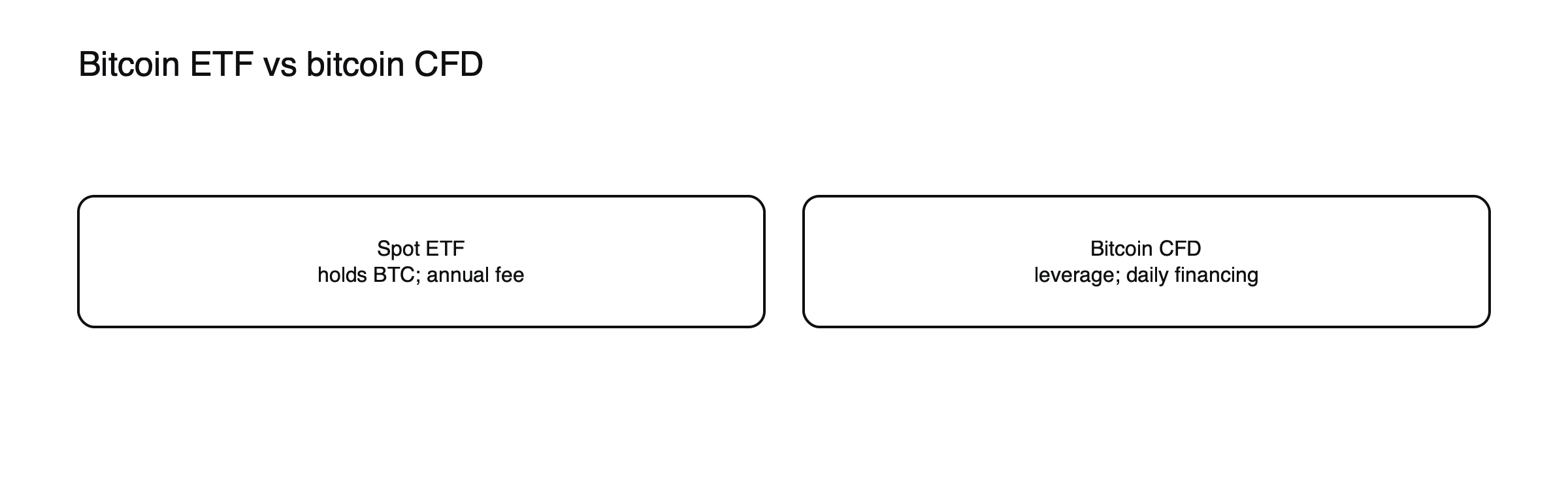
Figure: Two ways to get bitcoin exposure.
How a spot bitcoin ETF works
A spot bitcoin ETF raises money from investors and uses it to buy bitcoin, which a custodian stores on the fund’s behalf. Large financial firms, known as authorized participants, create and redeem ETF shares in exchange for cash or bitcoin, which keeps the share price close to the value of the bitcoin held. Investors buy and sell the shares through an ordinary brokerage account, in the same way as other listed funds, without dealing with wallets or crypto exchanges.
The scale of ETFs
US spot bitcoin ETFs held around 6% of all bitcoin by 2026, with total assets above $100 billion. See who owns the bitcoin ETFs.
Cost over time
For long holding periods, an ETF’s annual fee is usually cheaper than daily CFD financing on the full position. For short-term trades, CFD costs may be lower. See how much it costs to hold a bitcoin CFD for a month.
Costs over a year and a week, illustrated
Suppose a trader wants $10,000 of bitcoin exposure. (Illustrative figures.) Holding an ETF with an annual fee of 0.25% for a year costs about $25, plus brokerage commissions. Holding a bitcoin CFD for a year with financing at 8% a year costs about $800, plus the spread. For a one-week trade, the CFD’s financing is only about $15, and the ability to trade at weekends or go short may matter more than the fee difference. The holding period largely decides which is cheaper.
Weekend risk
ETFs cannot trade when exchanges are closed, so weekend bitcoin moves show up as a gap at Monday’s open; CFDs may trade through the weekend.
A weekend move, illustrated
Suppose bitcoin falls 8% between Friday’s US close and Sunday evening. (Illustrative scenario.) A CFD that trades at weekends reflects the fall as it happens, and a stop can be triggered on Saturday. An ETF holder can do nothing until Monday, when the shares open roughly 8% lower; any stop order executes at the first available price. Neither route avoids the loss, but they differ in when and how it is realized.
Tracking and premiums
Spot ETFs usually track the value of their bitcoin closely, but small differences can arise from fees, the timing of the fund’s reference price and trading in the shares. In volatile markets, the share price can briefly trade above or below the value of the underlying bitcoin. CFD prices depend on the provider’s feed and spread instead.
Leverage with an ETF
Buying ETF shares in a margin account adds borrowing, but brokers’ margin rules for these funds are often strict. Leveraged and inverse bitcoin ETFs also exist in some markets; they reset daily, so their returns over weeks can differ sharply from a simple multiple of bitcoin’s move. A CFD’s leverage is simpler: it is fixed by the margin requirement and the size chosen.
When safer does not mean lower risk
«ETFs are safer» refers to leverage and regulation, not price: both lose value when bitcoin falls.
See what a crypto CFD is.
Shorting
A CFD makes going short as easy as going long. Shorting an ETF requires borrowing the shares through a broker, which may not always be possible or cheap, or using inverse products with their own complexities. Traders who want to profit from falls or hedge a holding often find CFDs more practical.
Which suits whom
| Goal | Usually better fit |
|---|---|
| Hold bitcoin exposure for years | Spot ETF |
| Short-term trading, including weekends | CFD |
| Hedging or going short | CFD |
| Exposure inside a retirement or tax-advantaged account | Spot ETF, where permitted |
| Avoiding leverage | Spot ETF |
ETF flows and the bitcoin price
Money flowing into or out of spot ETFs leads to purchases or sales of bitcoin by the funds, so large flows can influence the price. Daily flow figures are published and watched by traders as a sentiment indicator. Strong inflows have coincided with rallies, and outflows with declines, though the direction of cause and effect can run both ways.
Custody inside an ETF
ETF investors do not hold private keys, but the fund’s bitcoin is held by a custodian, and a few custodians hold a large share of all ETF bitcoin. That concentration is a risk to monitor, though custodians are regulated and use strict security procedures. A CFD holder has no bitcoin in custody at all, but depends on the provider instead.
Options on bitcoin ETFs
Listed options on some spot bitcoin ETFs began trading in the United States in late 2024, giving investors another way to hedge or take leveraged positions on bitcoin through a regulated market. They add flexibility but also complexity, and suit experienced traders.
Using both
Some investors hold a spot ETF for long-term exposure and use CFDs for short-term trades or to hedge around events, such as a weekend when they expect volatility. Combining the two can be efficient, but total exposure across both needs to be tracked.
Common misreadings
- Assuming an ETF removes bitcoin’s price risk.
- Comparing costs without considering the holding period.
Spot ETFs outside the United States
Other markets have their own versions. Hong Kong approved spot bitcoin ETFs in 2024, and several European markets list exchange-traded products backed by bitcoin, often structured as notes rather than funds. Their fees, trading hours and availability to retail investors differ by country. Investors outside the United States may not be able to buy US-listed ETFs because of local rules on fund distribution.
When the ETF market is closed
Spot ETFs trade only during exchange hours, typically about six and a half hours on weekdays in the United States. Bitcoin itself trades around the clock, so most of its price movement happens while ETF markets are closed. ETF holders experience those moves as gaps at the next open. For traders who want to react to news in the evening or at weekends, that limitation can matter more than cost.
Choosing in practice
Investors who want long-term exposure, low running costs and the familiarity of a brokerage account usually lean toward ETFs. Traders who want flexibility, short selling and round-the-clock access lean toward CFDs, accepting higher holding costs and leverage risk.
Fees compared over time
Over five years, an ETF fee of 0.25% a year costs about 1.25% of the investment in total, while CFD financing at 8% a year would cost about 40% of the position value. For long-term holders, that difference outweighs almost every other consideration. Over shorter periods, the gap is much smaller, which is why holding period matters most.
Frequently asked questions
Is a bitcoin ETF the same as owning bitcoin?
No. You own shares in a fund that holds bitcoin. You cannot withdraw coins or use them on the network.
Can I buy a bitcoin ETF everywhere?
Availability depends on the country and the type of account. Some markets restrict access for retail investors or offer different products, such as exchange-traded notes.
This article is educational content and does not constitute financial, investment, legal or tax advice. Digital assets are volatile and you may lose the amount you invest.
Sources
- Bitcoin ETFs total assets surpass $100B (about 6%–6.3% of supply) — Crypto Briefing, September 2026
- IBIT: the ETF that made bitcoin a blue chip (US spot ETFs launched January 11, 2024; custody concentration) — BIT Knowledge Hub
- ESMA adopts CFD measures (2:1 for cryptocurrencies; 50% margin close-out; negative balance protection) — Finadium