
How to Plan a Crypto CFD Trade Before Opening It
Define the idea and timeframe, set entry, stop and target, size from risk, check costs and events and decide exits in advance: planning a crypto CFD trade.
To plan a crypto CFD trade, write down the reason and timeframe, choose an entry, a stop where the idea is wrong and a target, size from your risk amount, check spreads, financing and events, and decide in advance what would make you exit early. A planned trade is easier to manage when fast moves arrive.
Before you start
Have your account balance, risk limit and the coin’s recent range at hand.
Planning it, step by step
State the idea
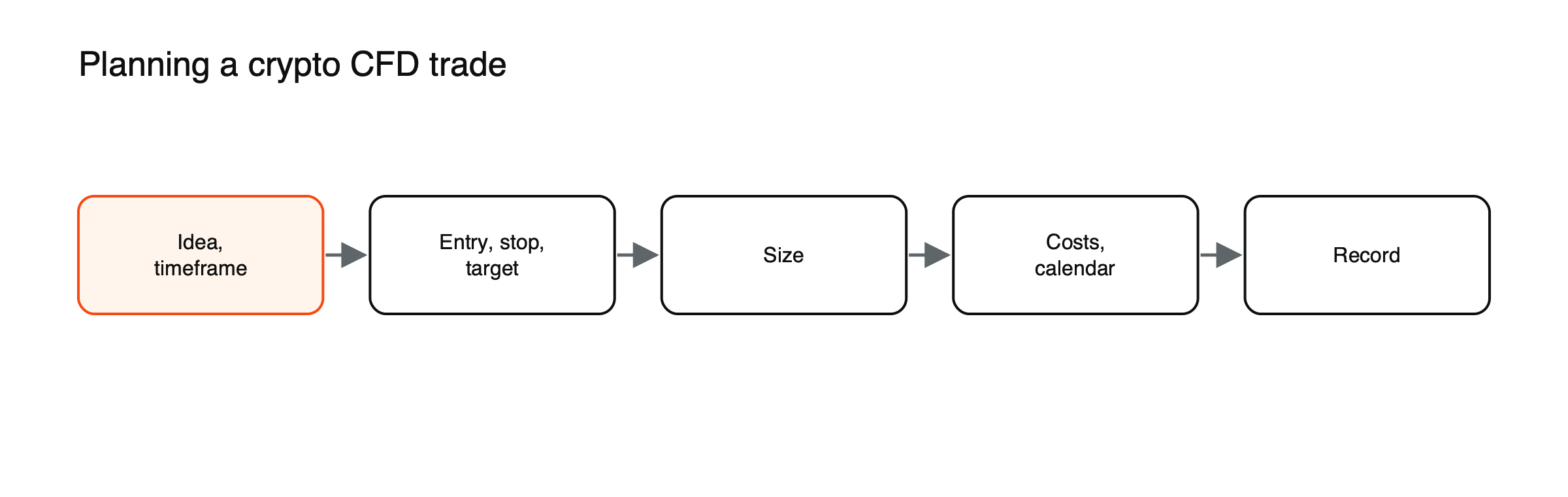
Figure: Planning before opening.
Why this coin, why now, and over what period?
Set entry, stop and target
The stop goes where the idea is proven wrong; the target where you expect to take profit. See how to set a take-profit level.
Calculate size
Coins = risk amount ÷ stop distance. See how to size a crypto CFD position.
Check costs
Spread now, and financing for the expected holding period. See how much it costs to hold a bitcoin CFD.
Check the calendar
Major data, regulatory decisions, token unlocks or upgrades that could cause gaps.
Define early exits
What would make you close before the stop or target?
Record it
Log the plan and the result. See how to keep a trading journal.
A complete plan, illustrated
Account: $10,000. Idea: ether has held support near $2,900 for three weeks while bitcoin rose; a move toward $3,500 is expected within two weeks as activity picks up. Entry: $3,000. Stop: $2,760, 8% below, below the support area. Target: $3,480, 16% above. Risk: 1.5%, $150. Size: $150 ÷ $240 per coin = 0.625 ETH, a $1,875 position needing about $938 of margin. Costs: spread about $2; financing about $13 for 14 days at 18%. Calendar: US inflation data in week one; no upgrades or major unlocks. Early exit: close if bitcoin closes a day more than 10% lower, or if the idea has not played out after 14 days. (Example values.)
The plan risks $150 to make about $300, a reward of twice the risk, and every decision that matters is made before entry.
What-if scenarios
Before entering, it helps to run through what the plan says in different cases. If ether gaps below the stop at the weekend, the loss may exceed $150, which the size should allow for. If ether reaches the target in two days, the plan says take profit rather than hope for more. If nothing happens for two weeks, the plan says close. Writing these answers down prevents decisions driven by emotion when they happen.
Common mistakes
Deciding the stop after entering and sizing by available margin. See risk management rules for crypto CFD trading and what a crypto CFD is.
Plans for shorts
A short plan follows the same steps with the stop above entry and the target below. Because short losses grow as prices rise and crypto can jump on news, short plans often use smaller sizes and specific time limits. See how shorting bitcoin with a CFD works.
Reviewing the plan afterward
After closing, compare what happened with the plan: was the entry as planned, was the stop respected, did costs match expectations and did the idea play out? Reviewing many plans shows which kinds of trades work for you and which rules you tend to break.
Linking plans to overall limits
Each plan should fit within account-wide rules, such as maximum risk per trade, maximum total crypto exposure and a limit on losses in a week or month. See risk management rules for crypto CFD trading.
A simple template
Idea and timeframe; entry, stop and target; risk and size; costs; calendar; early-exit conditions; result and lessons. Keeping the same template for every trade makes plans quick to write and easy to compare.
Risk, reward and win rate
A plan that risks $150 to make $300 can be wrong more often than right and still make money. With a win rate of 40%, ten such trades would produce four wins of $300 and six losses of $150, a net gain of $300, before costs. (Illustrative figures.) Plans with targets smaller than their stops need a high win rate to work, which is hard to sustain in volatile markets. Checking the reward-to-risk ratio before entering filters out trades that only work if almost everything goes right.
Plans for different holding periods
A plan for a trade lasting hours focuses on the spread, intraday levels and scheduled data. A plan for a trade lasting weeks adds financing, weekend risk and events further ahead, such as token unlocks or regulatory decisions. Matching the plan’s detail to the holding period keeps short trades simple and long trades thorough.
When not to trade
Part of planning is deciding not to trade: when no clear idea exists, when spreads are unusually wide, before a major announcement with no plan for it, or after a series of losses when judgment may be affected. Skipping trades that do not meet the plan’s conditions is as important as taking those that do.
Plans and emotions
Crypto’s speed can push traders to act on impulse: chasing a sudden rally, closing a winner too early or moving a stop to avoid a loss. A written plan gives a reference point in those moments. The question becomes whether the plan says to act, not whether the move feels urgent.
Common misreadings
- Treating a plan as a prediction rather than a set of decisions.
- Changing the plan mid-trade without a new written reason.
Alerts that enforce the plan
Price alerts at the entry, stop, target and any early-exit levels let the plan run without constant screen-watching, which matters in a market that trades around the clock. When an alert fires, the response has already been decided, so the trader acts rather than deliberates.
A journal entry, illustrated
After the ether trade above, a journal entry might read: entered as planned at $3,000; inflation data caused a dip to $2,840, stop held; target reached on day nine; actual costs $11 financing and $2 spread; net gain about $287. Lesson: the stop placed below support survived a dip that a tighter stop would not have. (Example values.) A few lines like this, repeated over many trades, reveal patterns that no single trade can.
Adapting to volatility
When volatility rises, the same plan structure applies but the numbers change: wider stops, smaller sizes and sometimes more distant targets. Updating plans for current conditions, rather than reusing old numbers, keeps risk consistent.
Plans for several positions
When several crypto trades are open, each plan should also note how it fits with the others. Two long positions in correlated coins are closer to one larger bet, so their combined risk should stay within the account limit.
When a plan fails
Some plans will lose even when followed perfectly. A losing trade that followed its plan is a normal cost of trading; a losing trade that broke its plan is a lesson. Distinguishing the two keeps attention on what can actually be improved.
Sharing plans
Some traders share plans with a trusted peer or mentor before entering, which forces clearer reasoning and exposes weak ideas early. Even writing a plan for an imaginary reader improves plans, because vague reasons become obvious once they have to be explained clearly to someone else.
Frequently asked questions
How long should a plan take to write?
For most trades, five to ten minutes. The value lies in making decisions before entering, not in length.
What if the market moves before I finish the plan?
Then the trade is skipped or re-planned at the new price. Chasing a move without a plan is one of the most common sources of losses.
This article is educational content and does not constitute financial, investment, legal or tax advice. Digital assets are volatile and you may lose the amount you invest.