
Crypto CFDs vs Crypto Futures and Perpetuals
Crypto CFDs are provider contracts with financing; perpetuals trade on exchanges with funding every 8 hours and liquidation engines. How they compare.
Crypto CFDs, futures and perpetuals differ in venue, cost and loss handling. CFDs are regulated provider contracts with retail leverage caps, overnight financing and stop-outs. Perpetuals trade on crypto exchanges, never expire, track spot through funding every 8 hours or so and use liquidation engines, often at far higher leverage.
Side by side
| Crypto CFD | Perpetual futures | Dated futures | |
|---|---|---|---|
| Venue | Regulated provider | Crypto exchange | Exchange (such as CME) or crypto exchange |
| Expiry | None | None | Set date |
| Holding cost | Overnight financing | Funding payments | In the futures price |
| Leverage | Capped (2:1 EU retail) | Often very high | Exchange-set |
| Loss handling | Margin call, stop-out | Liquidation | Margin calls |
| Retail protections | Depends on jurisdiction | Often limited | Exchange rules |
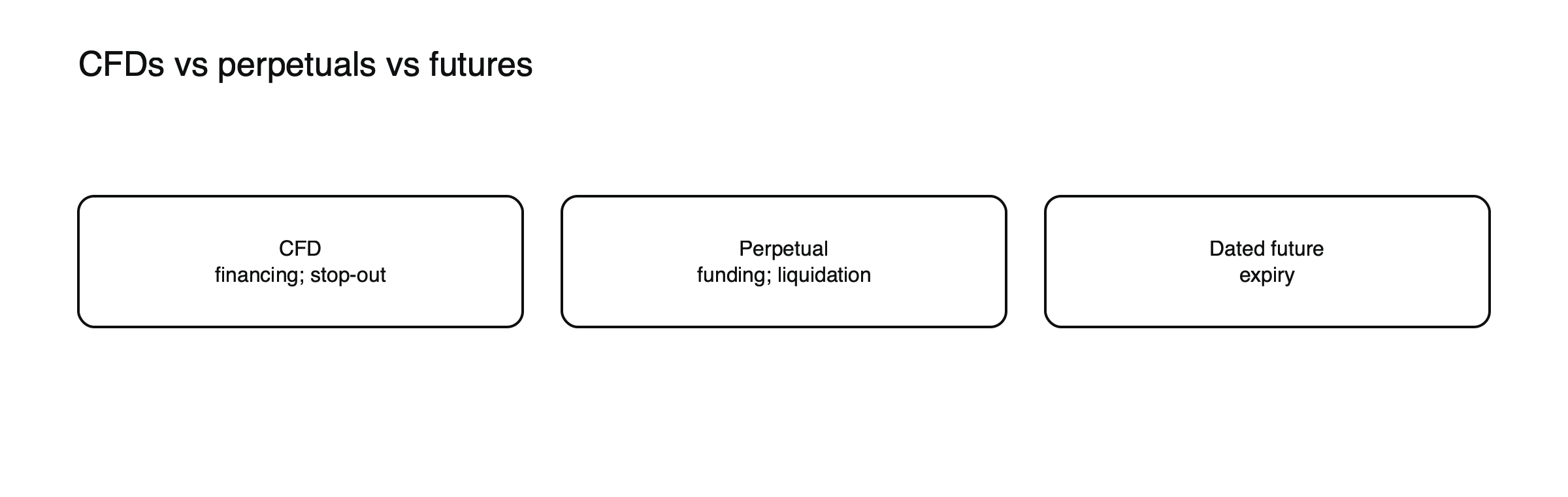
Figure: Three ways to trade crypto prices.
Funding vs financing
Perpetual funding moves between longs and shorts depending on whether the contract trades above or below spot; CFD financing is charged by the provider. See what the funding rate is and funding rates vs overnight financing.
Funding and financing compared, illustrated
Suppose a trader holds $10,000 of long bitcoin exposure for 30 days. (Illustrative figures.) On a perpetual contract with funding of 0.01% every eight hours, paid by longs, the cost is about 0.03% a day, about $90 over the month, roughly 11% a year. If funding turns negative, longs receive payments instead; in heated rallies it can be several times higher. A CFD with financing at 8% a year costs about $66 over the same period, but the rate is set by the provider rather than by the market. Comparing the two over the expected holding period shows which is cheaper.
Liquidation vs stop-out. Exchange liquidations can cascade in fast markets; CFD stop-outs close positions at a margin level. See stop-out vs liquidation.
Leverage compared, illustrated
At 20:1 on a perpetual contract, a move of about 5% against the position can wipe out the margin, and exchanges typically liquidate before that point. At 2:1 on an EU retail CFD, the position is closed out after a fall of roughly 25% if the account holds only the required margin. Bitcoin moves 5% in a day often; 25% in a short period is rare but has happened. The lower leverage of CFDs is a restriction, but it also makes it much less likely that ordinary volatility ends the trade.
Liquidation cascades
When prices fall quickly, liquidations on exchanges force sales, which push prices lower and trigger further liquidations. In the crash of October 10, 2025, this kind of cascade wiped out more than $19 billion of leveraged positions. CFD positions are closed under the provider’s margin rules rather than by an exchange’s liquidation engine, but they track the same prices, so they are affected by the moves such cascades create.
Regulated dated futures
Bitcoin futures have traded on CME, a regulated US derivatives exchange, since December 2017, with smaller micro contracts added later. They are cash-settled, expire monthly and are used mainly by institutions and experienced traders. Their prices include a premium or discount to spot, known as the basis, which reflects interest rates and demand. Access requires a futures account and larger sizes than many CFD positions.
When higher leverage is a disadvantage
Higher leverage on perpetuals looks like an advantage but magnifies liquidation risk; in October 2025, more than $19 billion of leveraged positions were wiped out in a single crash.
See what perpetual futures are and what a crypto CFD is.
Counterparty and venue risk
A CFD is a contract with a single provider, so its financial strength and regulation matter. Crypto exchanges offering perpetuals vary widely in regulation and transparency, and several have failed or frozen withdrawals in the past. Regulated futures exchanges use central clearing, which reduces counterparty risk but brings larger contract sizes and stricter requirements.
Which suits whom
CFDs suit retail traders who want regulated access, modest leverage and negative balance protection. Perpetuals suit experienced traders comfortable with exchange risk, variable funding and high leverage. Dated futures on regulated exchanges suit institutions and larger accounts that want central clearing and transparent pricing.
Settlement and expiry
Dated futures expire on set dates and are settled, often in cash, at a reference price. Traders who want to keep exposure must roll to the next contract, paying the difference between the two prices. Perpetuals and CFDs avoid expiry, replacing it with funding or financing charges. Expiry dates can bring heavy trading around settlement time.
Trading hours
Perpetuals on crypto exchanges trade continuously, every day. Regulated dated futures follow the exchange’s schedule, which may include weekend closures, so weekend moves appear as gaps when trading resumes. CFD hours depend on the provider: many quote crypto at weekends, sometimes with wider spreads.
Margin currency
CFD accounts usually hold margin in a regular currency such as dollars or euros. Crypto exchanges may require margin in stablecoins or in crypto itself, such as bitcoin. Margin held in bitcoin falls in value when bitcoin falls, so a long position margined in bitcoin loses twice in a decline: on the position and on the collateral.
A comparison, illustrated
Suppose a trader wants $5,000 of long bitcoin exposure for two weeks. (Illustrative figures.) Through a CFD at 2:1, margin is $2,500, financing about $15 and the account is protected against negative balances. On a perpetual at 10:1, margin is $500, funding might cost $10 to $40 depending on market conditions and a 10% fall could trigger liquidation. Through a dated futures contract, the minimum size may exceed $5,000 and requires a futures account. Each route suits a different trader.
Common misreadings
- Assuming funding is always cheaper than CFD financing.
- Treating exchange leverage as a sign of better value.
Regulation and access
Crypto CFDs are offered by regulated providers under rules that differ by country, and are unavailable to retail clients in some, such as the UK. Many crypto exchanges offering perpetuals restrict access in certain countries, and some operate with limited regulation. Regulated futures exchanges are open to clients of authorized brokers who meet account requirements. Checking which products are legally available to you is the first step before comparing costs.
Orders and tools
CFD platforms typically offer stop-losses, limit orders and sometimes guaranteed stops for a fee. Crypto exchanges offer a wide range of order types and tools for managing leveraged positions, but rarely guaranteed stops. Regulated futures platforms provide standard order types used across other futures markets.
Records and taxes
Each route produces different records: provider statements for CFDs, exchange histories for perpetuals and broker statements for futures. Tax treatment can also differ between them depending on the country, so keeping complete records of every trade, funding payment and financing charge makes reporting easier.
Funding spikes
In strong rallies, demand for long positions on perpetuals can push funding rates to several times their usual level, making longs expensive to hold for days or weeks. In sharp sell-offs, funding can turn negative, so shorts pay longs. CFD financing is more stable, set by the provider rather than by market demand. Over a month of heavy demand, funding on a long perpetual can cost far more than CFD financing, while in a falling market a long might be paid to hold. Comparing recent funding history with the CFD rate helps avoid surprises.
Frequently asked questions
Why do perpetual futures have no expiry?
Because the funding mechanism keeps their price close to spot, they do not need to converge at a settlement date.
Are crypto CFDs available everywhere?
No. The UK bans their sale to retail clients, and other countries apply their own rules.
This article is educational content and does not constitute financial, investment, legal or tax advice. Digital assets are volatile and you may lose the amount you invest.
Sources
- Funding rate (crypto perpetuals since 2016; funding roughly every 8 hours) — BIT Knowledge Hub
- ESMA adopts CFD measures (2:1 for cryptocurrencies; 50% margin close-out; negative balance protection) — Finadium
- DeFi TVL drops 39% in 2026 (October 10, 2025 crash erased more than $19 billion in leveraged positions) — Cointelegraph, June 2026