
What Is a Crypto Index CFD?
A crypto index CFD tracks a basket of large cryptocurrencies in one position, so one coin's move matters less. How these indices are built, weighted and traded.
A crypto index CFD tracks a basket of cryptocurrencies, such as the largest coins by market value, in one position, so you trade the crypto market as a whole. Most crypto indices are weighted by market value, so bitcoin usually dominates and they move closely with it, but sharp moves in one smaller coin matter less.
How crypto indices are built
- Membership: often the top coins by market value, excluding stablecoins.
- Weighting: usually by market value, sometimes with caps to limit bitcoin’s share.
- Rebalancing: members and weights change on a schedule. See how index rebalancing works.
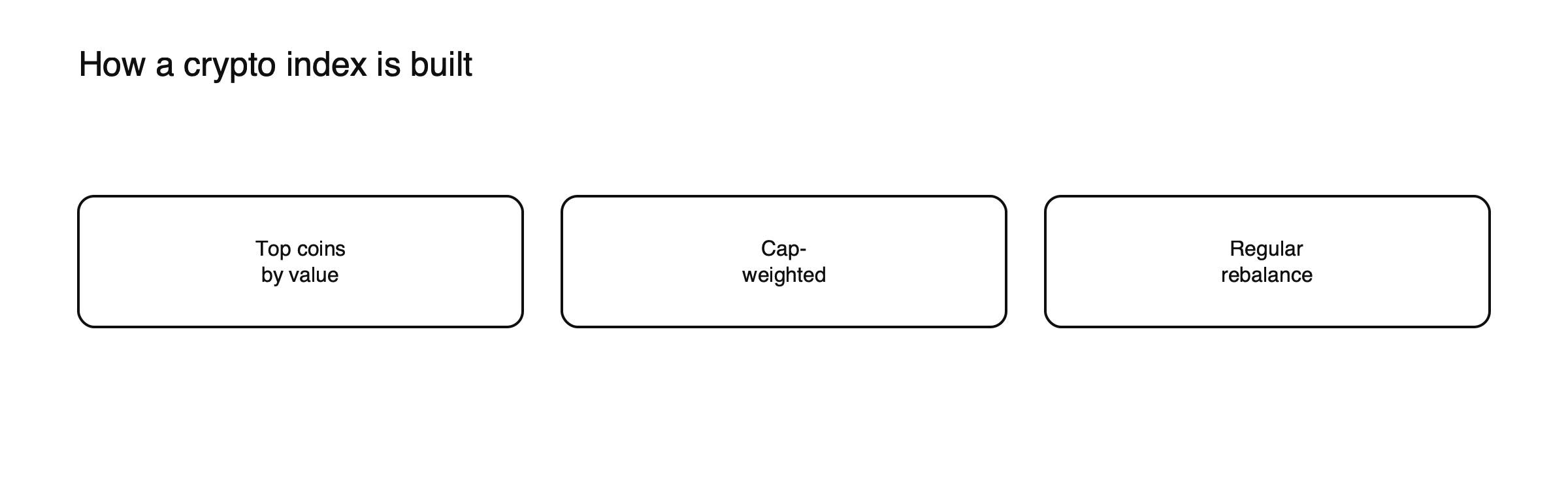
Figure: Building a crypto index.
An index in practice, illustrated
Suppose a crypto index holds bitcoin at 60%, ether at 20% and a group of other coins at 20%. (Illustrative weights.) In a sell-off where bitcoin falls 10%, ether 14% and the other coins 25%, the index falls about 13.8%: 60% × 10% plus 20% × 14% plus 20% × 25%. That is more than bitcoin alone but much less than the smaller coins. The index smooths individual moves but stays heavily driven by bitcoin.
Capped and uncapped indices
Without caps, bitcoin’s large share of the crypto market can make an index behave almost like bitcoin itself. With bitcoin dominance around 57% to 59% in September 2026, an uncapped index of the largest coins would hold bitcoin near that weight or higher once stablecoins are excluded. Some index providers cap the largest member at a lower weight, giving more influence to other coins, which makes the index more volatile but more diversified.
Why traders use them
- Broad exposure in one trade.
- Less single-coin risk: one project’s collapse affects only its weight.
- Simpler hedging of a diversified crypto holding.
Hedging a mixed holding, worked through
An investor holds $6,000 of bitcoin, $2,000 of ether and $2,000 spread across several smaller coins. Rather than shorting each coin, they short $10,000 of a crypto index CFD with similar weights. If the market falls 15%, the holdings lose about $1,500 and the index short gains a similar amount, depending on how closely the index’s weights match the portfolio. Differences in weights mean the hedge is approximate rather than exact. (Illustrative figures.)
What to watch
- Concentration: bitcoin and ether may make up most of the index. See why a handful of stocks can drive an entire index for the same effect in shares.
- Correlation: in sell-offs, most coins fall together, so diversification helps less.
- Costs: spreads and financing as on other crypto CFDs; leverage capped at 2:1 for EU and Australian retail clients.
Where the usual answer flips. “An index is safer” holds only partly: crypto assets are highly correlated, and many smaller tokens fail entirely, which is why index rules matter.
See what a crypto CFD is.
Rebalancing and failed coins
Crypto indices are rebalanced on a schedule, adding rising coins and removing those that have fallen in value or failed to meet rules on liquidity and listing. With more than half of all tokens launched having failed by 2025, according to CoinGecko data, these rules matter: an index that removes failing coins avoids holding them all the way down, though it may sell them after much of the damage is done.
Stablecoins are usually excluded
Large dollar-linked stablecoins make up a significant part of the total crypto market, but most crypto indices exclude them, because they are designed not to move. Including them would dampen the index without reflecting crypto price exposure.
Sizing an index position
Because an index is somewhat less volatile than smaller coins but still highly volatile, size it from risk as with any crypto CFD. A stop that suits bitcoin may be slightly too tight for an index with a large share of smaller coins. See how to size a crypto CFD position for high volatility.
How index providers build them
Crypto index providers publish rules setting which coins qualify, typically based on market value, trading volume and availability on reputable exchanges, and how weights are calculated and capped. They also define how prices are sourced, often averaging several exchanges. A CFD provider may use a published index or build its own basket, so checking the methodology behind the specific product matters.
An index or several single-coin CFDs?
Holding an index CFD means one position, one spread and one financing charge. Building the same exposure from several single-coin CFDs allows choosing exact weights and closing parts independently, but multiplies costs and requires more monitoring. For broad exposure or hedging, an index is usually simpler; for specific views on particular coins, single-coin CFDs give more control.
When altcoins lead
During periods when altcoins outperform bitcoin, an index with meaningful weight in smaller coins rises faster than bitcoin. When bitcoin leads, as in periods when its dominance rises, the index lags bitcoin. Capped indices feel these swings more than uncapped ones.
Costs compared
Index CFD spreads are often wider than bitcoin’s but narrower than those of smaller coins, and financing is usually charged at a crypto rate on the full position value. For short-term trades, the spread matters most; for longer holds, financing dominates.
Common misreadings
- Assuming an index removes crypto’s volatility.
- Ignoring how much of the index is bitcoin.
Weights change over time, illustrated
Suppose an index starts the year with bitcoin at 55%, ether at 20% and other coins at 25%. (Illustrative weights.) If bitcoin rises 40% while the others are flat, bitcoin’s weight grows to about 63% before the next rebalance. In an uncapped index, the winner takes a larger share; in a capped one, the rebalance trims it back. Either way, the index’s behavior changes as weights shift, so checking current weights matters before relying on past behavior.
Thinking in portfolio terms
An index CFD can stand in for a diversified crypto holding when the aim is a view on the market as a whole. Its main drawback is that crypto assets are highly correlated in falls, so diversification inside the index reduces risk from single-project failures much more than from market-wide crashes.
Who uses crypto index CFDs
They suit traders who want broad crypto exposure without choosing individual coins, investors hedging a mixed portfolio and those who want to trade crypto-wide news, such as regulatory decisions, rather than project-specific developments.
Building a custom basket, worked through
A trader who prefers equal exposure to bitcoin, ether and two other large coins could open four single-coin CFDs of $1,500 each, a $6,000 basket, instead of an index weighted 60% to bitcoin. (Illustrative figures.) The basket gives smaller coins more influence and lets each position be adjusted separately, but pays four spreads and requires four sets of stops and financing checks. The index does the weighting automatically at the cost of less control.
Events that move the whole index
News affecting the whole crypto market, such as approvals or rejections of funds, major regulatory decisions, large exchange failures or shifts in interest rate expectations, moves crypto indices strongly, because nearly all members react together. Project-specific news, such as a single upgrade or hack, affects the index only through that coin’s weight, which is one of the main reasons to choose an index over a single coin.
A crypto index checklist
- Which coins are in the index, and at what weights?
- Is bitcoin’s weight capped?
- How often is it rebalanced, and when?
- Are stablecoins excluded?
- Which price sources and exchanges does the provider use?
- How do its spread and financing compare with single-coin CFDs?
Answering these before trading shows whether the index really offers the exposure you want, and whether a few single-coin positions would simply serve you better.
Frequently asked questions
Does a crypto index CFD include stablecoins?
Usually not; most crypto indices exclude them because they are designed to hold a stable value.
Is an index CFD cheaper than several single-coin CFDs?
Often, because it involves one spread and one financing charge rather than several, but compare the provider’s index spread with single-coin spreads.
This article is educational content and does not constitute financial, investment, legal or tax advice. Digital assets are volatile and you may lose the amount you invest.
Sources
- ESMA adopts CFD measures (2:1 for cryptocurrencies; 50% margin close-out; negative balance protection) — Finadium
- Read this before trading CFDs (from March 29, 2021, 2:1 for CFDs referencing crypto-assets; margin close-out; negative balance protection) — ASIC
- Over half of all crypto tokens are now dead (CoinGecko: 53.2% of projects failed by 2025) — CryptoPotato via KuCoin, January 2026
- Altcoin Market Dominance — September 2026 update (BTC dominance about 57%–59%; above 60% early in 2026; about 55% in Q2) — Binance Square