
What Is Currency Intervention and Does It Work?
Currency intervention is when authorities buy or sell their own currency. How Japan's 2022, 2024 and 2026 interventions worked and why the effects often fade.
Currency intervention is when authorities buy or sell their own currency to change its price. Japan bought yen in 2022, 2024 and 2026, including a record ¥15.4 trillion between late July and late August 2026, partly alongside the United States. Intervention can cause sharp moves and buy time, but rarely reverses a trend alone.
Why governments intervene
Authorities usually act when they think a currency’s move has become too fast or too far from what the economy justifies. A sharply weaker currency raises the cost of imports such as energy and food and can push up inflation; a sharply stronger one can hurt exporters and push prices down. Central banks and finance ministries often say they care about volatility rather than a specific level, but in practice markets watch for round numbers where action has come before.
How it works
To support a weak currency, authorities sell foreign reserves, usually dollars, and buy their own currency. To weaken a strong one, they do the reverse. Some interventions are announced; others are confirmed only later in official data.
Verbal intervention
Before spending reserves, officials usually try words. Warnings that moves are “excessive” or that authorities will take “appropriate action” are meant to make speculators think twice. Escalating language, such as a minister saying the time for decisive action is approaching, has often been the last step before real intervention. Traders read these statements closely, because the risk of a sudden move against crowded positions rises with each warning.
Sterilized and unsterilized intervention
When a central bank buys its own currency with reserves, it takes some of that currency out of circulation, which can tighten money conditions at home. Most central banks offset this with other operations, so that intervention changes the currency’s supply in the market without changing interest rates. That offset, called sterilization, is one reason intervention alone often has only a temporary effect: the underlying rate gap stays the same.
Japan in 2022
- September 2022: ¥2.83 trillion, the first yen-buying intervention in about 24 years.
- October 2022: ¥6.34 trillion, a record at the time.
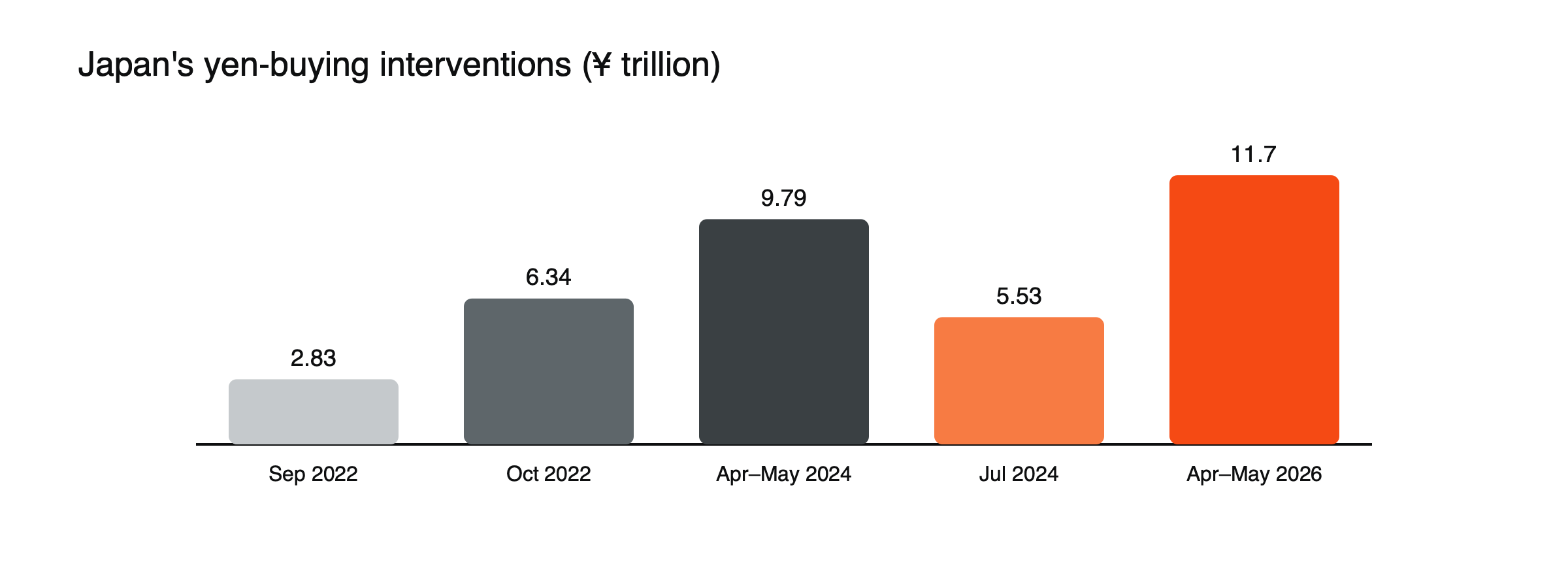
Figure: Japan’s yen-buying interventions (trillion yen). Sources: Nippon.com; WAM; Reuters via Investing.com.
Japan in 2024 and 2026
- April–May 2024: ¥9.79 trillion after the yen weakened past 160 per dollar, a 34-year low.
- July 2024: about ¥5.5 trillion as the yen hit about 161.8.
- April–May 2026: about ¥11.7 trillion after the yen slid to around 160.7 per dollar.
- July–August 2026: about ¥15.4 trillion, the largest monthly amount on record, including a joint operation with the United States on July 31, the first time the two had bought yen together since 1998.
Other famous interventions
| Year | What happened |
|---|---|
| 1985 | The Plaza Accord: five major economies acted together to push the dollar down |
| 2000 | G7 central banks intervened jointly to support the newly launched euro |
| 2011 | G7 members sold yen together to stop it rising after the earthquake in Japan |
| 2011–2015 | The Swiss National Bank defended a minimum of 1.20 francs per euro, then abandoned it |
| 2026 | Japan and the United States bought yen together for the first time since 1998 |
Coordinated actions by several countries have generally had a stronger effect than a single country acting alone. See the Plaza Accord and the 2015 Swiss franc floor removal.
Does it work in the short term?
Yes: in April 2024, the dollar dropped about five yen in a short span after the first operation.
Does it work in the long term?
Not alone: analysts noted the effects tend to fade if the rate gap with the US stays wide. A lasting turn usually needs a change in interest rates or policy, as when the Bank of Japan raised rates in July 2024.
What it means for traders
Interventions bring sudden, large moves that can gap past stops. Warnings from officials about “excessive” moves often come first. See how stop-loss orders work, how interest rate differentials drive currency pairs and what moves currency prices.
Reserves set the limits
A country can only buy its own currency for as long as it has foreign reserves to sell. Japan holds very large reserves, which is why it can intervene in amounts of tens of billions of dollars at a time; smaller economies have far less room. Markets watch reserve levels closely, and a defense that visibly drains them tends to invite more selling, as Thailand and others found in 1997. Selling a strong currency, by contrast, has no hard limit, since a central bank can always create more of its own money, though the resulting reserves bring their own risks. See the 1997 Asian financial crisis.
Spillovers into other markets
To raise dollars for yen-buying, Japan may sell some of the US government bonds it holds as reserves. Large sales can add to upward pressure on US yields, which in turn can widen the rate gap that weakened the yen in the first place. Intervention also moves other yen pairs, Japanese shares and, through global risk appetite, sometimes stocks elsewhere.
Intervention in emerging markets
Many emerging market central banks intervene routinely, smoothing daily swings in their currencies or slowing sharp falls during stress. Some use foreign exchange swaps or forward contracts rather than spot sales to conserve reserves. These operations are often less publicized than Japan’s but can shape how exotic currencies trade, including sudden reversals when a central bank steps in.
Who decides and who acts
Arrangements differ by country. In Japan, the Ministry of Finance decides when to intervene, and the Bank of Japan carries out the trades on its instructions. In the euro area, the European Central Bank holds the main responsibility, and in Switzerland the Swiss National Bank acts directly. Knowing which institution decides helps traders read the warnings: statements from Japan’s top currency officials at the finance ministry carry particular weight, because they are the ones who can order an operation. Their exact wording is rarely chosen by chance.
What 2026 showed
The 2026 operations were the largest Japan had ever carried out, and the July action had the added weight of US participation. Each round pushed USD/JPY several yen lower within hours. Yet the yen was still trading near 160 per dollar in late June after the spring operation, and it gained only modestly after the summer one, because US interest rates remained well above Japanese ones. The episode reinforced the lesson of earlier decades: intervention can set limits and punish one-way bets, but lasting change needs the rate gap to narrow.
A trader’s checklist around intervention
- Is the currency near a level where authorities have acted before?
- Have official warnings been getting stronger?
- How large is the position, and could a sudden move of several percent be absorbed?
- Is the move driven by a rate gap that intervention cannot change?
- Are stops placed where an intervention spike would trigger them at the worst moment?
Frequently asked questions
How do traders know an intervention has happened?
Sometimes officials confirm it the same day; often the market suspects it from a sudden sharp move, and the finance ministry or central bank confirms the amounts later in official data.
Can intervention make a currency weaker as well as stronger?
Yes. Authorities sell their own currency to weaken it, as Switzerland did to cap the franc and as G7 members did with the yen in 2011.
This article is educational content and does not constitute financial, investment, legal or tax advice. Digital assets are volatile and you may lose the amount you invest.
Sources
- Japan spends record amount on yen-buying intervention in October (¥2.83 trillion in September and ¥6.34 trillion in October 2022) — Nippon.com
- Japan spent record $62 billion in April–May to slow currency fall (¥9.79 trillion; dollar fell about 5 yen from 160 on April 29; effects short-lived) — WAM, May 2024
- History of Japan’s intervention in currency markets (July 2024 ¥5.53 trillion; April–May 2026 ¥11.7 trillion) — Investing.com / Reuters
- Japan spent $62 bn to support yen (effectiveness and rate gap) — Business Standard, May 2024
- Japan spent record $96 billion in yen interventions (¥15.4 trillion between July 30 and August 26, 2026; first joint US–Japan yen purchase since 1998; 2011 G7 action) — Kuwait Times / AFP, August 2026
- Japan steps in to defend the yen (intervention on April 30, 2026, at about 160.7; “final warning” before acting) — FN News, May 2026
- Japan’s record yen intervention called a success, but the yen tells a different story (yen still near 160 in late June 2026) — Crypto Briefing, 2026