
What Is an Ethereum CFD?
An Ethereum CFD tracks the price of ether without holding it. How it differs from owning ether, what moves its price and what you give up, such as staking.
An Ethereum CFD tracks the price of ether (ETH), Ethereum’s native coin, so you can trade its moves long or short without owning ether or a wallet. Retail leverage is capped at 2:1 in the EU and Australia, and the UK bans retail crypto derivatives. Unlike holding ether, a CFD gives no staking rewards or on-chain use.
How it works
Choose a size in ether, post margin and close for the price difference in cash. Example: 2 ETH at $3,000 = $6,000 position; at 2:1, margin is $3,000; a $150 move in ether is $300. (Example values.)
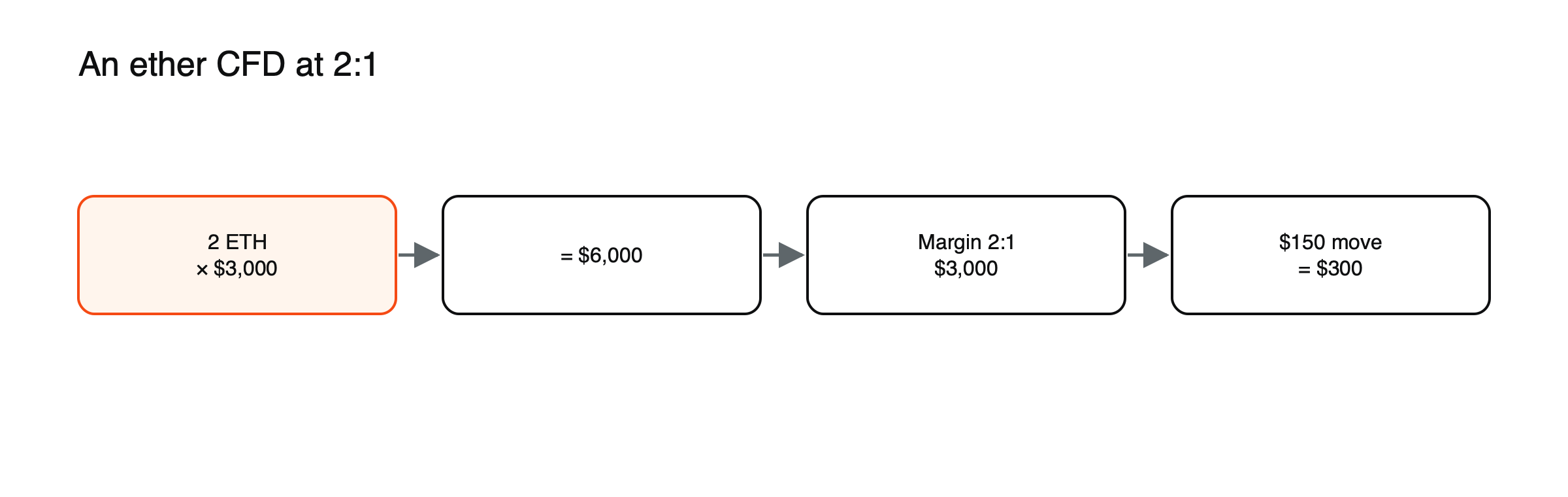
Figure: An ether CFD trade (example values).
A full trade, worked through
A trader buys 2 ETH at $3,000, a $6,000 position needing $3,000 of margin at 2:1. Over 14 days, ether rises 10% to $3,300, a gross gain of $600. Financing at an illustrative 18% a year costs about $41, and the spread about $6, leaving a net gain of about $553. A 10% fall instead would have cost about $647 after costs. (Example values.) See how to calculate profit and loss on a bitcoin CFD for the same method.
What moves ether
- Network activity and fees, which affect how much ether is burned. See how the ETH burn works.
- Staking: since the Merge on September 15, 2022, ether has been secured by staking. See what the Ethereum Merge was.
- Bitcoin and overall crypto sentiment.
- Competition from other smart-contract networks. See Ethereum vs Solana.
Supply and fees
Part of every Ethereum transaction fee is burned, removing ether from supply. After the Dencun upgrade on March 13, 2024, which made transactions on related networks much cheaper, fees on Ethereum fell and less ether was burned. By February 2025, the supply had climbed back above its level at the Merge. Changes in network use and fees therefore feed into ether’s supply, one of the factors traders watch.
Ether against bitcoin
Many traders follow the ETH/BTC ratio, ether’s price in bitcoin. When it rises, ether is outperforming, often during periods of strong interest in applications built on Ethereum; when it falls, money is concentrating in bitcoin. The ratio helps separate ether-specific developments from moves in crypto as a whole.
What you give up
No staking yield, no on-chain use and no ownership. Holding a CFD for months also adds financing.
Volatility
Ether has typically moved more than bitcoin in percentage terms, so positions need smaller sizes for the same risk.
See what a crypto CFD is and crypto CFDs vs buying crypto.
Staking income forgone
Ether holders can stake their coins to help secure the network and earn rewards, typically a few percent a year. CFD holders receive none of this. Over a year, a holder of $6,000 of ether staking at an illustrative 3% would earn about $180, while a CFD holder would instead pay financing. For long-term views, owning and staking ether is usually more efficient than holding a CFD.
Network upgrades as events
Major Ethereum upgrades, which are scheduled well in advance, can move ether’s price around their dates as traders anticipate or react to changes in fees, staking or scalability. They are worth adding to a trading calendar alongside economic data and earnings from crypto-related companies.
Spot ether ETFs
Spot ether ETFs began trading in the United States in 2024, giving investors another regulated route to ether exposure, with an annual fee rather than daily financing. Flows into and out of these funds are watched as a sign of institutional demand.
Ether’s volatility, illustrated
If bitcoin’s typical daily move in a volatile period is about 3%, ether’s is often about 4%. (Illustrative figures.) For the same $100 risk per trade, a bitcoin position with an 8% stop might be about $1,250, while an ether position needing a 10% stop would be about $1,000. Small differences in volatility translate directly into different position sizes.
Network activity and fees
Demand to use Ethereum, for trading, lending, stablecoin transfers and other applications, shows up in transaction fees. High fees mean heavy use and more ether burned; low fees can reflect lower demand or the shift of activity to cheaper networks built on top of Ethereum. Traders watch activity data as a gauge of demand for ether itself.
Competition
Other networks, such as Solana, compete with Ethereum for users and developers, especially in fast-growing areas such as memecoin trading. During 2024 and early 2025, activity and liquidity moved toward competitors during a memecoin boom, and ether lagged. Shifts in where activity happens can move ether’s price relative to bitcoin and its rivals. See Ethereum vs Solana.
Ether in a crash
In broad crypto sell-offs, ether usually falls more than bitcoin, because more leveraged positions are built on it and its market is smaller. In the October 2025 crash, more than $19 billion of leveraged crypto positions were liquidated across the market, and ether’s moves were sharper than bitcoin’s. Positions should be sized with that in mind.
Weekend and holding costs
As with other crypto CFDs, ether CFDs are often traded at weekends with wider spreads and charged financing every night. Holding for months adds up, while owning and staking ether earns a return instead.
Common misreadings
- Treating ether as a lower-risk alternative to altcoins.
- Forgetting the staking yield given up by using a CFD.
The Merge and staking
Since the Merge on September 15, 2022, Ethereum has been secured by validators who stake ether rather than by miners. Staking reduced the amount of new ether issued and created a yield for holders who stake. For CFD traders, the Merge matters mainly through its effect on supply and on how investors value ether as a yield-bearing asset. See what the Ethereum Merge was.
Ether and the wider economy
Like other risky assets, ether tends to rise when interest rates are expected to fall and investors are willing to take risks, and to fall when rates rise or markets turn fearful. Major US economic releases and central bank decisions can therefore move ether as much as Ethereum-specific news.
A pre-trade checklist
- What is the ETH/BTC trend telling you?
- Are there upgrades, ETF flow reports or major data releases due?
- Is the stop wide enough for ether’s volatility?
- How much financing will the planned holding period cost?
Large holders and flows
Large holders of ether, including funds, exchanges and long-standing early investors, can move the market when they buy or sell. On-chain data showing large transfers to exchanges is sometimes read as a sign of selling to come, though it is often ambiguous. ETF flow reports provide another view of institutional demand.
Ether CFD or ether ETF
For long-term exposure without leverage, a spot ether ETF charges an annual fee rather than daily financing, while a CFD offers leverage, short selling and trading outside exchange hours. The choice mirrors that between bitcoin CFDs and bitcoin ETFs. See bitcoin CFD vs bitcoin ETF.
Gas spikes and network stress
During periods of extreme demand, such as major token launches or market crashes, Ethereum fees can spike sharply as users compete to get transactions processed. These episodes often coincide with large price moves, and they can make on-chain responses slow or expensive for holders, one area where CFD traders, who never touch the network, face fewer frictions. Such spikes usually fade again within days.
Frequently asked questions
Is an Ethereum CFD the same as owning ether?
No. It is a contract on ether’s price; there are no coins, no staking rewards and no network use.
Why does ether often move more than bitcoin?
Its market is smaller and more influenced by activity in applications built on Ethereum, so sentiment swings tend to move it further.
Leverage, margin and cost figures in this article are example values for illustration. Actual terms depend on the provider, the instrument and the rules in your country.
This article is educational content and does not constitute financial, investment, legal or tax advice. Digital assets are volatile and you may lose the amount you invest.
Sources
- The Merge (September 15, 2022) — ethereum.org
- ESMA adopts CFD measures (2:1 for cryptocurrencies; 50% margin close-out; negative balance protection) — Finadium
- FCA bans the sale of crypto-derivatives to retail consumers (from January 6, 2021) — FCA
- Ethereum’s Dencun upgrade is making ETH inflationary again (Dencun live March 13, 2024; blobs) — The Block, May 2024
- Ethereum supply climbs to pre-Merge levels (120,521,523 ETH; ~383 ETH above Merge day) — The Block, February 2025