
Forex vs Stocks: How Trading Each One Differs
Forex trades around the clock in pairs with higher leverage caps; stocks trade in set hours on company news. A side-by-side comparison for traders.
The key difference in forex vs stocks is what drives prices and when you can trade. Currencies trade around the clock on weekdays, in pairs, mostly on rates and macro data. Stocks trade in exchange hours and respond to earnings and company news. EU retail leverage caps also differ: 30:1 for major pairs, 5:1 for shares.
Side by side
| Forex | Stocks | |
|---|---|---|
| Market size | About $9.6 trillion a day | Smaller and spread across exchanges |
| Hours | Sunday to Friday, around the clock | Exchange hours, with some extended sessions |
| What moves prices | Rates, inflation, growth, policy | Earnings, company news, sector trends |
| Number of instruments | A few dozen liquid pairs | Thousands of companies |
| Retail CFD leverage (EU cap) | 30:1 majors, 20:1 others | 5:1 |
| Gaps | Mostly over weekends | Overnight and weekends |
| Holding costs (CFD) | Rollover based on rate differentials | Financing plus dividend adjustments |
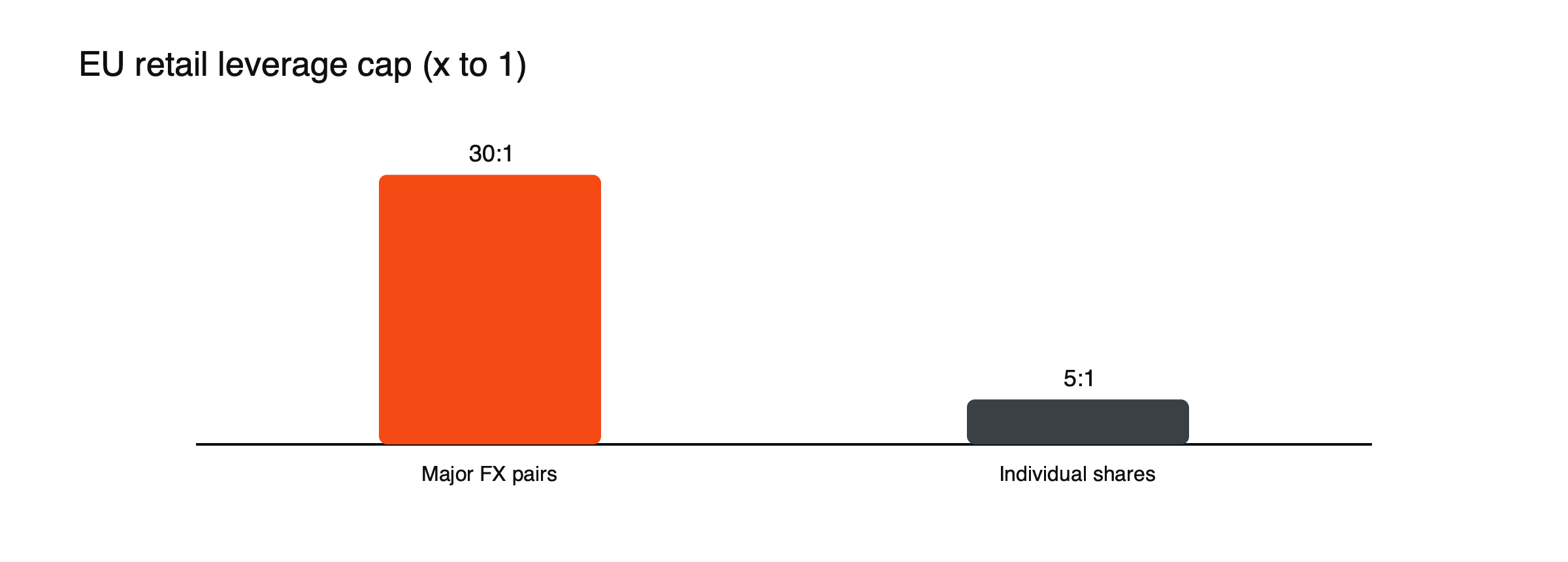
Figure: EU retail leverage caps. Source: ESMA.
A typical day’s move, compared
Suppose EUR/USD moves 0.5% on a typical day and a large share moves 2%. (Illustrative moves.) At an effective leverage of 30 to 1, the currency move equals 15% of the margin; at 5 to 1, the share move equals 10%. The different leverage caps roughly balance out the difference in typical volatility, which is the reasoning behind them. The result is that, on a margin basis, both can move a leveraged account by similar amounts on an ordinary day.
Why the differences matter
Focus: a currency trader follows a handful of central banks and data releases; a stock trader may follow hundreds of companies.
Gap risk: stocks can gap every morning on overnight news; currencies mainly over weekends and on surprise policy moves. See why prices gap over weekends.
Leverage: higher caps on currencies reflect lower typical volatility of major pairs, not lower risk.
Liquidity is not the same as safety
“Forex is more liquid, so it is easier” overlooks that major-pair moves are small, so traders use more leverage, which magnifies losses. Liquidity lowers costs; it does not lower risk.
See how the forex market works and what a CFD is.
What gives a trader an edge
In stocks, careful research into a company’s business, competitors and accounts can produce insight that others have missed, especially in smaller companies. In major currencies, the key information, central bank decisions and economic data, is public and analyzed by thousands of professionals at the same moment, which makes a lasting informational edge harder to find. Currency traders tend to focus instead on risk management, timing and understanding how markets react to data.
Costs compared
| Cost | Forex (major pairs) | Stocks (via CFDs) |
|---|---|---|
| Spread | Usually very tight | Varies; wider on smaller companies |
| Commission | Often none, or small on raw-spread accounts | Often charged per trade |
| Overnight cost | Rollover based on the rate gap | Financing on the full position |
| Other | Wider spreads at rollover time | Dividend adjustments; borrowing fees on shorts |
How the two interact
Currencies and stocks are linked. A falling stock market often lifts the dollar, yen and Swiss franc, and hits commodity and emerging market currencies. A weaker home currency can lift the share prices of exporters, as with Japanese companies when the yen falls. Holding positions in both markets therefore means checking how they might move together in a sell-off. See risk-on vs risk-off.
Ownership and long-term investing
Buying shares outright gives ownership, voting rights and dividends, and suits long-term investing without leverage. Currencies offer no equivalent long-term return beyond the interest rate gap, so currency trading is mostly about shorter-term moves and hedging. See CFD trading vs owning the underlying asset.
Which suits whom
Forex tends to suit traders who prefer following a small number of instruments driven by macroeconomic news, who want to trade outside normal exchange hours and who are comfortable with leverage. Stocks suit those who enjoy researching companies, want a wide choice of opportunities and may want to own assets for the long term. Many traders combine both, using currencies for macro views and stocks for company-specific ideas.
Trading hours in practice
Because currencies trade from Sunday evening to Friday evening, a forex trader can react to news at almost any hour, including events that happen while stock exchanges are closed. Stock traders face set sessions, so news that breaks overnight shows up as a gap at the next open. The flip side is that forex positions are exposed around the clock, and important moves can happen while a trader sleeps. Stops and position sizes need to reflect that.
How news hits each market
A single US inflation report can move every dollar pair at once, along with stock indices and bonds. Company earnings, by contrast, mostly move one share and perhaps its competitors. Forex traders therefore watch a shared calendar of macro events, while stock traders track earnings seasons and company announcements. Both need to know when the important news for their positions is due. See how to use an economic calendar.
Liquidity in practice
Major currency pairs can absorb very large orders with little effect on price for most of the trading day. Large company shares are also liquid during exchange hours, but smaller companies can have wide spreads and thin order books, so even modest orders move the price. For retail-sized trades, liquidity rarely limits major pairs or large shares; it matters more for small companies and exotic currencies.
Diversifying across both
Holding both currency and stock positions can spread risk, but only if they respond to different drivers. A long stock index position and a long AUD/USD position, for instance, both tend to suffer in a risk-off move, so together they concentrate rather than diversify. Pairing stock exposure with a position that tends to benefit when stocks fall, such as a long yen position, is closer to genuine diversification.
A combined account, illustrated
Suppose an account holds a long position in a US stock index CFD worth $20,000 and a long AUD/USD position worth $30,000. (Illustrative example.) On a sharp risk-off day, the index falls 3%, losing about $600, and AUD/USD falls 1.5%, losing about $450. The two positions that looked like separate ideas lose together, about $1,050 in total. Adding a small long yen position might have offset part of that, at the cost of some rollover in calm periods.
The learning curve
New traders often find forex simpler at first, because there are only a few major pairs to follow. Stocks offer more choice but require more research per idea. In both markets, the hardest skills to learn are the same: sizing positions, accepting losses and following a plan. Those matter far more than which market is chosen.
Choosing where to start
A practical way to choose is to start with the market whose news you follow. Someone who reads about central banks and economic data each day may find currencies a natural fit; someone who follows companies and industries may prefer shares. Starting small in one market avoids spreading attention too thin.
Common misreadings
- Assuming forex is easier because it is more liquid.
- Comparing leverage caps without comparing how much each market moves.
- Treating currency and stock positions as independent when they often move together in a sell-off.
Frequently asked questions
Is forex riskier than stocks?
Not inherently. Major currencies usually move less than individual shares, but higher leverage can make forex positions just as risky or more so. Risk depends mainly on position size and leverage.
Can I trade forex and stocks from the same account?
Many CFD brokers offer both from one account, which makes it easy to trade each, but also easy to build up combined exposure without noticing.
This article is educational content and does not constitute financial, investment, legal or tax advice. Digital assets are volatile and you may lose the amount you invest.
Sources
- Global FX trading hits $9.6 trillion per day — BIS, September 2025
- ESMA adopts CFD measures (30:1 major pairs, 20:1 non-major pairs, 5:1 individual equities) — Finadium
- Forex trading hours (Sunday to Friday, 5 p.m. New York) — Benzinga
- Fees and charges (equity CFD financing; dividend adjustments) — Axi