
How Inflation Data Moves Currencies
Inflation reports move currencies by changing expected interest rates. Why a hot CPI print often lifts a currency, when it does not, how to read the surprise.
Inflation data moves currencies mainly through rate expectations. A hotter-than-expected report usually lifts a currency because markets expect rates to stay higher for longer; a cooler one tends to weaken it. The surprise matters more than the level, and the reaction can flip if high inflation signals policy failure.
The usual chain
- Inflation comes in above forecasts.
- Markets price more or longer rate rises.
- Short-term yields rise, widening the rate gap with other countries.
- The currency strengthens.
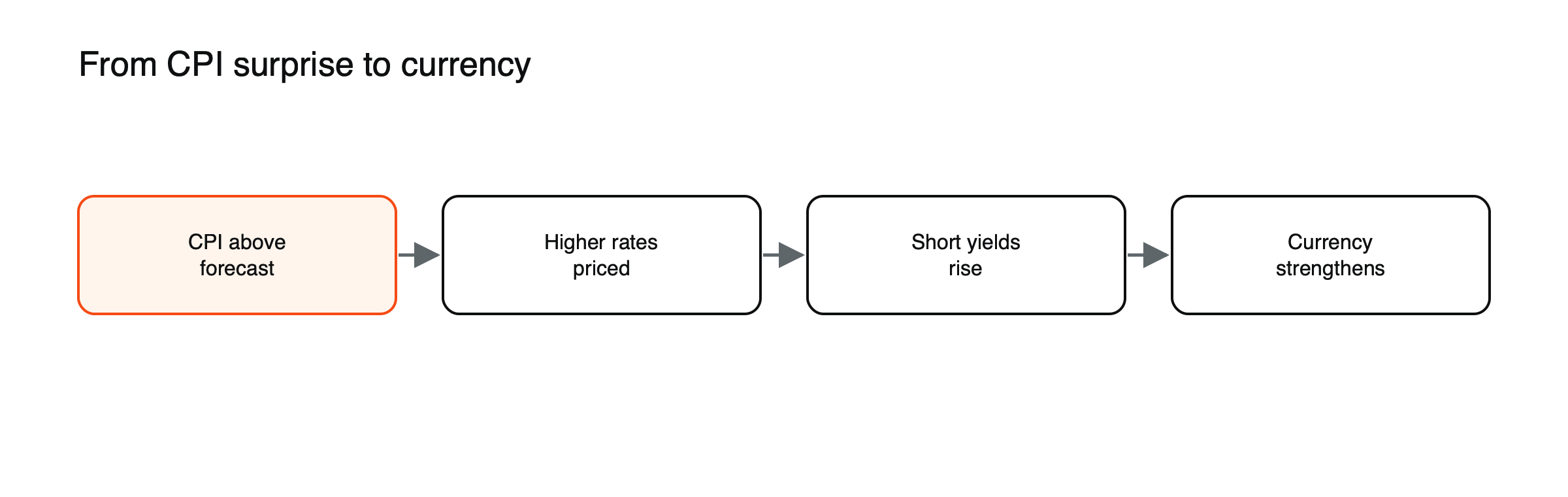
Figure: The usual path from an inflation surprise to a currency move.
In 2022, hot US inflation reports repeatedly triggered sharp moves across markets: a September 2022 report sent bitcoin down about 10% and stocks lower in a single day as rate expectations jumped, while the dollar index climbed to a 20-year high that month.
A release, worked through
Suppose economists expect US core consumer prices to rise 0.2% in a month, and the report shows 0.4%. (Illustrative figures.) Within seconds, traders reduce bets on Federal Reserve rate cuts, the two-year Treasury yield jumps by a noticeable amount, and the dollar rises against most currencies, perhaps by around half a percent against the yen and euro. If the next month’s report undershoots, much of that move can unwind. What moved the market was the 0.2-point gap between expectation and outcome, not the level of inflation itself.
What traders watch
- Headline vs core: core inflation, excluding food and energy, shows underlying pressure.
- Month-on-month change: often moves markets more than the annual rate.
- Services and wages: signal how persistent inflation may be.
The reports that matter most
| Report | Why currency traders watch it |
|---|---|
| US consumer price index | The first broad read on US inflation each month |
| US personal consumption expenditures price index | The measure the Federal Reserve targets |
| Euro area flash inflation | Early estimate for the ECB |
| UK consumer price index | Key input for Bank of England decisions |
| Tokyo consumer prices | An early signal for Japan’s national figures |
| Australian inflation data | Shapes Reserve Bank of Australia expectations |
The first report of the month often moves markets most, because it surprises before others have confirmed the picture.
Base effects
Annual inflation rates compare prices with the same month a year earlier, so a big jump or fall a year ago can distort today’s annual figure. If energy prices spiked twelve months ago, the annual rate can drop sharply even though prices are still rising month to month. Traders watch monthly changes and annualized three-month rates to see through these effects.
Inflation expectations
Central banks care not only about current inflation but about what households, businesses and markets expect. Surveys of consumers and businesses, and the inflation rate implied by the gap between ordinary and inflation-linked government bonds, all feed into policy. A rise in expected inflation can push a central bank toward a tougher stance even before actual inflation moves, and currencies often react to these expectations measures too.
When the reaction flips
If inflation is high and the central bank is seen as unwilling or unable to respond, higher inflation erodes a currency’s value instead. Over the long run, persistently higher inflation tends to weaken a currency. See what purchasing power parity is.
Release-day risk
Spreads widen and prices can jump in seconds after major inflation releases. Stops may fill at worse prices. See how stop-loss orders work.
See inflation surprise vs inflation trend and what moves currency prices.
Inflation and real interest rates
What ultimately attracts money to a currency is the real interest rate, the nominal rate minus inflation. If inflation rises while the central bank holds its rate steady, real rates fall and the currency can weaken. If the central bank responds by raising rates faster than inflation rises, real rates climb and the currency usually strengthens. That is why the same inflation figure can lead to opposite currency moves depending on how markets expect the central bank to respond. See how interest rate differentials drive currency pairs.
Surprises on both sides of a pair
Currency pairs react to the balance of inflation news in two countries. A hot US report on the same week as a hot euro area report may leave EUR/USD roughly unchanged, while a hot US report alongside a soft European one can move it sharply. Keeping track of recent surprises in both economies helps judge which way the balance is tilting.
A release-day checklist
- What is the consensus forecast for headline and core, monthly and annual?
- How much would a surprise change expected rate decisions?
- Are other releases or central bank speakers due the same day?
- Are positions sized so that a sudden move and wider spreads would be acceptable?
Common misreadings
- Reacting to the annual figure when the monthly change was the surprise.
- Ignoring revisions to the previous month’s data.
- Assuming higher inflation always strengthens a currency.
Inflation over the long run
Over years rather than days, persistently higher inflation tends to weaken a currency, because each unit buys less. Countries whose inflation runs well above their trading partners’ usually see their currencies drift lower over time, unless high interest rates compensate investors. Short-term reactions to data and long-term trends can therefore point in opposite directions. Long-term investors watch inflation trends as well as monthly surprises. See what purchasing power parity is.
Frequently asked questions
Why does the currency sometimes fall after a high inflation reading?
Because markets may doubt the central bank will respond firmly enough, or because the details, such as core inflation, were softer than the headline. In those cases the high number can weaken the currency.
Which inflation measure does the Fed target?
The Federal Reserve’s 2% goal is defined in terms of the personal consumption expenditures price index, though markets watch the consumer price index closely because it is released earlier.
This article is educational content and does not constitute financial, investment, legal or tax advice. Digital assets are volatile and you may lose the amount you invest.
Sources
- Big macro week: FOMC minutes, PPI and CPI (bitcoin −10% on the September 2022 CPI day, in step with stocks) — K33 Research, October 2022
- The Dollar Index (20-year high in September 2022; Fed rate path) — BIT Knowledge Hub
- Is Bitcoin showing greater sensitivity to US CPI releases again? (surprise vs median expectation) — Block Scholes