
How to Calculate Pip Value on Any Currency Pair
Pip value = pip size × position size, converted into your account currency. Worked examples for EUR/USD, USD/JPY, USD/CAD and EUR/GBP in US dollars.
Pip value is how much one pip is worth on your position: pip value = pip size × position size, in the quote currency, then converted into your account currency. For a dollar account trading one standard lot, a pip is $10 on EUR/USD, about $6.67 on USD/JPY at 150 and about $7.35 on USD/CAD at 1.36.
The formula
Pip value (in quote currency) = pip size × number of units
Then convert to your account currency at the current rate. Pip size is 0.0001 for most pairs and 0.01 for yen pairs.
Worked examples (1 standard lot = 100,000 units, US dollar account)
EUR/USD (quote USD): 0.0001 × 100,000 = $10. No conversion needed.
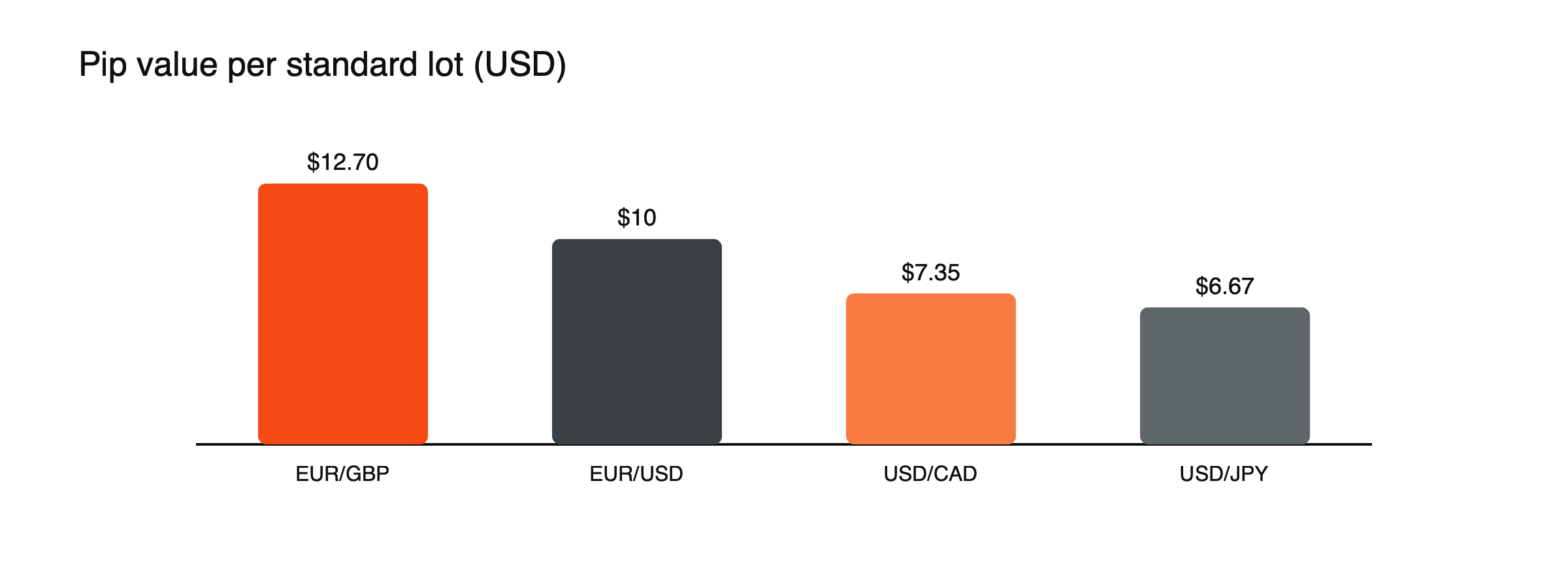
Figure: Pip value per standard lot depends on the pair (example rates).
USD/JPY at 150.00 (quote JPY): 0.01 × 100,000 = ¥1,000 → ¥1,000 ÷ 150 = $6.67.
USD/CAD at 1.3600 (quote CAD): 0.0001 × 100,000 = C$10 → C$10 ÷ 1.36 = $7.35.
EUR/GBP with GBP/USD at 1.2700 (quote GBP): 0.0001 × 100,000 = £10 → £10 × 1.27 = $12.70.
Example 1: EUR/USD, dollar account
Pip value = 0.0001 × 100,000 = $10 per standard lot. The quote currency is the dollar, so no conversion is needed.
Example 2: USD/JPY at 150.00, dollar account
Pip value = 0.01 × 100,000 = ¥1,000. Converted at 150.00: ¥1,000 ÷ 150 ≈ $6.67 per standard lot.
Example 3: USD/CAD at 1.3600, dollar account
Pip value = 0.0001 × 100,000 = C$10. Converted: C$10 ÷ 1.36 ≈ $7.35.
Example 4: EUR/GBP, dollar account
Pip value = 0.0001 × 100,000 = £10. Converted at GBP/USD 1.2700: £10 × 1.27 = $12.70.
Example 5: EUR/USD, euro account
Pip value = $10. Converted to euros at 1.1000: $10 ÷ 1.10 ≈ €9.09.
Quick rules
- If the quote currency is your account currency, pip value is fixed: $10 per standard lot.
- If the base currency is the dollar (USD/JPY, USD/CAD), divide by the pair’s price.
- For crosses, convert using the relevant dollar rate.
Why it changes
Pip values move with exchange rates whenever conversion is involved, so the dollar value of a USD/JPY pip rises as the yen strengthens.
How pip value drifts
In example 2, if USD/JPY falls from 150.00 to 140.00, the same ¥1,000 pip is worth ¥1,000 ÷ 140 ≈ $7.14, up from $6.67. Positions sized when the yen was weaker carry slightly more dollar risk per pip after it strengthens. For large or long-held positions, recalculating pip value from time to time keeps risk estimates accurate.
Pip value by lot size
| Lot | Units | Pip value on EUR/USD |
|---|---|---|
| Standard | 100,000 | $10 |
| Mini | 10,000 | $1 |
| Micro | 1,000 | $0.10 |
The pip value scales directly with size: half a standard lot is worth $5 a pip on EUR/USD.
Using it
Multiply pip value by your stop distance to know your risk before entering. See how lot size changes your risk per pip, what a pip is and how to size a CFD position using risk per trade. For the bigger picture, read how the forex market works.
Example 6: EUR/JPY, dollar account
Pip value = 0.01 × 100,000 = ¥1,000, the same as on USD/JPY because the quote currency is the yen. Converted at USD/JPY 150.00: about $6.67 per standard lot. The euro’s price in yen does not enter the calculation; only the yen’s value in dollars does.
Example 7: USD/JPY, euro account
Pip value = ¥1,000, about $6.67 at 150.00. Converted into euros at EUR/USD 1.1000: about €6.06. Two conversions are needed when neither currency in the pair is your account currency and the yen is involved.
A method that works for any pair
- Find the pip size: 0.0001 for most pairs, 0.01 for yen pairs.
- Multiply by the number of units in your position to get the pip value in the quote currency.
- If the quote currency is your account currency, you are done.
- If not, convert the result into your account currency using the current exchange rate between the two.
- Multiply by your stop distance in pips to get the money at risk.
Following the same steps every time avoids the most common error, assuming a pip is always worth $10.
Pip values across popular pairs
| Pair (dollar account) | Pip value per standard lot | Depends on |
|---|---|---|
| EUR/USD, GBP/USD, AUD/USD | $10 | Fixed |
| USD/JPY, EUR/JPY | About $6.67 at 150 yen per dollar | USD/JPY rate |
| USD/CAD | About $7.35 at 1.36 | USD/CAD rate |
| USD/CHF | Ten Swiss francs, converted | USD/CHF rate |
| EUR/GBP | About $12.70 at 1.27 | GBP/USD rate |
(Example rates.) The pairs where the dollar is the quote currency have a fixed pip value for a dollar account; all others change as rates move.
Common pip value mistakes
- Assuming a pip is worth $10 on every pair, which overstates risk on yen pairs and understates it on EUR/GBP.
- Forgetting to convert into the account currency for non-dollar accounts.
- Using an old exchange rate for the conversion after a large move.
- Treating a pipette as a pip and getting a figure ten times too small.
Smaller lots on yen pairs
The same steps apply to smaller positions. A mini lot of USD/JPY, 10,000 units, has a pip value of ¥100, about $0.67 per pip at 150 yen per dollar; a micro lot, 1,000 units, about $0.07 per pip. Scaling the standard-lot figure by the position size gives the answer directly every time.
From pip value to risk
Suppose you plan a EUR/USD trade of 0.5 lots with a stop 40 pips away. Pip value is $5, so the risk is 40 × $5 = $200, before any slippage. If that is more than you want to risk, reduce the size; if the stop needs to be wider for the trade to make sense, reduce the size further. Pip value turns a stop distance into money, which is the number that actually matters to your account. See how to size a CFD position using risk per trade.
Frequently asked questions
Does my platform calculate pip value for me?
Most platforms show it in the contract details or order window, and many position-size tools use it automatically. Knowing how to calculate it lets you check the figures and plan trades before opening the platform.
Why is a pip worth less on USD/JPY than on EUR/USD?
Because the pip is measured in yen and converted into dollars at around 150 yen per dollar, which gives about $6.67 per standard lot rather than $10.
Leverage, margin and cost figures in this article are example values for illustration. Actual terms depend on the provider, the instrument and the rules in your country.
This article is educational content and does not constitute financial, investment, legal or tax advice. Digital assets are volatile and you may lose the amount you invest.