
What Is Purchasing Power Parity?
Purchasing power parity says exchange rates should move toward levels that equalize prices. How PPP works, what the 2026 Big Mac index showed and its limits.
Purchasing power parity (PPP) is the idea that exchange rates should drift toward levels that make the same goods cost the same everywhere. If a burger costs far more in Switzerland than in the US, the franc looks overvalued. In January 2026, the Big Mac index put the franc about 48% overvalued and the yen 50% undervalued.
How the PPP rate is calculated
Implied PPP rate = local price ÷ US price
Worked example: the yen
In January 2026, a Big Mac cost about ¥480 in Japan and $6.12 in the US. Implied rate = 480 ÷ 6.12 ≈ ¥78 per dollar. The market rate was about ¥160, so by this measure the yen was roughly 50% undervalued.
Absolute and relative PPP
The version above, comparing price levels directly, is called absolute PPP. A second version, relative PPP, looks at changes rather than levels: it says that a currency should weaken over time by roughly the difference between its inflation rate and that of its partner. If prices rise 6% a year in one country and 2% in another, relative PPP suggests the first country’s currency should lose about 4% a year against the second’s. (Illustrative rates.) Relative PPP tends to hold better than absolute PPP over long periods, especially for countries with high inflation, where currency weakness and rising prices go hand in hand.
The law of one price, and why it breaks
PPP builds on the idea that identical goods should sell for the same price everywhere once converted into one currency, because otherwise traders could buy cheap in one place and sell dear in another. In practice, transport costs, tariffs, taxes, local regulations and differences in quality and branding all get in the way. Many goods and services, from haircuts to rent, cannot be traded across borders at all, so their prices are set by local wages and land costs.
The Big Mac index
Created by The Economist in 1986, it is a light-hearted, simplified version of PPP using one standard product sold worldwide. In January 2026, Switzerland had the most expensive Big Mac at $9.08 against the US price of $6.12.
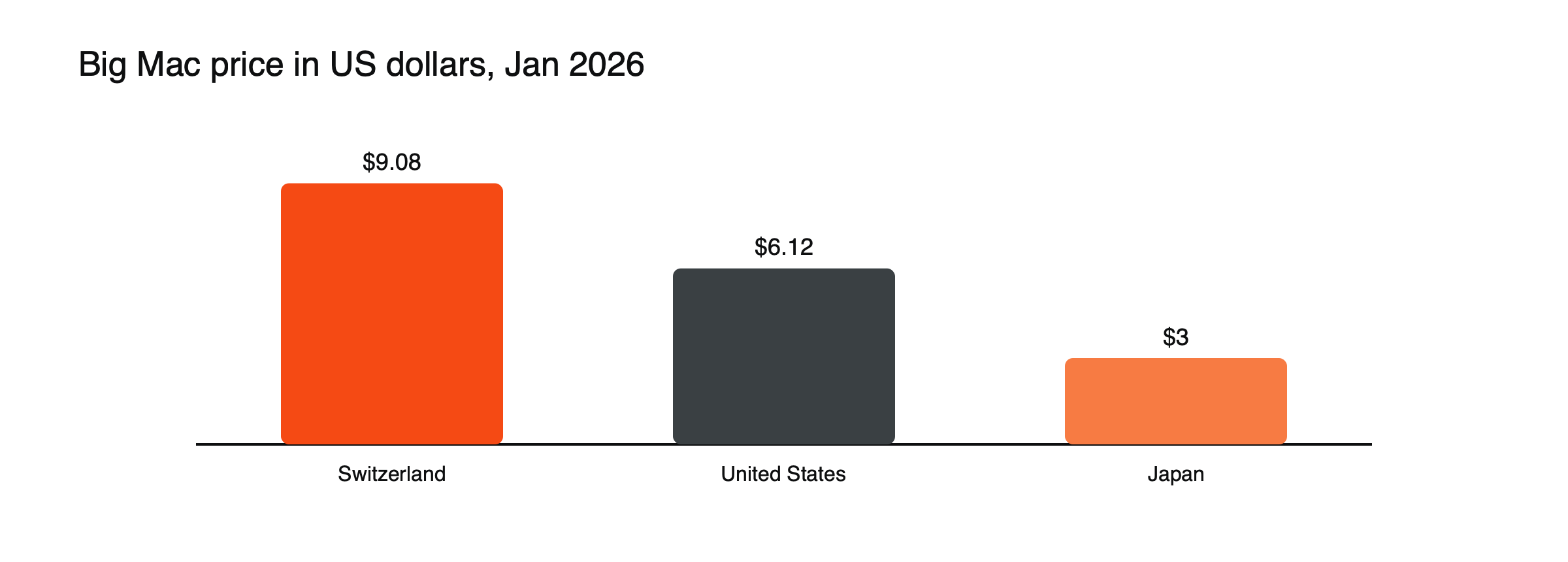
Figure: Big Mac prices at market exchange rates, January 2026. Source: The Economist.
Why markets drift from PPP
- Local costs: wages and rents differ, so non-traded goods are cheaper in poorer countries.
- Capital flows and interest rates move currencies far more than goods prices in the short run.
Why poorer countries often look cheap
Measures of PPP regularly show the currencies of lower-income countries as undervalued. A common explanation is that productivity in industries producing traded goods is higher in richer countries, which pushes up wages across their whole economies, including in services. Those higher wages make local services, and a Big Mac with its local labor and rent, more expensive. So part of what looks like undervaluation in poorer countries is simply lower local costs, which may persist for decades rather than correcting.
A pegged exception
Hong Kong’s dollar looks deeply undervalued by the index, about 48% in January 2026, but it is pegged to the US dollar, so PPP pressure cannot move it freely.
How long gaps last
Research over many decades has generally found that deviations from PPP fade only slowly, often taking several years to shrink by half, and that exchange rates can move away from PPP for long stretches before turning back. Short-term moves are driven far more by interest rates, capital flows and risk sentiment. That is why a currency can look “cheap” on PPP for years while continuing to fall, as the yen did in the early 2020s.
PPP beyond currency trading
PPP is widely used to compare living standards and the size of economies. International institutions publish GDP figures converted at PPP rates as well as at market exchange rates, because market rates can understate how much income buys in countries where local prices are low. Rankings of the world’s largest economies change noticeably depending on which measure is used. Statistical agencies calculate these PPP rates from large baskets of goods and services, not a single burger.
How traders use PPP
As a long-term anchor, not a timing tool. Currencies can stay far from PPP for years; a large gap may hint at long-run pressure but says little about next month. See what moves currency prices and fixed vs floating exchange rates. For the bigger picture, read how the forex market works.
Using PPP in a trading plan
For traders, PPP works best as background. A large gap suggests where long-term pressure may lie, which can matter for positions held for months or years, or for judging how far a currency might run before value-based buyers or sellers step in. It does not provide entry or exit timing, and a trade built only on a currency looking cheap or expensive on PPP can lose for a long time. Combining PPP with interest rate trends and positioning gives a more complete picture.
A basket calculation, illustrated
Suppose a basket of goods and services costs €100 in the euro area and $115 in the United States. (Illustrative prices.) The PPP rate for EUR/USD is 115 ÷ 100 = 1.15: at that rate, the basket costs the same in both places. If the market rate is 1.10, the euro buys less in dollars than PPP suggests, so by this measure it is about 4% undervalued. Official PPP estimates work the same way, but with baskets containing thousands of items weighted by how much people actually spend on them.
The yen’s long gap
The yen shows how far and how long a currency can sit from PPP. By the Big Mac measure in early 2026, the yen’s implied rate was around ¥78 per dollar while the market rate was about ¥160, a gap of roughly 50%. Broader measures told a similar story. The gap reflected years of very low Japanese interest rates relative to the United States, which kept money flowing out of yen, showing that rate differentials can dominate valuation for long periods. See why USD/JPY follows US Treasury yields.
Other ways to value a currency
PPP is one of several valuation approaches. Real effective exchange rates compare a currency with a basket of trading partners after adjusting for inflation, showing whether it has become more or less competitive over time. Other models estimate the exchange rate consistent with a sustainable trade balance or with economic fundamentals such as productivity. They often disagree with each other, which is a reminder that “fair value” for a currency is a range, not a number.
Where to find PPP estimates
International organizations such as the OECD, the IMF and the World Bank publish PPP conversion rates, usually updated once a year. The Economist publishes its Big Mac index twice a year. Comparing a few sources gives a better sense of how far a currency sits from fair value than relying on any measure, especially one built on a single product.
Common misreadings
- Treating a PPP gap as a short-term trading signal.
- Comparing currencies on PPP without allowing for differences in local costs.
- Forgetting that pegged currencies cannot adjust freely toward PPP.
Frequently asked questions
Does a currency that is undervalued on PPP have to rise?
No. It may stay undervalued for years, and the gap can close partly through faster inflation at home rather than through a stronger exchange rate.
Is the Big Mac index a serious measure?
It was created partly as a light-hearted guide, but it is widely cited because it is simple and consistent. Official PPP estimates use much broader baskets of goods and services.
This article is educational content and does not constitute financial, investment, legal or tax advice. Digital assets are volatile and you may lose the amount you invest.
Sources
- Big Mac prices worldwide, January 2026 (Switzerland $9.08 vs US $6.12, franc 48.4% overvalued) — Mappr, citing The Economist
- Big Mac index (January 2026: ¥480 in Japan, about $3; yen roughly 50% undervalued) — The World This Wiki, summarizing The Economist
- Big Mac index (introduced in 1986; limitations) — Model Diplomat
- Can you make money from the Big Mac index? (Hong Kong dollar undervalued but pegged) — The Economist via Breezy