
Revenue vs Earnings: Which Moves a Stock More?
Revenue shows demand; earnings show profit after costs. Growth stocks are judged on revenue, mature ones on earnings. Which moves a stock more, compared.

Revenue vs earnings: which matters more depends on the company. Revenue, the “top line,” shows how much customers buy; earnings, the “bottom line,” what is left after costs. Growth companies are judged mainly on revenue, mature ones on earnings and margins. Either way, a beat built on weak revenue gets less credit.
Side by side
| Revenue | Earnings | |
|---|---|---|
| What it measures | Sales to customers | Profit after all costs |
| Can be boosted by | Price rises, volume, acquisitions | Cost cuts, tax, buybacks, one-offs |
| Matters most for | Growth companies | Mature, profitable companies |
| Quality signal | Hard to manufacture | Easier to adjust |
| Related measure | Revenue growth rate | Earnings per share, margins |
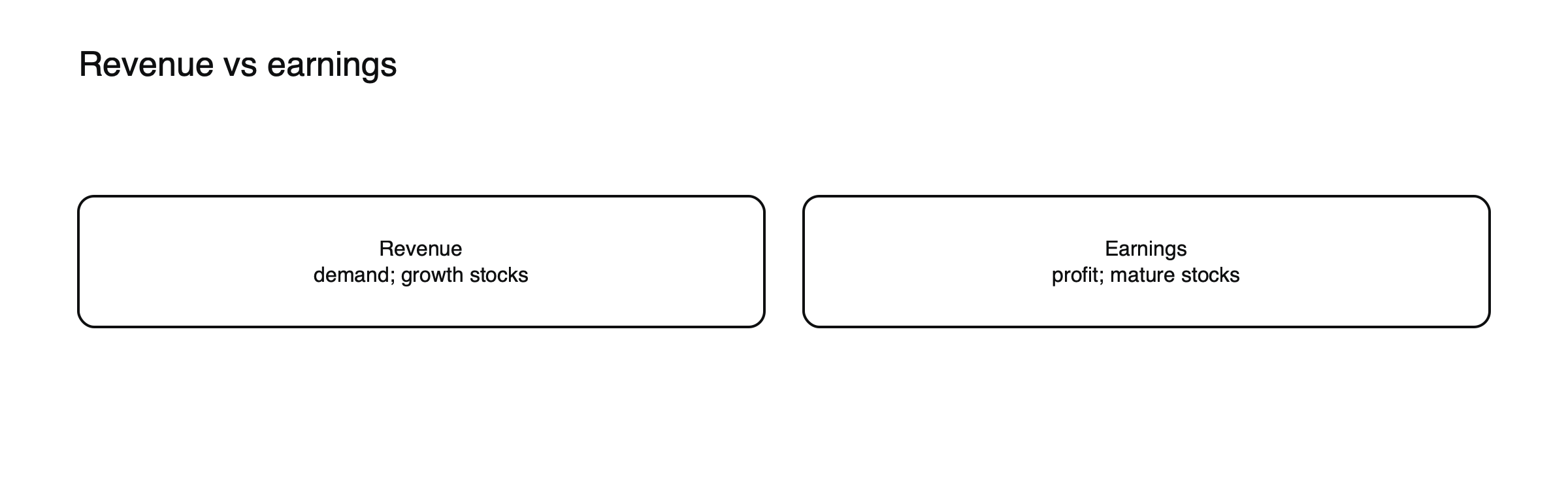
Figure: What each line shows.
Two ways to beat, illustrated
Two hypothetical companies, each expected to report revenue of $1,000 million and EPS of $1.95, both report EPS of $2.05. Company A gets there with revenue of $1,060 million, 6% above forecasts, on steady costs. Company B reports revenue of $970 million, a 3% miss, but cuts marketing spending and benefits from a lower tax rate. Both beat on the bottom line, but A’s beat shows growing demand, while B’s depends on savings that cannot be repeated forever. A usually earns a better reaction, and its estimates for future quarters are more likely to rise.
Why revenue often gets more weight
Revenue is harder to boost with accounting choices. A company that beats on earnings but misses on revenue may be cutting costs rather than growing. See why stocks sometimes fall after beating earnings.
When earnings matter more
For mature businesses with stable sales, profit margins and cash flow drive value. See how to calculate gross, operating and net margin and how earnings per share is calculated.
Organic and acquired growth
Revenue can rise because a company sells more of its own products, organic growth, or because it has bought other businesses. Acquisitions add revenue immediately but bring integration costs and debt, and they do not show whether the original business is growing. Many companies report organic growth separately, and investors usually value it more.
How revenue is recognized
Accounting rules decide when revenue is counted, typically when goods or services are delivered rather than when cash is received. For long contracts or subscriptions, revenue may be spread over time. Changes in recognition policies, or aggressive interpretation of them, can make revenue look stronger than the business, which is one reason auditors and regulators scrutinize this area closely.
Gross and net revenue
Some businesses, such as marketplaces or travel agents, can report either the full value of transactions they handle or only the fee they keep. The two can differ enormously in size. Comparing companies that use different approaches can be misleading, so checking how revenue is defined matters, especially for platform businesses.
A metric beyond revenue
For some companies, an operating metric matters even more than revenue or earnings. When Netflix reported in April 2022 that it had lost about 200,000 subscribers and expected to lose about 2 million more, its shares fell 35% the next day, because subscribers drive future revenue. For subscription businesses, user numbers can be the first warning of slowing growth.
When growth companies are judged on profit
When rates are high and investors want profits now, even growth companies can be punished for weak earnings or rising costs, as Meta was in 2022 when spending rose.
See how earnings reports move share prices and what moves stock prices.
The Rule of 40
For software companies, investors sometimes use a shortcut combining growth and profitability: revenue growth rate plus profit margin should total at least 40%. A company growing 30% with a 10% margin passes; one growing 15% with a 5% margin does not. The rule is crude, but it captures how investors trade off growth against profit in that sector.
Revenue growth and valuation
For companies with little or no profit, investors often value shares as a multiple of revenue. A company valued at ten times its sales needs fast growth and a credible path to profit to justify that price. When growth slows, the multiple can shrink quickly, and the share can fall sharply even if revenue keeps rising, because investors are pricing future growth, not current sales.
Comparing like with like
Many businesses are seasonal, so revenue is usually compared with the same quarter a year earlier. Currency moves can distort the comparison for international companies: a stronger dollar reduces the dollar value of sales made abroad, so many companies also report growth at constant exchange rates. Looking at both figures shows whether growth came from the business or from exchange rates.
Deferred revenue and bookings
Subscription and software companies often collect cash before they can count it as revenue. The amount waiting to be recognized appears as deferred revenue, and new contracts signed are often reported as bookings or billings. Rising deferred revenue and bookings point to future revenue growth; slowing figures can warn of a slowdown before it shows in reported revenue.
Earnings quality
Earnings that come with strong operating cash flow, steady margins and few one-off items are considered high quality. Earnings boosted by lower tax rates, gains on asset sales or reduced investment are lower quality, because they are less likely to repeat. Revenue growth tends to support earnings quality, since it gives profits a base that does not depend on cutting costs.
Common misreadings
- Treating any earnings beat as good news.
- Ignoring currency and acquisition effects on revenue.
- Comparing revenue across companies that define it differently.
Margins connect the two
Revenue and earnings are linked by margins. If revenue grows 10% and margins hold steady, earnings grow about 10%; if margins expand, earnings grow faster; if they shrink, earnings can fall even as revenue rises. Many of the biggest share price moves happen when margins surprise, because a small change in margin on a large revenue base produces a large change in profit. See how to calculate gross, operating and net margin.
Revenue and earnings in a slowdown
In an economic slowdown, revenue usually weakens first as customers cut spending. Earnings then fall faster because of operating leverage, as fixed costs are spread over fewer sales. Companies often respond by cutting costs, which can protect earnings for a while even as revenue keeps falling. Investors watching for the turning point usually look at revenue and orders, since earnings can be held up temporarily by cost cuts.
A simple test for any report
For each report, ask three questions: did revenue grow faster or slower than expected, did margins widen or narrow, and did guidance for both rise or fall? A company that beats on all three usually earns a strong reaction; one that beats only on earnings, with weaker revenue and margins, rarely does. The test takes only seconds once the key figures are in front of you.
Frequently asked questions
Is revenue or earnings more important for a share price?
It depends on the company. Revenue matters most for young, fast-growing firms; earnings and cash flow matter most for mature ones. In most reports, investors look at both, plus guidance.
Can revenue be manipulated?
Less easily than earnings, but timing and recognition choices can flatter it. Watching receivables and cash flow alongside revenue helps spot problems.
This article is educational content and does not constitute financial, investment, legal or tax advice. Digital assets are volatile and you may lose the amount you invest.
Sources
- Why Meta shares nosedived (rising costs, investment in Reality Labs and profit decline) — The Week, February 2022
- Wall Street ends winning run (earnings delivery rewarded or penalized) — The Jakarta Post / Reuters
- Netflix shares fall 35% after revealing drop in streaming subscribers ($54 billion of market value; forecast loss of another 2 million subscribers) — Bloomberg via The Irish Times, April 2022