
Why the Australian Dollar Tracks China and Commodities
The Australian dollar moves with iron ore prices, Chinese demand and risk appetite. Why AUD/USD is a commodity and risk currency, with a 2024 example.
The Australian dollar tracks China and commodities because iron ore is Australia’s largest export and China is its largest customer. When Chinese demand or metal prices rise, AUD/USD tends to rise; when they fall, it weakens. The Australian dollar is also a classic risk currency, gaining when markets are confident and falling in sell-offs.
The China and iron ore link
China buys about 70% of the world’s seaborne iron ore, and iron ore exports were worth about $118 billion to Australia in 2021. Higher prices improve Australia’s trade balance and support demand for its currency. After China’s stimulus announcements in late September 2024, iron ore jumped back above $100 a tonne. See how China’s policy moves ripple into commodities and the Australian dollar.
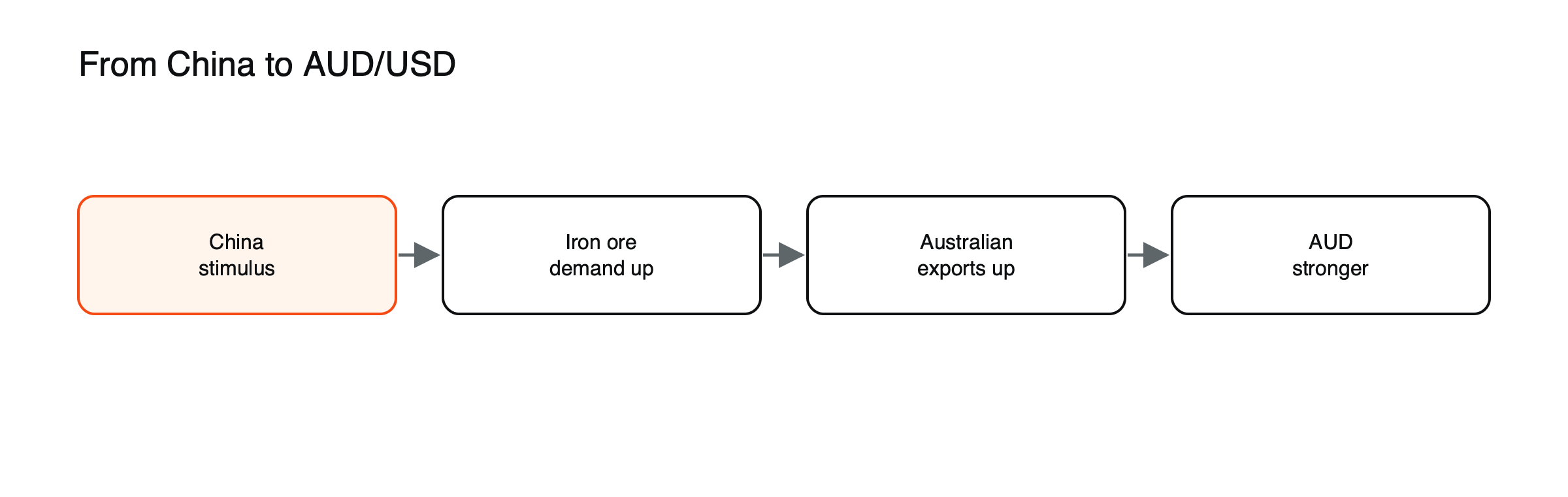
Figure: How Chinese demand reaches the Australian dollar.
What Australia sells to the world
Iron ore is Australia’s single largest export, used by Chinese steelmakers, but it is far from the only one. Coal, liquefied natural gas, gold and agricultural products also bring in large export earnings. When prices for these goods rise together, as they often do when global growth is strong, Australia earns more foreign currency, foreign buyers need more Australian dollars and the currency tends to strengthen. When they fall, the reverse happens.
From iron ore price to exchange rate
Higher iron ore prices work on the Australian dollar through several channels at once. Mining companies earn more and convert some of those earnings back into Australian dollars. The trade balance improves, and higher national income can lift growth and inflation, which may lead the Reserve Bank of Australia to keep rates higher. Investors who want exposure to the commodity cycle may also buy the currency directly as a liquid proxy. The link is strong over months but loose from day to day, since other drivers can dominate in any given session.
Risk sentiment
AUD/USD and AUD/JPY tend to rise in risk-on markets and fall in risk-off ones; AUD/JPY is among the most volatile pairs for this reason. See risk-on vs risk-off.
Interest rates
Reserve Bank of Australia decisions relative to the Fed also move the pair, and can pull against commodity signals.
The rate gap with the United States
Suppose the Reserve Bank of Australia holds its cash rate at 4.35% while the Federal Reserve is expected to cut from 4.5% toward 4%. (Illustrative rates.) The gap moves in the Australian dollar’s favor, which tends to support AUD/USD even if commodity prices are flat. If the Reserve Bank then signals cuts of its own, that support fades. Rate decisions and the bank’s statements about the outlook are therefore watched as closely as iron ore prices.
A recent example
When China announced a package of stimulus measures in late September 2024, iron ore prices jumped back above $100 a tonne and the Australian dollar rose with them, as traders bet on stronger Chinese demand for steel. As details of the stimulus turned out to be aimed more at stabilizing than at boosting growth, part of the enthusiasm faded. The pattern, a sharp move on headlines followed by a reassessment of the details, is typical of how the currency responds to Chinese policy news.
When the link weakens
Chinese stimulus aimed at stabilizing rather than boosting growth often disappoints, and the property slump has capped steel demand. Copper and iron ore can also diverge.
The Australian dollar data calendar
| Release | Why it matters |
|---|---|
| Reserve Bank of Australia decisions | Set the cash rate and the tone |
| Australian inflation (quarterly and monthly) | Shapes rate expectations |
| Australian labour market data | Employment and jobless rate |
| Chinese trade, industrial and property data | Signal demand for Australian exports |
| Iron ore and other commodity prices | Feed directly into export earnings |
| US jobs and inflation data | Move the dollar side of the pair |
What to watch
Iron ore prices, Chinese data and policy announcements, Reserve Bank of Australia meetings and global risk appetite. See what moves currency prices.
Practical notes for trading AUD/USD
AUD/USD is active during Asian hours, when Australian and Chinese data are released, as well as during the US session. It is a major pair, but its moves are generally larger in percentage terms than EUR/USD’s, and it reacts strongly to shifts in global risk appetite. One standard lot is worth about $10 per pip. Under EU retail rules, pairs that include the Australian dollar fall under the 20:1 leverage limit rather than 30:1. Because it often falls when stocks fall, an AUD/USD long can add to a portfolio’s risk rather than diversify it. See major, minor and exotic currency pairs.
AUD/JPY and AUD/NZD
The Australian dollar is traded against other currencies too. AUD/JPY pairs a commodity and risk-sensitive currency with a safe haven, so it swings strongly with global risk appetite and is often watched as a gauge of market mood. AUD/NZD pairs two commodity currencies from neighboring economies and usually moves in a narrower range, driven by differences between the two central banks and the two countries’ export mixes. Choosing the right pair lets traders focus on the driver they actually have a view on. See risk-on vs risk-off.
When rates and commodities disagree
Sometimes the Reserve Bank of Australia signals cuts while iron ore prices are rising, or the reverse. In those periods AUD/USD can trade sideways or move erratically, as each piece of news favors a different driver. Recognizing that the drivers are in conflict helps explain choppy price action and suggests smaller positions until one driver clearly dominates.
Households, housing and the Reserve Bank
Australian households carry relatively high levels of debt, and many mortgages have rates that adjust quickly when the central bank moves. That makes the Reserve Bank of Australia sensitive to how rate changes affect household spending, and it pays close attention to consumer and housing data. Signs that households are struggling can lead markets to expect earlier rate cuts, weighing on the Australian dollar even when commodity prices are firm. Retail sales and housing figures therefore matter for the currency more than their size might suggest. Household budgets are also a regular theme in its assessments.
Common misreadings
- Treating the Australian dollar as a pure iron ore trade and ignoring interest rates.
- Reacting to Chinese stimulus headlines before the details are known.
- Assuming AUD/USD diversifies a stock portfolio, when it often falls with stocks.
- Ignoring Asian-hours data releases while trading the pair in other sessions.
Frequently asked questions
Why is the Australian dollar called a risk currency?
Because it tends to rise when investors are optimistic about global growth and commodities, and to fall when they become fearful and move into safer assets such as the dollar and the yen.
Does the Australian dollar always follow iron ore?
Not always. Over months the two often move together, but interest rates, risk sentiment and US dollar moves can push the currency in a different direction for long periods.
This article is educational content and does not constitute financial, investment, legal or tax advice. Digital assets are volatile and you may lose the amount you invest.
Sources
- Exuberant iron ore, subdued copper show different sides of China stimulus (China about 70% of seaborne iron ore) — Reuters column via Mining.com
- Australian dollar FAQs (iron ore largest export, $118 billion in 2021; China largest trading partner; RBA) — FXStreet
- China stimulus a very good development for Australia (iron ore back above $100) — AAP, September 2024
- Top 10 most volatile forex pairs (AUD/JPY consistently volatile) — Forex.com