
Why Crypto Has Started Reacting to US Economic Data
Since 2022 bitcoin has moved sharply on US inflation and jobs data. Why macro releases matter for crypto, examples from 2022 and 2026, how the link changes.
Crypto and economic data became linked in 2022, when inflation drove the Fed’s rate decisions and those decisions drove all risk assets. Bitcoin fell 6% on the hot April 2022 inflation report and 10% after the August report, and its Nasdaq correlation topped 0.8 at times. The link has weakened and strengthened since.
Why data moves crypto
Inflation and jobs reports change expectations for interest rates. Higher expected rates raise the dollar and real yields and reduce appetite for risk, and bitcoin has traded as a risk asset in those moments. See how real yields connect gold, growth stocks and crypto.
The chain from data to crypto, illustrated
Suppose the monthly US inflation report shows core prices rising 0.5% against expectations of 0.3%. (Illustrative scenario.) Within minutes, traders raise expectations for Fed rates, the 2-year Treasury yield jumps, the dollar strengthens and Nasdaq futures fall. Bitcoin, trading around the clock, drops perhaps 4% in the first hour as leveraged long positions are liquidated. A softer-than-expected report would set off roughly the opposite chain. The size of the surprise, not the number itself, drives the move.
2022: the clearest example
- May 11, 2022: an above-expected April CPI release; bitcoin fell about 6%.
- June 10, 2022: the May CPI release pushed bitcoin down 3.4% and helped trigger the sell-off that led to failures at crypto lenders.
- September 2022: a hotter CPI print sent bitcoin down about 10% on the day, in step with US stocks.
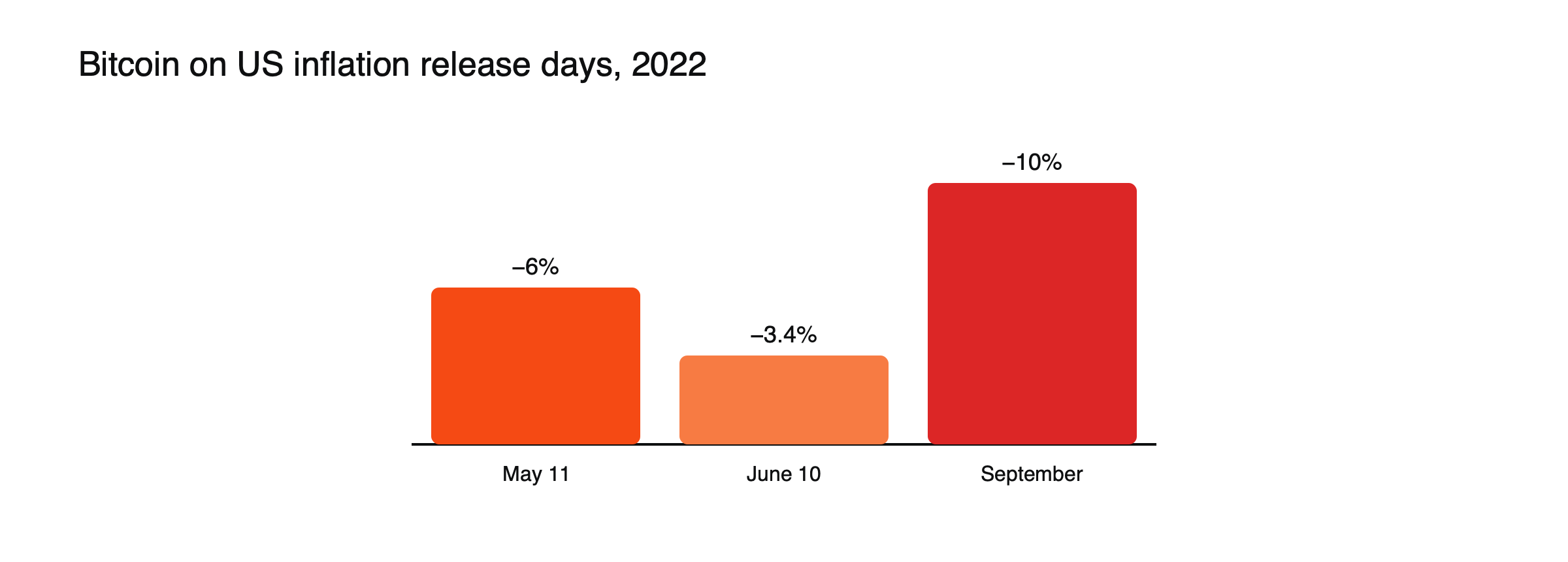
Figure: Bitcoin on CPI days in 2022. Source: K33 Research.
Why 2022 was special
In 2022, inflation was the single biggest driver of markets, and the Fed was raising rates at the fastest pace in decades. Every inflation report changed expectations for the size of the next hike, so data releases moved all risk assets in the same direction. Crypto, held largely by investors who also owned technology shares, became tightly linked to the Nasdaq; its correlation topped 0.8 at times. See why crypto and tech stocks move together.
How the link changes
As inflation cooled and spot bitcoin ETFs brought new kinds of buyers, the correlation with tech stocks fell at times. By 2026, as inflation became a focus again, one study found bitcoin’s one-hour reaction to CPI surprises was again strongly linked to the size of the surprise, while its reaction to payroll data had faded.
How to read it
Check the economic calendar before trading, expect wider moves around CPI and Fed announcements, and remember that the surprise against expectations matters more than the number itself. See what moves bitcoin’s price and why crypto and tech stocks often trade as the same risk asset.
Which releases matter
The consumer price index has usually produced the biggest crypto reactions, followed by Fed decisions and press conferences, the monthly jobs report and, at times, retail sales and producer prices. According to 2026 research, bitcoin’s reaction to CPI surprises was again strong while its reaction to payrolls had faded, showing that the most important release depends on what the Fed is most focused on.
Trading around releases
Many traders reduce position size or widen stops before major releases, because prices can gap and liquidity can thin in the first minutes. Others wait for the initial move to settle before trading. Leverage is especially dangerous around releases, because a sharp move can trigger liquidations before the price stabilizes. See how to read an economic calendar.
Crypto’s own drivers
Economic data are not the only force. ETF flows, regulatory news, exchange events, token unlocks and large liquidations can overwhelm macro signals for days or weeks. The October 10, 2025 crash, in which more than $19 billion of leveraged positions were liquidated, was driven by leverage within crypto markets rather than by an economic release.
Fed meetings and crypto
Federal Reserve decisions and press conferences can move crypto as much as inflation data, especially when the outcome or the guidance surprises markets. A decision in line with expectations may produce little reaction, while a shift in the projected path of rates, or a change of tone in the press conference, can trigger large moves. Crypto traders often watch the Fed’s projections and the chair’s comments as closely as the decision itself. See how central bank meetings move markets.
The jobs report
Strong employment data can push rate expectations up and crypto down, while weak data can do the reverse, unless weakness is severe enough to raise recession fears, which can hurt all risk assets. The reaction depends on whether markets are more worried about inflation or growth at the time.
The dollar link
Data that strengthen the dollar tend to weigh on crypto, because a stronger dollar tightens global financial conditions. Watching the dollar index alongside bitcoin around releases often explains a large part of the move. See how a strong dollar hits commodities, emerging markets and crypto.
Around the clock
Because crypto trades 24 hours a day, it reacts to US data instantly, even when releases fall outside traditional market hours for traders in other time zones. It also reacts to weekend news before other markets open, which can make it a first indicator of sentiment, and a source of gaps for traders holding positions in other assets.
Common misreadings
- Trading the headline number instead of the surprise.
- Assuming the 2022 relationship holds in every period.
When growth data take over
As inflation cooled after 2022, growth data, such as jobs and retail sales, mattered more for rate expectations. A weak jobs report could then lift crypto by raising hopes of rate cuts, or hurt it if it raised recession fears. The data that move crypto most are whichever ones are most likely to change the Fed’s next step, and that changes with the economic cycle.
A data-day routine
- Check the economic calendar for the day’s releases and their expected values.
- Note how much leverage is in the market, using funding rates and open interest.
- Decide in advance whether to reduce size, stay flat or trade the reaction.
- After the release, compare the actual figure with expectations before reacting.
- Watch Treasury yields and the dollar to confirm the direction of the move.
Inflation expectations
Crypto reacts not only to inflation itself but to what it implies for future policy. A high inflation reading that markets see as temporary may barely move prices, while a moderate reading that suggests inflation is becoming entrenched can trigger a large sell-off. Breakeven inflation and Fed commentary help show which interpretation is winning.
Liquidity and the Fed’s balance sheet
Beyond rates, changes in the Fed’s balance sheet affect liquidity in financial markets. When the Fed shrinks its holdings, liquidity tightens, often weighing on speculative assets; when it expands them, as in 2020, liquidity surges. Crypto has been among the most sensitive assets to these shifts.
When data stop mattering
In some periods, crypto barely reacts to economic releases, because crypto-specific news, such as ETF flows or regulatory decisions, dominates, or because the Fed’s path seems settled. Recognizing these quieter phases helps traders avoid expecting large moves around every release and sizing positions for volatility that does not arrive. Checking funding rates and open interest usually shows whether leverage is building up quietly and dangerously before major releases.
Frequently asked questions
Why does crypto react to US data and not other countries’?
Because the Fed’s decisions drive the dollar, global liquidity and US risk appetite, which matter most for crypto prices.
Does the reaction always last?
No. Many data-driven moves fade within hours or days if the surprise does not change the bigger picture.
This article is educational content and does not constitute financial, investment, legal or tax advice. Digital assets are volatile and you may lose the amount you invest.
Sources
- Market bracing for 8.8% CPI release (bitcoin −6% on May 11 and −3.4% on June 10, 2022; correlation peak above 0.8) — K33 Research, July 2022
- Big macro week: FOMC minutes, PPI and CPI (bitcoin −10% on the prior CPI release day) — K33 Research, October 2022
- Is Bitcoin showing greater sensitivity to US CPI releases again? (one-hour R² near 80% on a 12-release window; payroll reaction fading) — Block Scholes, 2026
- DeFi TVL drops 39% in 2026 (October 10, 2025 crash erased more than $19 billion of leveraged positions) — Cointelegraph, June 2026